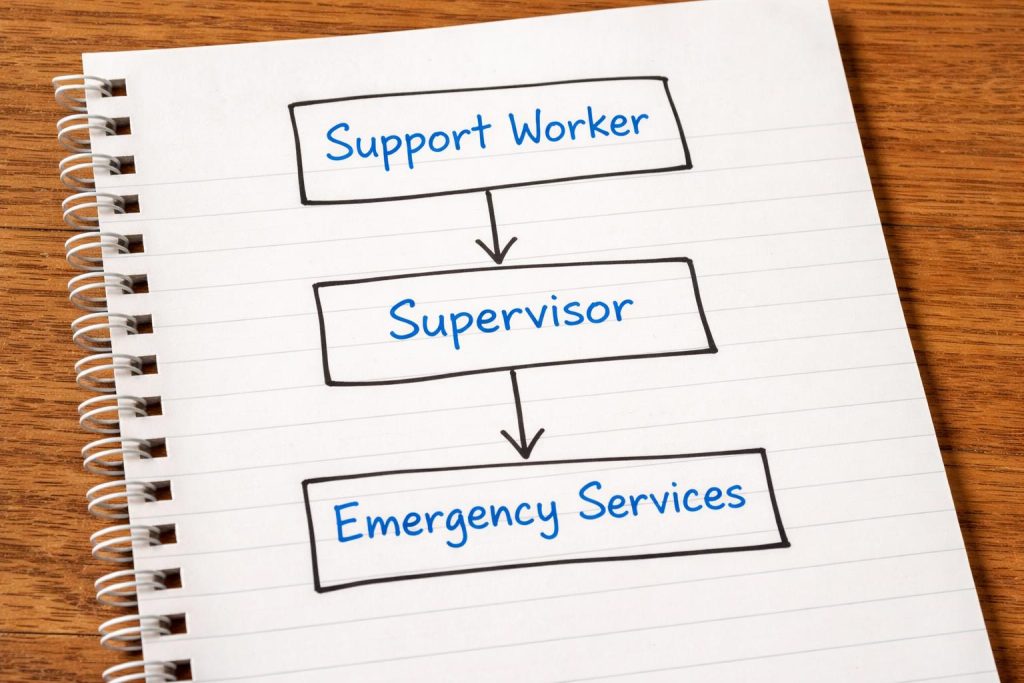
When NDIS providers think about after-hours support, attention naturally goes to the most serious situations.
A participant is injured.
An ambulance is required.
A support worker reports a medication concern.
A worker does not arrive for an overnight shift.
There is an allegation of abuse or neglect.
A participant cannot be located.
A serious behavioural incident occurs.
These situations deserve clear escalation pathways because the consequences of delay can be significant.
But there is another category of after-hours contact that is just as important to define:
the call that does not require immediate action.
At 10:30 pm, a participant may want to ask about a shift scheduled for next Tuesday.
At 11:15 pm, a family member may want to update a telephone number.
At 6:00 am, someone might report a maintenance problem that presents no immediate safety concern.
A general enquiry may arrive on Saturday afternoon.
A worker may have an administrative question that can reasonably be handled by the rostering or service-delivery team when the office opens.
These calls still matter.
They should not be ignored, forgotten or dismissed simply because they are not emergencies.
But they also do not necessarily justify waking an operations manager at 2:00 am.
This is why next-business-day follow-up needs to be an intentional category within an NDIS provider’s after-hours escalation framework.
A strong after-hours system does not only tell workers when to escalate.
It also tells them when immediate escalation is not required, what should happen instead and how the matter will reliably reach the appropriate person the following business day.
For providers using After Hours Response, this distinction can help create a more effective operational model. Urgent matters can be triaged and escalated according to agreed protocols, while routine and non-urgent matters can still be acknowledged, documented, categorised and included in the appropriate handover process.
The result is not less responsive after-hours support.
It is better prioritised after-hours support.
Why NDIS Providers Need a “Can Wait Until Morning” Category
Without clear escalation thresholds, frontline workers face a difficult decision.
Something has happened.
It does not appear to be an emergency.
But they are not sure whether they are allowed to leave it until morning.
So they call the manager.
This is understandable.
If workers are told to “escalate anything you’re unsure about”, many will naturally choose the safest option from their perspective: escalate everything.
Over time, this can create an after-hours system where:
-
routine questions reach senior managers;
-
non-urgent scheduling changes interrupt people overnight;
-
minor maintenance requests are treated like emergencies;
-
general enquiries enter the same pathway as incidents;
-
managers become accustomed to low-priority calls;
-
genuine urgent calls compete with routine contacts; and
-
workers remain unsure what actually constitutes an urgent escalation.
The problem is not that workers are doing something wrong.
The problem is usually that the provider has not given them sufficiently clear thresholds.
A good after-hours framework therefore needs at least three broad categories:
Act now.
Assess and potentially escalate now.
Document and follow up next business day.
That third category is essential.
It gives workers permission to make a proportionate response without simply ignoring the matter.
Deferring Action Is Not the Same as Ignoring a Call
This distinction should be explicit in any after-hours procedure.
When a provider decides that a matter can wait until the next business day, that should not mean:
“Do nothing.”
It should mean:
“No immediate operational intervention is required, but the matter must be captured and routed for appropriate follow-up.”
There is a major difference.
Imagine a participant calls at 9:45 pm to say they would like to move a support shift scheduled for the following week.
There may be no reason for an on-call manager to change the roster immediately.
But somebody should still:
-
acknowledge the request;
-
record who called;
-
confirm what change is being requested;
-
identify the relevant service or team;
-
note any required timeframe;
-
document the request; and
-
make sure it reaches the appropriate daytime staff.
That is a response.
It simply is not an urgent response.
After Hours Response can help providers formalise this distinction so non-urgent calls do not disappear while urgent pathways remain available for matters that genuinely need immediate attention.
Why Prioritisation Matters in NDIS After-Hours Support
An after-hours system has finite attention and capacity.
At 2:00 pm, an organisation may have service managers, rostering staff, administration, HR, quality personnel and executives available.
At 2:00 am, the provider may have one primary escalation pathway.
That makes prioritisation particularly important.
Consider two calls arriving within several minutes.
The first is from a worker reporting that a participant has fallen and appears seriously injured.
The second is from someone wanting to confirm the time of an appointment later in the week.
Both callers deserve a professional response.
But they do not require the same response.
The first may need immediate emergency and internal escalation.
The second can usually be documented for the relevant team to address during business hours.
If the organisation has not established these distinctions, its after-hours resources can become unnecessarily occupied by matters that do not require immediate intervention.
The goal of triage is therefore not to decide which callers matter.
Every caller matters.
The purpose is to determine what needs to happen next and how quickly it needs to happen.
Start With Risk, Not With the Type of Caller
Providers should be careful about assuming that certain types of calls are always non-urgent.
A family call is not automatically routine.
A maintenance call is not automatically minor.
A roster question is not automatically administrative.
A complaint is not automatically something that can wait.
The circumstances determine urgency.
For example:
“The kitchen cupboard hinge is loose.”
may be a next-business-day maintenance matter.
But:
“The front door cannot be locked and the property is unsecured.”
may require action tonight.
Similarly:
“Can Tuesday’s support start at 10 instead of 9?”
may be a routine scheduling request.
But:
“Nobody has arrived for tonight’s active overnight shift.”
is a completely different staffing situation.
An effective after-hours triage process should therefore ask:
Is anyone currently unsafe?
Could delaying action create a significant risk?
Is essential support being interrupted?
Is urgent clinical input required?
Has an incident occurred?
Is there an immediate safeguarding concern?
Does somebody need authority to act before the office reopens?
If the answer to these questions is no, next-business-day follow-up may be appropriate.
What Types of Calls May Be Suitable for Next-Business-Day Follow-Up?
There is no universal list that applies to every NDIS provider.
Participant circumstances, services, risk assessments and organisational procedures all matter.
However, providers can develop clear examples to help workers and after-hours responders understand the intended thresholds.
Common categories may include the following.
Routine Administrative Questions
Some contacts are simply administrative.
Examples might include:
-
asking for an office email address;
-
requesting a copy of routine information;
-
asking which team handles a particular administrative matter;
-
requesting an update to non-urgent account information;
-
asking about standard office opening hours;
-
confirming where paperwork should be sent; or
-
requesting a callback from administration.
These matters deserve accurate recording.
They rarely require an operations manager to be contacted overnight.
The after-hours responder can capture the information and direct it to the appropriate team for the next business day.
This is one area where After Hours Response can help protect the provider’s urgent escalation pathway without making participants, families or other callers feel that their enquiries have disappeared.
Non-Urgent Scheduling Requests
Scheduling generates a significant amount of communication for disability providers.
Not every roster-related call is urgent.
Compare:
“My worker has not arrived for tonight’s shift.”
with:
“Can I change my support time next Thursday?”
The first may affect immediate continuity of supports.
The second may be appropriately managed by the rostering team during business hours.
Other examples might include:
-
requests to change a future shift;
-
preferred start-time changes several days away;
-
requests for a particular worker for a future service;
-
questions about future appointments;
-
requests to add a future service; or
-
changes that do not affect immediate participant safety or continuity.
The after-hours responder should gather enough information so the daytime team does not need to start again from the beginning.
For example:
Participant: Jane Smith
Request: Move Thursday community-access shift from 9:00 am to 11:00 am
Reason: Medical appointment
Urgency: No immediate support affected
Follow-up: Rostering team next business day
That is much more useful than:
“Jane called about roster.”
General Enquiries
Potential participants, families, support coordinators and other people may contact an NDIS provider outside business hours.
They may ask:
-
whether the provider delivers a particular support;
-
whether the organisation has capacity;
-
which suburbs are serviced;
-
how referrals work;
-
how to speak with a service manager; or
-
where to send further information.
These enquiries may have significant commercial value.
They should not necessarily be escalated to an operational manager overnight.
Instead, the enquiry can be captured accurately and directed to the relevant business-development, intake or service team.
After Hours Response can support enquiry and referral capture after hours, helping providers avoid losing potential opportunities simply because somebody called when the office was closed.
The important information might include:
-
caller name;
-
contact details;
-
reason for enquiry;
-
service required;
-
preferred location;
-
relevant timeframe;
-
referral source; and
-
preferred callback arrangements.
The daytime team can then continue the conversation with context.
Requests to Update Contact Information
A participant, family member or other authorised person might call to advise that their phone number or email address has changed.
Where there is no immediate operational consequence, this may be suitable for next-business-day processing.
The after-hours responder should not necessarily alter official participant records unless that is part of an authorised and controlled process.
Instead, the information can be captured securely and directed to the appropriate team.
However, context matters.
If the caller says:
“This is the only number you can reach me on tonight because there is an emergency at the house,”
the contact update is no longer the main issue.
The underlying emergency determines the pathway.
Low-Priority Maintenance Matters
Disability providers, particularly those involved in Supported Independent Living or other accommodation-based services, may receive property-related calls after hours.
Again, severity matters.
Examples potentially suitable for next-day follow-up might include:
-
a cupboard door needing adjustment;
-
a non-essential appliance issue where safe alternatives are available;
-
minor cosmetic damage;
-
a light failure in a non-critical area where safe lighting remains available;
-
minor garden or external maintenance;
-
a slow maintenance issue presenting no immediate safety concern; or
-
another non-urgent repair.
These should still be recorded.
Useful information includes:
-
property;
-
exact issue;
-
when it was noticed;
-
whether anyone is affected;
-
whether a temporary safe arrangement is in place;
-
photographs or additional information where the provider’s process allows; and
-
who needs to receive the maintenance request.
The responder also needs to understand the escalation threshold.
A maintenance issue should move out of the next-day category if it creates an immediate risk.
Examples could include fire, flooding, electrical hazards, serious security failures, loss of essential utilities affecting participant safety or damage that makes accommodation unsafe.
After Hours Response can work with providers to establish these property escalation thresholds rather than leaving individual workers to decide from scratch.
Non-Urgent Service Feedback
Participants and families may provide feedback after hours.
For example:
“I’d prefer a different arrival time for this worker in future.”
“The communication about yesterday’s roster change could have been better.”
“I’d like the service manager to call me about how we organise weekend activities.”
Not every piece of feedback requires immediate management escalation.
But it should be respected and documented.
The NDIS Practice Standards require registered providers to maintain complaints-management arrangements that are appropriate to their services and ensure complaints and feedback are welcomed, acknowledged, respected and well managed.
The important point is to distinguish non-urgent feedback from information indicating an immediate safety, quality or safeguarding concern.
If a caller says:
“I’d like to discuss how staff communicate roster changes,”
next-business-day follow-up may be appropriate.
If they say:
“A worker has just threatened me and I do not feel safe,”
the matter is no longer routine feedback.
The content determines urgency, not the label “feedback”.
A Complaint Is Not Automatically a Next-Day Matter
This deserves particular attention.
Providers should not create a rule saying:
“Complaints wait until office hours.”
Some can.
Some cannot.
The NDIS Commission expects providers to have effective complaint-management practices and states that providers should promptly take action when someone raises a concern or complaint about the quality and safety of supports.
The after-hours responder therefore needs to understand whether the complaint contains an urgent underlying issue.
A complaint about:
-
invoice formatting;
-
communication preferences;
-
a non-urgent scheduling concern; or
-
dissatisfaction with an administrative process
may be acknowledged and routed for next-business-day follow-up.
A complaint alleging:
-
abuse;
-
neglect;
-
assault;
-
immediate unsafe support;
-
serious misconduct;
-
participant harm; or
-
another significant safety issue
may need to enter the provider’s incident, safeguarding or emergency escalation pathway immediately.
The purpose of triage is to identify that difference.
Routine Does Not Mean Unimportant
One risk of creating a next-business-day category is that staff begin to interpret it as:
“Low priority, therefore not important.”
That is not the intention.
Many non-urgent matters are extremely important to the participant’s overall experience.
A scheduling preference may affect their independence.
A complaint about communication may reveal a recurring service problem.
A general enquiry may become a new participant relationship.
A maintenance request may become more serious if repeatedly ignored.
A request to update information may affect future communication.
The distinction is about timing, not importance.
The right question is:
Does this require action before normal business operations resume?
If not, the provider should still ensure there is a reliable pathway for action afterwards.
The Three-Part Test for Next-Business-Day Follow-Up
Providers can develop their own criteria, but a useful conceptual test involves three questions.
1. Is There an Immediate Safety or Wellbeing Risk?
If yes, the matter may require immediate escalation.
If no, continue.
2. Will Delaying Action Until the Next Business Day Materially Affect Essential Support?
If a delay could leave a participant without necessary support, create a significant clinical concern or allow a serious risk to continue, immediate action may be needed.
If not, continue.
3. Is There a Clear Daytime Team That Can Appropriately Resolve the Matter?
If yes, document and route it.
This might be:
-
rostering;
-
service delivery;
-
administration;
-
intake;
-
finance;
-
maintenance;
-
quality;
-
HR; or
-
another appropriate team.
The aim is to create a destination rather than simply postponing the problem.
Build “Next Business Day” Into the Escalation Matrix
Many escalation matrices focus almost entirely on the serious end.
For example:
Emergency → 000
Clinical concern → RN/clinical pathway
Serious incident → manager
Staffing gap → on-call operations
But the matrix should also include:
Routine/non-urgent → document and route to day team
This completes the decision framework.
An illustrative structure might look like this:
| Situation | After-hours response | Destination |
|---|---|---|
| Life-threatening emergency | Immediate emergency response | Emergency services + internal escalation |
| Serious incident | Immediate triage/escalation | Designated manager/key personnel |
| Urgent clinical concern | Clinical/emergency pathway as applicable | RN/clinician/manager |
| Essential worker no-show | Immediate operational action | After-hours staffing pathway |
| Future roster change | Document request | Rostering next business day |
| Routine administrative query | Capture details | Administration |
| General service enquiry | Capture lead/referral information | Intake/business development |
| Minor maintenance | Document issue | Maintenance/facilities |
| Non-urgent service feedback | Acknowledge and record | Service/quality team |
| Routine contact-detail update | Record securely | Administration |
| Non-urgent callback request | Capture context | Relevant daytime team |
Every provider should adapt this to its own operations.
The important feature is that every category has a destination.
Give Frontline Workers Permission Not to Escalate Everything
This is partly a cultural issue.
Workers may understand the written policy but still fear being blamed if they fail to call a manager.
If the organisational culture sends the message:
“If in doubt, wake somebody up,”
workers will understandably escalate broadly.
Providers need to give staff both:
clear thresholds
and:
confidence that following those thresholds is the expected behaviour.
Scenario-based training can help.
Ask workers:
A participant wants to move a shift scheduled next week. What do you do?
The fridge has stopped working but food has been safely moved to another available refrigerator. What happens next?
A family member wants the service manager to call about a routine issue tomorrow. Does the on-call manager need to be contacted now?
Then compare these with:
The overnight worker has not arrived.
The participant has fallen and hit their head.
A family member alleges that a worker assaulted the participant earlier tonight.
Workers should be able to see the difference immediately.
What Should the After-Hours Responder Record?
A next-business-day matter should leave a useful record.
At minimum, the provider may want the responder to capture:
-
date and time;
-
caller;
-
contact details where appropriate;
-
participant or service involved;
-
reason for contact;
-
requested action;
-
urgency assessment;
-
any relevant context;
-
whether any immediate action was taken;
-
destination team;
-
requested or required follow-up timeframe; and
-
any commitments made to the caller.
The exact record will depend on the provider’s systems and procedures.
The principle is straightforward:
The daytime employee receiving the handover should understand the matter without needing to reconstruct the entire conversation.
Avoid Vague Handover Notes
Consider the difference between these two records.
Poor handover:
“Sarah called. Wants someone to ring her.”
And:
Useful handover:
“Sarah, participant’s authorised family contact, called at 8:40 pm regarding next Thursday’s community-access shift. She would like to discuss moving the start time from 9:00 am to 11:00 am because of a medical appointment. No immediate supports affected. Requested callback from rostering tomorrow morning. Contact details confirmed.”
The second note allows the daytime team to act immediately.
The first creates more work.
Structured after-hours documentation should reduce the workload of the day team, not merely transfer it.
Create a Morning Follow-Up Queue
One of the most practical ways to manage deferred contacts is to create a structured morning queue.
Instead of sending unrelated emails and messages to several managers overnight, matters can be categorised.
For example:
Urgent outstanding
Issues stabilised overnight but requiring immediate morning action.
Rostering
Future shift changes and non-urgent scheduling matters.
Participant/service follow-up
Requests for service managers or participant-facing teams.
Maintenance
Non-urgent property matters.
Administration
Contact updates, paperwork and routine queries.
Enquiries/referrals
Potential participants, families and referral partners.
Feedback/complaints
Non-urgent matters requiring the appropriate quality or service response.
The exact categories should match the organisation.
After Hours Response can help providers create a more structured handover process so the morning team receives actionable information rather than a miscellaneous collection of overnight messages.
Decide What “Next Business Day” Actually Means
This phrase can be surprisingly ambiguous.
Imagine somebody calls at 7:00 pm on Friday.
Does “next business day” mean Monday?
What if Monday is a public holiday?
What if the issue can reasonably wait overnight but not three days?
Providers should consider whether some non-emergency matters need an intermediate category.
For example:
No immediate overnight escalation, but weekend duty follow-up required.
This may be relevant for organisations operating seven days a week.
The after-hours procedure should therefore reflect the provider’s actual operating model rather than assuming every organisation follows a Monday-to-Friday office structure.
Use Time Sensitivity as Well as Risk
Not every issue that needs action soon is an emergency.
Consider a participant calling Saturday evening to cancel a Sunday morning shift.
There may be no safety concern.
But waiting until Monday to process the cancellation makes no operational sense.
The issue is not urgent because of danger.
It is urgent because of time sensitivity.
This is why an effective triage framework should consider at least:
Safety urgency
Clinical urgency
Operational urgency
Time sensitivity
Regulatory significance
A future shift change next month can wait.
A shift change affecting tomorrow morning may need action tonight.
The underlying request is similar, but the timeframe changes the pathway.
When a Routine Call Becomes an Urgent Call
After-hours responders should also be trained to recognise escalation triggers within apparently routine conversations.
A caller may begin with:
“I have a question about tomorrow’s support.”
During the conversation, they reveal that the participant is currently alone because the worker left unexpectedly.
The call is no longer administrative.
Similarly:
“I want to complain about a worker.”
may initially sound like a matter for the complaints team.
Then the caller says:
“They threatened the participant tonight and are scheduled to return in an hour.”
That changes the urgency immediately.
Or:
“There is a maintenance problem.”
becomes:
“Water is coming through the ceiling near electrical equipment.”
A good after-hours responder listens for the underlying risk rather than simply categorising the call based on the caller’s first sentence.
This is another reason After Hours Response focuses on structured triage rather than basic message taking.
What About NDIS Incidents?
Providers need to be particularly careful about treating potential incidents as routine next-day matters.
Current NDIS Commission guidance states that incidents connected with NDIS supports and services need to be identified, assessed, recorded, managed and resolved. Registered providers are also required to maintain an incident-management system appropriate to their organisation and supports.
Some incidents also meet the definition of an NDIS reportable incident and carry specific notification obligations.
Frontline workers should therefore understand that a matter potentially involving participant harm, serious risk, abuse, neglect or another incident category should enter the provider’s incident-management pathway rather than simply being labelled “follow up tomorrow”.
This does not mean every minor concern requires waking the CEO.
It means the provider needs an incident escalation structure that determines who should know and when.
After Hours Response can operate within these agreed thresholds, helping providers distinguish between routine next-day contacts and matters requiring immediate incident escalation.
What About Complaints and Feedback?
The same principle applies to complaints.
The NDIS Commission expects providers to have effective complaints-management arrangements. Complaints should be welcomed, acknowledged, respected and appropriately managed.
An after-hours service should therefore not dismiss a complaint because it arrived outside office hours.
Instead, the responder can:
-
listen;
-
acknowledge the concern;
-
gather relevant information;
-
identify whether there is an immediate safety issue;
-
escalate if necessary;
-
document the complaint; and
-
route non-urgent matters to the appropriate daytime process.
This provides a better participant experience than either extreme:
Escalating every piece of feedback to an executive immediately
or:
Telling callers to ring back during office hours.
Protect the Urgent Channel From Routine Traffic
One of the strategic benefits of a next-business-day category is that it protects the provider’s urgent response capacity.
Imagine a manager receives ten overnight calls.
Nine are routine.
One is serious.
Repeated low-priority interruptions can make the entire on-call system less sustainable.
They can also create what might be described operationally as “noise”: important calls and routine calls arrive through the same channel with no prioritisation.
A managed NDIS after hours support model should help separate that traffic.
After Hours Response can act as the first operational point of contact, working through agreed provider protocols to determine which calls require:
-
emergency response;
-
clinical escalation;
-
immediate management escalation;
-
operational action;
-
documentation for next-day follow-up; or
-
another predetermined pathway.
Managers still receive the calls that genuinely require their authority.
They do not necessarily need to receive every call.
Next-Business-Day Follow-Up Supports Better Management Boundaries
The sustainability of internal on-call arrangements also matters.
A manager who is repeatedly woken for minor administrative questions may still need to lead a full day of operations the next morning.
Over time, an after-hours system that escalates everything can create:
-
fatigue;
-
frustration;
-
inconsistent responses;
-
reluctance to participate in on-call rosters;
-
slower responses;
-
unnecessary management interruption; and
-
dependence on a small number of experienced people.
Clear next-day thresholds can help preserve management attention for situations that genuinely require it.
This does not mean shielding managers from important information.
It means delivering information at the appropriate time and through the appropriate pathway.
The Morning Handover Closes the Loop
A deferred call is only successfully managed when the handover is complete.
Imagine a participant calls at 10:00 pm requesting a callback from their service manager.
The after-hours responder documents everything correctly.
But the service manager never receives the message.
From the participant’s perspective, the system failed.
That is why morning handover is not an administrative extra.
It is part of the response.
A reliable process should establish:
-
where deferred matters are stored;
-
who receives them;
-
when they receive them;
-
how priorities are indicated;
-
how ownership is assigned;
-
whether receipt is confirmed;
-
how unresolved matters are tracked; and
-
how repeated failures are reviewed.
After Hours Response can help create this bridge between overnight contact and daytime action.
Separate Overnight Status From Morning Priority
A matter can be non-urgent overnight but high priority in the morning.
For example:
A support coordinator calls at 8:00 pm about a potential new referral.
There is no need to wake a manager.
But the intake team may want to return the call promptly the following morning.
Likewise, a participant may make a non-urgent complaint.
There is no immediate safety issue.
But the service manager or quality team should not leave it unanswered for several days.
The handover system can therefore use two separate assessments:
After-hours urgency
and:
Daytime follow-up priority
This prevents the phrase “can wait until morning” from becoming “can wait indefinitely”.
Set Service Expectations for Follow-Up
Providers may also benefit from setting internal expectations for how deferred matters are handled.
For example:
-
urgent morning follow-up before a defined time;
-
routine rostering requests reviewed at start of business;
-
enquiries assigned to intake;
-
maintenance requests entered into the relevant system;
-
complaints transferred to the complaints process;
-
administrative changes verified and processed appropriately.
The exact timeframes should reflect the provider’s procedures and obligations.
What matters is ownership.
Every deferred call should eventually reach a person or team responsible for doing something with it.
Review What Gets Deferred
After-hours call data can also reveal useful operational patterns.
Providers can review:
-
how many calls are deferred each month;
-
the most common types;
-
which teams receive the most morning follow-ups;
-
whether callers repeatedly contact after hours about the same issue;
-
whether routine matters are being resolved promptly the next day;
-
whether any calls were incorrectly classified as non-urgent;
-
whether too many matters are being unnecessarily escalated;
-
whether important issues are being under-escalated; and
-
whether the categories need adjustment.
This creates a feedback loop.
For example, if dozens of participants call after hours because they cannot find basic roster information, the underlying issue may be daytime communication rather than the after-hours service itself.
If workers repeatedly call with the same administrative question, training or procedures may need improvement.
If non-urgent maintenance requests repeatedly become urgent because they are not followed up during business hours, the daytime maintenance process may need review.
After-hours data can therefore identify broader operational weaknesses.
Train Workers Using Examples, Not Just Definitions
Telling workers:
“Escalate urgent matters and defer non-urgent matters”
is not enough.
Give them scenarios.
Example 1
A participant wants to move a community-access shift scheduled in two weeks.
Likely pathway: document for rostering.
Example 2
A participant’s active overnight worker has not arrived.
Likely pathway: immediate operational response.
Example 3
A family member wants a manager to call tomorrow about communication preferences.
Likely pathway: document for service-management follow-up.
Example 4
A family member alleges a worker has assaulted the participant.
Likely pathway: immediate safeguarding/incident escalation according to procedure.
Example 5
A cupboard handle is broken but presents no safety issue.
Likely pathway: maintenance follow-up.
Example 6
The front door will not lock.
Likely pathway: assess security risk and potentially take immediate action.
Example 7
A support coordinator asks whether the provider has capacity for a future referral.
Likely pathway: capture enquiry for intake.
Example 8
A participant says they feel seriously unwell.
Likely pathway: health/emergency triage according to relevant procedures.
The examples teach workers to assess consequences rather than memorise categories.
Avoid These Common Next-Day Follow-Up Mistakes
Treating “non-urgent” as “not important”
Deferred matters still need action.
Leaving vague messages
The daytime team needs enough information to respond effectively.
Automatically deferring all complaints
The underlying content may require immediate escalation.
Automatically deferring all maintenance
Some property issues create immediate participant-safety risks.
Looking only at the category, not the context
A roster request can be routine or urgent depending on when the affected shift occurs.
Failing to confirm the appropriate destination
A message without an owner can disappear.
Using personal text messages as the handover system
Important information can become fragmented or inaccessible.
Not reviewing repeat contacts
Repeated routine calls may reveal an underlying service problem.
Having no escalation option when circumstances change
A call initially classified as routine may become urgent as more information emerges.
A Practical After-Hours Decision Framework
When a call arrives, an after-hours responder can conceptually work through the following sequence.
1. Is there an immediate threat to life, health or safety?
If yes, activate the appropriate emergency pathway.
2. Is there a significant participant-safety, safeguarding or incident concern?
If yes, follow the provider’s incident/escalation procedure.
3. Is urgent clinical input required?
If yes, activate the appropriate clinical pathway.
4. Is essential support at risk of interruption?
If yes, begin the operational continuity response.
5. Does the issue require action before the normal team becomes available?
If yes, follow the appropriate after-hours operational pathway.
6. Can the matter safely and reasonably be handled by the daytime team?
If yes, document and route it for next-business-day follow-up.
That final step is not a failure to respond.
It is a deliberate triage outcome.
How After Hours Response Can Manage Non-Urgent Calls Without Losing Them
The value of an after-hours service should not be measured only by how it responds to emergencies.
A significant part of effective after-hours operations is managing the ordinary calls properly too.
After Hours Response can work with NDIS providers to establish clear protocols defining:
-
what needs immediate escalation;
-
what requires operational action;
-
what requires clinical escalation;
-
which managers should be contacted for particular situations;
-
what can wait until business hours;
-
which daytime team should receive each type of deferred contact;
-
what information should be documented; and
-
how the morning handover should be structured.
This means a routine caller can still receive a professional response without unnecessarily activating the provider’s emergency or management escalation pathways.
For example, rather than simply saying:
“The office is closed. Please call tomorrow,”
the process can capture the reason for contact, gather the relevant information and make sure the appropriate team receives it.
At the same time, if the conversation reveals an urgent issue, the call can move into the provider’s escalation process.
This is a more useful distinction than treating every after-hours contact as either an emergency or somebody else’s problem.
Better Triage Means Better After-Hours Support
A mature NDIS after hours support system should be capable of doing two things well.
It should recognise when immediate action is required.
And it should recognise when it is not.
Both require judgement, clear provider protocols and reliable documentation.
Over-escalation can exhaust managers, create unnecessary interruptions and make the on-call system inefficient.
Under-escalation can expose participants and providers to serious risk.
The answer is not to automatically choose one side.
It is to build a system with clear thresholds.
Emergency matters go to emergency pathways.
Clinical matters go to appropriate clinical pathways.
Serious incidents are escalated according to the provider’s incident-management procedures.
Immediate staffing problems receive operational attention.
Routine matters are documented and transferred to the appropriate daytime team.
And if circumstances change, the escalation level changes with them.
The Goal Is Not Fewer Calls — It Is the Right Response to Every Call
NDIS providers should not measure a successful after-hours system simply by how few managers are contacted.
Sometimes a manager absolutely needs to be called.
Sometimes 000 needs to be contacted.
Sometimes clinical escalation is appropriate.
Sometimes an incident requires urgent senior attention.
But sometimes a participant simply wants someone from rostering to call them tomorrow.
Treating those situations identically does not make an organisation safer.
It makes the escalation framework less meaningful.
A well-designed after-hours process gives frontline workers and responders the confidence to distinguish between them.
That creates a more sustainable system for everyone involved.
Participants can still make contact.
Workers have somewhere to call.
Non-urgent matters are not lost.
Managers are protected from unnecessary interruption.
Urgent pathways remain available.
And the day team begins with a clear record of what requires attention.
Build Next-Business-Day Follow-Up Into Your NDIS After-Hours Procedure
When reviewing your current after-hours arrangements, ask:
Do workers know what can safely wait?
Do they know what absolutely cannot wait?
Does every deferred matter have a clear destination?
Can the after-hours responder recognise when an apparently routine call contains an urgent safety issue?
Are calls documented well enough for the day team to act?
Does somebody own the morning follow-up?
Can you distinguish between overnight urgency and morning priority?
Are routine calls being unnecessarily escalated to managers?
Are potentially serious concerns being incorrectly deferred?
Do you review after-hours data to improve these thresholds?
If the answer to several of these questions is unclear, the provider may need to strengthen the next-business-day component of its escalation framework.
Create a More Structured After-Hours System With After Hours Response
Not every after-hours call requires an emergency response.
Not every call needs an RN.
Not every call needs a senior manager.
But every call should have an appropriate pathway.
After Hours Response helps NDIS providers create a structured after-hours model in which urgent matters can be appropriately actioned and escalated, while non-urgent matters are accurately captured, documented and directed to the right daytime team.
That can include routine scheduling requests, general enquiries, non-urgent participant and family contacts, maintenance matters, service feedback and other issues that can reasonably wait until normal operations resume.
At the same time, if a call reveals an incident, safeguarding concern, urgent clinical issue, staffing problem or immediate participant risk, the matter can move into the provider’s agreed escalation pathway.
This helps create an after-hours service based on appropriate action rather than automatic escalation.
For management teams, it can mean fewer unnecessary overnight interruptions without sacrificing visibility.
For frontline workers, it provides clearer guidance about what needs escalation and what does not.
For participants and families, it means their call can still be acknowledged and captured even when the matter does not require an immediate manager response.
And for the daytime team, structured documentation and morning handover mean important requests are less likely to disappear between shifts.
The principle is simple:
A good escalation matrix should tell workers when to escalate — and when not to.
The second half is just as important as the first.
Contact After Hours Response to discuss your current after-hours arrangements, review how urgent and non-urgent calls are being managed, and explore how a managed after-hours operations desk can help your organisation create clearer escalation, documentation and next-business-day follow-up pathways.