Supported Independent Living does not operate on office hours.
Participants live in their homes overnight, on weekends and throughout public holidays. Support workers may be delivering active overnight support, completing sleepover shifts or working in environments where only one worker is immediately available. Participants may need assistance with personal care, medication, mobility, behaviours of concern, health needs and everyday household activities at any hour.
That means incidents do not conveniently wait until 9:00 am.
A participant may fall at 11:30 pm. An ambulance may be called at 2:00 am. A worker might report a medication concern during an active night shift. A participant may leave the property unexpectedly. An allegation could be made between residents or against a worker. A support worker may suddenly become unwell and need to leave. Another worker might fail to arrive for the overnight shift.
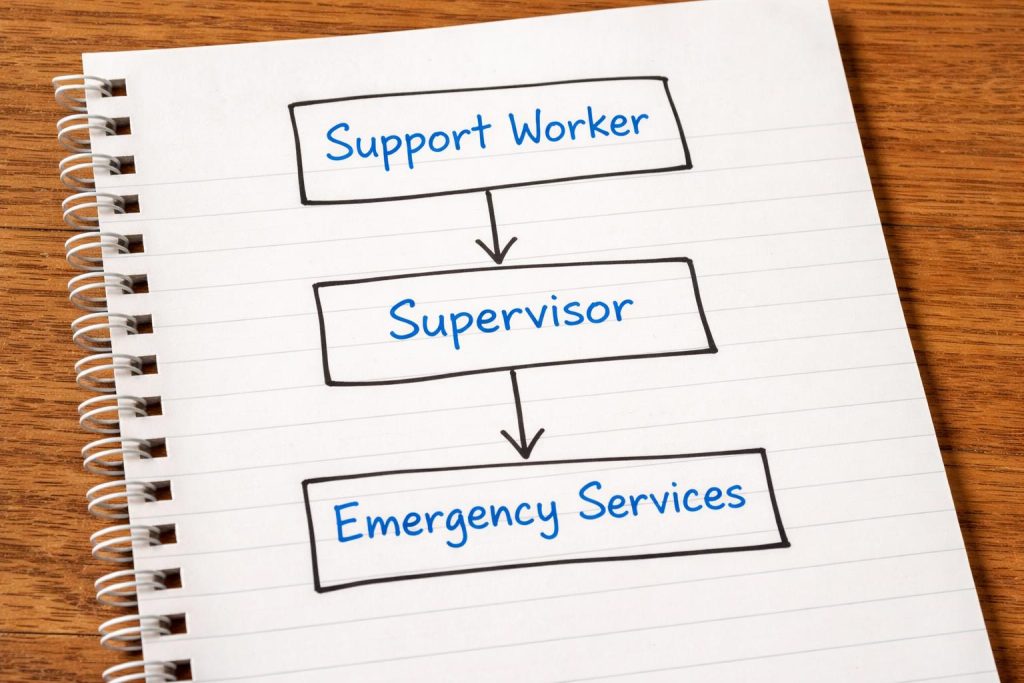
When something happens at night, the frontline worker needs more than an instruction to “call the manager”.
The provider needs an after-hours incident-management system capable of supporting the worker, protecting participants, coordinating operational actions, escalating appropriately, documenting what happened and making sure important information reaches the right people.
For SIL providers, a practical overnight incident-management chain can be thought of as:
Immediate safety → triage → escalation → stakeholder communication → documentation → assessment of reporting obligations → morning handover.
Each part matters.
If one link fails, a situation that was handled reasonably well at 1:00 am can become a serious operational problem by 9:00 am.
This is where After Hours Response can support SIL providers. Instead of relying entirely on managers personally answering overnight calls, providers can establish structured protocols for incidents, staffing disruptions, clinical escalation, emergency situations, documentation and morning handover.
The objective is not to replace the provider’s NDIS incident management responsibilities. It is to help those responsibilities continue functioning when the normal office is closed.
Why SIL Incident Management Is Different After Hours
Incident management is important across disability services, but SIL creates particular operational challenges.
A participant’s home remains a support environment overnight. There may be several participants sharing a residence. Workers may be responsible for responding to the needs of one person while still maintaining appropriate support for others.
There may also be fewer organisational resources immediately available.
During the day, a worker might be able to contact a house supervisor, service manager, rostering coordinator, clinical lead, quality team or operations manager.
At 2:00 am, that entire organisational structure can be reduced to one on-call phone number.
The worker may simultaneously be:
-
supporting an injured participant;
-
contacting an ambulance;
-
reassuring another resident;
-
following an individual support or emergency plan;
-
trying to contact management;
-
documenting observations;
-
dealing with family or other stakeholders; and
-
wondering whether another worker needs to attend.
This creates an important principle for SIL incident management:
The frontline worker should not have to manage the incident and coordinate the organisation’s entire response alone.
There should be an established pathway behind them.
A strong SIL after hours support model gives workers somewhere reliable to escalate issues while allowing the provider to activate the appropriate operational, clinical and management response.
What Does NDIS Incident Management Require?
All NDIS providers have responsibilities for effectively managing incidents, while registered NDIS providers also have specific incident-management system and reportable-incident obligations.
The NDIS Quality and Safeguards Commission states that a registered provider’s incident-management system should be appropriate to the size of the provider and the classes of supports or services being delivered. It should also be documented in an accessible form and accessible to workers and people with disability receiving supports.
For SIL providers, this means incident management should not exist only as a policy document in the organisation’s quality-management system.
Workers need to know what it means in practice.
They need to know:
-
what constitutes an incident;
-
what needs immediate action;
-
when emergency services should be contacted;
-
who to contact after hours;
-
when clinical escalation is available;
-
when senior management must be notified;
-
how to protect other participants;
-
what information to document;
-
what happens if the first escalation contact does not answer; and
-
what needs to happen before the next business day.
The system also needs to recognise an important distinction:
An incident requiring internal management is not automatically an NDIS reportable incident.
However, some incidents or alleged incidents do meet the reportable-incident criteria, and registered providers have specific notification obligations.
That assessment needs to be built into the provider’s process without making frontline workers responsible for complex regulatory decisions while they are managing an emergency.
The Overnight SIL Incident Management Chain
A practical after-hours model can be organised around seven stages:
1. Immediate safety
Protect the participant and other people from immediate harm.
2. Triage
Establish what has happened, what the current risks are and how urgently further action is required.
3. Escalation
Activate the appropriate emergency, clinical, operational or management pathway.
4. Stakeholder communication
Make sure relevant people receive appropriate information at the right time.
5. Documentation
Create an accurate record of what happened, what was observed and what actions were taken.
6. Assessment of reporting obligations
Appropriate designated personnel determine whether the incident triggers external notification or other regulatory requirements.
7. Morning handover
Give the day team a clear account of what happened and what remains outstanding.
The process is rarely perfectly linear.
Emergency escalation might happen during the first stage. Documentation may continue throughout the event. Stakeholders may need several updates.
But this framework gives SIL providers a useful way to test whether their after-hours systems cover the full lifecycle of an incident.
Stage 1: Immediate Safety Comes First
When an incident occurs, the first priority is not completing a form.
It is safety.
The worker needs to respond according to their training, the participant’s support arrangements, relevant organisational procedures and the circumstances in front of them.
Where urgent emergency assistance is required, internal reporting should not delay it.
For example, if a participant experiences a potentially life-threatening injury, the priority may include calling 000 and providing appropriate assistance within the worker’s training and role.
If there is immediate violence or danger, protecting participants and workers and obtaining emergency assistance may be necessary.
If an allegation of abuse has been made and there is an ongoing threat, the provider needs to consider immediate safeguarding actions rather than waiting until the office opens.
This principle should be explicit in every SIL provider’s after-hours procedure:
Emergency response comes before administrative escalation.
The worker should never believe they need a manager’s permission to call emergency services where emergency assistance is clearly required.
Once immediate safety is being addressed, the provider’s internal response can begin.
Stage 2: Triage the Incident
After immediate risks have been addressed, somebody needs to establish what is actually happening.
This is where structured NDIS after hours support can be valuable.
Triage is not necessarily about diagnosing the participant or determining the final regulatory classification of an incident.
It is about gathering enough information to activate the correct pathway.
Useful initial questions might include:
-
What happened?
-
Who is involved?
-
Where is the participant now?
-
Is anyone currently unsafe?
-
Has anybody been injured?
-
Have emergency services been called?
-
Is there an urgent health concern?
-
Are other participants affected?
-
Is the worker able to continue providing support?
-
Is another worker required?
-
Is there an allegation involving another resident or worker?
-
Is the participant’s support plan relevant?
-
Does a clinician need to be contacted under the provider’s protocol?
-
Is the property safe?
-
Does senior management need immediate notification?
This creates a more useful response than simply receiving a message.
After Hours Response can help providers establish structured triage protocols for common SIL situations, allowing the after-hours team to identify which pathway needs to be activated and which matters can be managed within predetermined operational procedures.
Stage 3: Escalate to the Right Pathway
Not every SIL incident should go to the same person.
An effective escalation model may include several pathways.
Emergency pathway
For immediate threats to life, health or safety where emergency services are required.
Clinical pathway
For applicable health or medication concerns requiring clinical escalation according to the provider’s agreed arrangements.
Senior management pathway
For serious incidents, allegations, major safeguarding concerns or decisions requiring senior authority.
Operational pathway
For roster gaps, worker absence, property issues, transport disruption and other operational problems.
Next-business-day pathway
For matters that have been made safe and do not require further immediate intervention.
After Hours Response can work within these defined provider protocols, helping direct each incident to the appropriate pathway rather than automatically forwarding every call to the same manager.
This can reduce unnecessary management interruption while making sure serious situations are escalated promptly.
Scenario 1: A Participant Falls During the Night
Falls are a useful example because the same broad incident type can range from relatively minor to extremely serious.
Imagine a participant falls while walking to the bathroom at 1:15 am.
The worker attends immediately.
The response should be based on the participant’s circumstances, the worker’s training, the provider’s procedures and any applicable health or support plans.
Questions may include:
-
Did the participant hit their head?
-
Are they conscious and responsive?
-
Is there visible injury?
-
Are they reporting pain?
-
Is there an immediate medical emergency?
-
Does the participant have known risks relevant to the fall?
-
Is emergency medical assistance required?
-
Is clinical escalation appropriate under the provider’s protocol?
If an ambulance attends, additional operational questions may emerge.
Will the participant be transported to hospital?
Should a worker accompany them?
What happens to other residents if there is only one worker at the house?
Does replacement staffing need to be organised?
Who needs to be informed?
The fall itself may happen in seconds.
Managing its consequences can take hours.
This is why SIL after hours support needs to go beyond taking an incident message.
After Hours Response can provide a central escalation point while the frontline worker concentrates on immediate participant support.
Scenario 2: An Ambulance Is Called
Ambulance attendance can create a chain of decisions.
The provider needs to know:
-
why the ambulance was called;
-
what happened before it arrived;
-
whether the participant is being transported;
-
what information needs to accompany them;
-
whether their support needs continue at hospital;
-
whether another participant is affected by staffing changes;
-
who needs notification; and
-
what information needs documenting.
The person making these calls should not interfere with emergency clinicians or attempt to direct clinical treatment.
The provider’s role is to make sure its own support responsibilities continue appropriately.
For a SIL house with one overnight worker and multiple residents, ambulance transport can create an immediate staffing problem.
If the worker accompanies one participant, who supports the others?
If the worker stays, does the participant require another support arrangement at hospital?
These questions should be anticipated within the provider’s protocols.
After Hours Response can help coordinate the operational side of the response according to those protocols, including appropriate escalation and staffing actions where agreed.
Scenario 3: A Behavioural Incident Occurs Overnight
Behavioural incidents can be particularly challenging during overnight SIL shifts.
There may be fewer workers present.
Other residents may be sleeping.
A lone worker may need to manage immediate risks while following a participant’s behaviour support plan and organisational procedures.
The response should be participant-specific and consistent with the person’s current plans, rights and applicable behaviour-support requirements.
Where an implementing provider uses regulated restrictive practices, separate NDIS behaviour-support and restrictive-practice obligations can apply. The NDIS Commission states that a restrictive practice is unauthorised where, for example, it is not in a behaviour support plan, lacks required state or territory authorisation, or is not being used in accordance with the behaviour support plan. Unauthorised restrictive practices are reportable incidents.
The after-hours pathway should therefore help workers answer practical questions such as:
-
Is anyone currently at risk?
-
Does the participant’s behaviour support plan provide instructions relevant to the situation?
-
Is emergency assistance required?
-
Are other residents safe?
-
Does a senior manager need immediate notification?
-
Has a restrictive practice potentially been used?
-
What exactly needs to be recorded?
-
Is additional staffing required?
Workers should not have to improvise these pathways in the middle of an escalating incident.
Scenario 4: An Allegation Is Made Between Residents
Imagine one SIL resident tells the overnight worker that another resident assaulted them earlier that evening.
The worker may not have witnessed the alleged event.
That does not mean the allegation should be dismissed until morning.
Immediate considerations include:
-
Is the person currently safe?
-
Are the two residents still together?
-
Is medical attention required?
-
Is there an ongoing risk?
-
Is police involvement appropriate?
-
Can the residents continue to be supported safely in the same environment?
-
Does management need immediate escalation?
-
What exactly did the participant say?
-
What actions have already been taken?
The worker’s job should not be to conduct an improvised investigation.
They need to respond appropriately to immediate safety, preserve accurate information and escalate according to the provider’s procedure.
This distinction is important for NDIS incident management.
An allegation can itself be relevant to reportable-incident obligations. The NDIS Commission makes clear that reportable incidents include qualifying incidents that have happened or are alleged to have happened in connection with the provision of NDIS supports or services.
That makes prompt internal escalation particularly important.
Scenario 5: An Allegation Is Made Against a Worker
An allegation involving a worker requires similarly careful handling.
Suppose a participant tells another worker at 10:30 pm that a staff member hurt them during an earlier shift.
The immediate response should centre on the participant’s safety and wellbeing.
Depending on the circumstances, the provider may need to consider:
-
whether the alleged worker is still on site;
-
whether they are due to work elsewhere;
-
whether immediate separation or other safeguarding action is required;
-
whether medical assistance is needed;
-
whether police or another authority should be contacted;
-
who in senior management needs immediate notification; and
-
how the participant’s account is documented accurately.
The overnight worker should not be expected to determine whether the allegation is true before reporting it.
Nor should they conduct a detailed investigative interview unless that is specifically within their role and procedure.
The after-hours system needs to make sure the information reaches people with the authority to take appropriate safeguarding action.
This is an area where After Hours Response can provide the escalation bridge between the SIL house and designated senior personnel, helping ensure serious allegations are not left sitting in an inbox until the next morning.
Scenario 6: A Medication Concern Occurs at 2:00 am
Medication-related incidents and concerns are another common reason SIL workers may require after-hours support.
Examples might include:
-
uncertainty about whether medication was administered;
-
medication apparently given at the wrong time;
-
incorrect medication;
-
missed medication;
-
documentation discrepancies;
-
participant refusal;
-
unexpected symptoms following administration; or
-
another concern requiring clinical input.
The exact response depends on the participant, medication, circumstances and relevant health plans.
A frontline disability support worker should not be placed in the position of making clinical decisions outside their role, training or competence.
The provider’s process should clearly establish:
-
what immediate information needs to be gathered;
-
when emergency services should be contacted;
-
what clinical escalation pathway applies;
-
which manager or other designated person requires notification;
-
what documentation is required; and
-
what follow-up must occur.
Where included in the provider’s service arrangements, After Hours Response can provide access to Registered Nurse clinical escalation, creating a defined pathway for applicable clinical concerns rather than leaving workers to search for advice in the middle of the night.
RN escalation does not replace emergency services, treating clinicians or the provider’s clinical governance arrangements. It forms part of a structured escalation framework.
Scenario 7: A Worker Has to Leave Unexpectedly
Now consider an operational incident.
At midnight, the active-night worker becomes suddenly unwell and says they cannot safely complete the shift.
The participants may be fine at that moment.
But the staffing situation could quickly create risk.
Questions include:
-
Can the worker remain safely until relief arrives?
-
What supports do the participants require overnight?
-
Is another worker already on site?
-
What competencies must a replacement worker have?
-
Which available workers can attend?
-
How quickly can they arrive?
-
Does management approval need to be obtained?
-
What happens if no replacement can be found?
The provider’s SIL incident management and workforce continuity systems intersect here.
A basic answering service could record:
“Worker sick and needs replacement.”
That does not solve the problem.
After Hours Response can work within agreed provider protocols to begin the operational response, which may include contacting appropriate replacement workers or activating the provider’s defined escalation pathway.
The aim is to make the call actionable.
Scenario 8: The Overnight Worker Does Not Arrive
A no-show can be even more challenging.
The outgoing worker may already have completed a long shift and be expecting to leave.
The incoming worker cannot be contacted.
The participants still need support.
An effective after-hours procedure should establish:
-
how long the outgoing worker waits before escalating;
-
who verifies the roster;
-
who contacts the scheduled worker;
-
who can contact replacements;
-
how participant risk is assessed;
-
what happens if no replacement is immediately available;
-
when senior management is involved; and
-
how all attempts are documented.
For some participants, a delayed worker may be inconvenient.
For others, loss of overnight support could create significant health or safety concerns.
The response therefore needs to consider the consequence of the roster gap, not merely the fact that a worker is absent.
After Hours Response can help SIL providers manage this process consistently instead of relying on whichever manager happens to answer their phone.
Scenario 9: Significant Property Damage Occurs
A SIL property is both somebody’s home and an environment in which supports are being delivered.
Property incidents can therefore quickly become participant-support incidents.
Examples might include:
-
burst water pipes;
-
significant flooding;
-
broken external doors;
-
power failure;
-
fire damage;
-
smashed windows;
-
major appliance failures;
-
loss of heating or cooling during extreme conditions; or
-
damage arising during another incident.
The first question is safety.
Does the damage create immediate danger?
Are emergency services required?
Can participants remain safely in the property?
After that, the operational pathway might involve:
-
emergency maintenance;
-
landlord or property contacts;
-
management escalation;
-
temporary changes to participant supports;
-
relocation arrangements where applicable;
-
staffing changes;
-
communication with relevant stakeholders; and
-
documentation.
A minor maintenance issue may safely wait until morning.
A broken external door that leaves a property unsecured may not.
The after-hours protocol should distinguish between them.
Scenario 10: A Participant Is Unexpectedly Absent
Participant absence requires a carefully individualised response.
A participant leaving the property is not automatically an emergency. SIL is the participant’s home, and participants have rights, autonomy and individual circumstances.
However, an unexpected absence can become a serious concern depending on factors such as:
-
the participant’s usual routines;
-
known risks;
-
communication needs;
-
health conditions;
-
environmental conditions;
-
the time of night;
-
whether the participant can be contacted;
-
circumstances before departure;
-
individual support and risk plans; and
-
information suggesting immediate danger.
The provider should have clear participant-specific procedures rather than expecting an overnight worker to invent a response.
Where escalation is required, accurate chronology becomes particularly important.
For example:
11:20 pm: Participant last observed at residence.
11:35 pm: Worker identifies participant is absent.
11:40 pm: Attempts contact according to procedure.
11:50 pm: After-hours pathway contacted.
12:05 am: Further escalation activated.
A central after-hours response can help maintain this chronology while coordinating the provider’s agreed escalation steps.
Stage 4: Communicate With the Right Stakeholders
Once immediate safety and escalation are underway, the next question is communication.
Depending on the incident and participant arrangements, relevant stakeholders might include:
-
emergency services;
-
the participant;
-
other residents;
-
family members or nominees;
-
guardians;
-
service managers;
-
senior management;
-
clinical personnel;
-
behaviour support practitioners;
-
replacement workers;
-
property contacts;
-
other providers; or
-
regulatory bodies.
Not everybody needs to be contacted about every incident.
Privacy, consent, participant preferences, legal obligations and organisational procedures all matter.
The after-hours procedure should therefore define who has authority to communicate what information.
This can prevent two opposite problems.
The first is under-communication, where important people do not learn about a serious event.
The second is over-communication, where sensitive participant information is unnecessarily distributed.
After Hours Response can work within provider-approved communication protocols so the right people are contacted when appropriate.
Stage 5: Document What Happened
Documentation is one of the most important components of after-hours incident management.
At 3:00 am, several conversations may be happening at once.
The support worker speaks with the participant.
The ambulance arrives.
The on-call service contacts a manager.
A replacement worker is called.
A family member is notified.
A clinician provides guidance.
If nobody maintains an accurate record, the organisation may later struggle to reconstruct the event.
Relevant documentation may include:
-
date and time;
-
location;
-
people involved;
-
what was observed;
-
what was reported;
-
participant statements;
-
immediate actions;
-
injuries or apparent impact;
-
emergency-service involvement;
-
clinical escalation;
-
people contacted;
-
instructions received;
-
staffing changes;
-
safeguarding actions;
-
outstanding risks;
-
outcome; and
-
required follow-up.
Documentation should distinguish observation from assumption.
For example:
“Participant stated that…”
is different from:
“Worker confirmed that…”
Accurate language becomes particularly important where allegations are involved.
The NDIS Commission’s current reportable-incident process requires providers to give information about the incident, its impact, immediate safeguarding actions and other relevant circumstances.
Good overnight documentation therefore supports both operational continuity and later incident-management processes.
Stage 6: Assess Whether the Incident Is an NDIS Reportable Incident
This stage requires an important distinction.
Not every SIL incident is an NDIS reportable incident.
A participant slipping without serious injury, a worker calling in sick or a minor property problem may still require internal management and documentation without necessarily meeting the NDIS Commission’s reportable-incident criteria.
Registered NDIS providers must, however, notify the NDIS Commission about defined reportable incidents that occur, or are alleged to have occurred, in connection with providing NDIS supports or services.
Current categories include events involving death, serious injury, abuse or neglect, unlawful sexual or physical contact or assault, sexual misconduct and unauthorised restrictive practices, subject to the applicable definitions and rules.
For most categories, the immediate notification must be submitted within 24 hours of key personnel becoming aware of the reportable incident. Further information is generally required within five business days. Different notification arrangements apply to unauthorised restrictive practices.
This has an important implication for overnight SIL operations:
The internal escalation process needs to get potentially reportable incidents to the appropriate key personnel promptly.
It is not enough to write an incident note and leave it for somebody to discover the following afternoon.
At the same time, the frontline worker should not be forced to make the final regulatory determination during the incident.
A sensible internal process might therefore be:
Worker identifies and reports incident → after-hours triage occurs → designated senior/key personnel are notified according to thresholds → appropriate personnel assess reporting obligations → required notifications are made within applicable timeframes.
This gives frontline workers a simple instruction:
Report and escalate according to procedure.
The organisation’s designated personnel can determine regulatory classification and notification requirements.
Do Not Wait for an Investigation Before Escalating an Allegation
This is particularly important when allegations are involved.
A provider does not necessarily need to establish that alleged conduct definitely occurred before the matter enters its incident-management pathway.
The NDIS Commission’s reportable-incident framework expressly includes relevant events that are alleged to have occurred.
Consider a participant who tells a night worker:
“The worker this afternoon hit me.”
The overnight worker does not need to decide whether the participant’s allegation can be proven.
Their responsibilities should be defined by the provider’s procedures and may include:
-
listening appropriately;
-
addressing immediate safety;
-
avoiding unnecessary questioning;
-
documenting the participant’s words accurately;
-
escalating promptly; and
-
following instructions regarding further safeguarding actions.
The assessment and investigation stages come later.
This separation helps prevent serious allegations from being unintentionally minimised overnight.
NDIS Reportable Incident Timeframes Make Overnight Escalation Important
Current Commission guidance makes the timing issue particularly relevant.
For most reportable-incident categories, a registered provider’s immediate notification is due within 24 hours of key personnel becoming aware of the incident. The Commission’s current portal guidance then generally requires additional information within five business days.
This means providers should clearly define:
Who counts as the relevant internal escalation point?
How quickly must workers notify them?
How are key personnel alerted?
What happens on weekends and public holidays?
Who is responsible for completing the Commission notification?
What happens if the primary person is unavailable?
An incident occurring at 11:00 pm on Saturday cannot simply disappear into an inbox until Monday morning.
A structured NDIS after hours support pathway helps make sure serious incidents reach the appropriate internal decision-makers promptly.
Stage 7: Morning Handover
An incident is not necessarily finished because the immediate crisis has passed.
Morning handover is the bridge between overnight response and the provider’s normal operations.
Imagine the day team arrives at 8:30 am after a difficult night.
They need more than:
“There was an incident last night. Check the notes.”
A useful handover should make clear:
What happened?
Provide a concise factual summary.
What immediate actions were taken?
For example, first aid, emergency services, clinical escalation or safeguarding actions.
Who was contacted?
Include relevant managers, clinicians, family contacts or other stakeholders.
What is the current situation?
Is the participant at home, in hospital or elsewhere?
Is anyone still at risk?
Identify unresolved participant, staffing, property or service risks.
What temporary arrangements are in place?
For example, replacement staffing or temporary property measures.
What needs follow-up today?
This might include incident review, regulatory assessment, clinical follow-up, family communication, workforce actions or property repairs.
Who owns each outstanding action?
Unassigned follow-up is easily missed.
After Hours Response places particular emphasis on morning handover because overnight response should not operate as an information silo.
The objective is continuity.
The night team manages what needs to happen overnight, and the day team begins with a clear understanding of what happened and what remains to be done.
What Should Be Resolved Before the SIL Office Opens?
Not every incident can be completely resolved overnight.
That should not be the expectation.
However, certain questions should ideally have clear answers before responsibility transfers to the daytime team.
Is everybody currently safe?
Any unresolved immediate safety risk needs explicit escalation.
Has urgent medical attention been obtained where required?
Emergency care should not be postponed for office hours.
Has appropriate internal escalation occurred?
Serious matters should not remain solely with the frontline worker.
Has the staffing situation been stabilised?
Where possible, immediate roster gaps should have an operational response.
Have relevant safeguarding measures been taken?
Where allegations or other serious concerns exist, immediate protective actions should be addressed according to procedure.
Has the event been documented?
The day team should not have to reconstruct the night from memory.
Have potential reporting obligations been escalated for assessment?
Designated personnel need enough time to meet applicable requirements.
Does the morning team know what remains outstanding?
Every unresolved action should have a clear handover.
That is a much more realistic definition of successful after-hours incident management than expecting every problem to be completely closed before breakfast.
Why Lone and Overnight Workers Need a Strong Escalation Pathway
One of the greatest vulnerabilities in SIL is expecting the frontline worker to carry too much of the organisational response.
A worker dealing with an injured participant may already be under significant pressure.
They should not simultaneously have to:
-
decide which executive to call;
-
find a replacement worker;
-
determine whether something is reportable;
-
coordinate family communication;
-
contact several managers;
-
search for clinical advice;
-
arrange emergency maintenance; and
-
create a complete management chronology.
Some of those actions may appropriately remain with the frontline worker.
Others can be coordinated by an after-hours operations function.
After Hours Response gives SIL workers a defined point of contact when the normal office is unavailable.
Within agreed protocols, the after-hours team can triage incoming issues, activate operational pathways, escalate to nominated personnel, access RN clinical escalation where included, document actions and prepare the information needed for morning handover.
That creates support behind the worker rather than leaving them isolated with the incident.
Build an SIL After-Hours Incident Matrix
SIL providers can strengthen their processes by creating a practical incident matrix.
Instead of simply listing incident categories, the matrix should answer:
| Situation | Immediate response | After-hours pathway | Further escalation |
|---|---|---|---|
| Serious injury | Emergency response/000 where required | After-hours incident escalation | Senior/key personnel |
| Ambulance attendance | Support participant and follow emergency procedures | Operational coordination | Manager/clinical pathway as applicable |
| Medication concern | Follow relevant health/emergency procedures | Clinical pathway where applicable | Management according to protocol |
| Allegation of abuse/neglect | Protect immediate safety | Urgent incident escalation | Designated senior/key personnel |
| Behavioural incident | Follow participant plan and emergency procedure | After-hours escalation | Behaviour/senior pathway as applicable |
| Worker leaves unexpectedly | Assess continuity risk | Staffing response | Manager if coverage cannot be secured |
| Worker no-show | Maintain participant support | Roster response | Senior escalation according to risk |
| Participant unexpectedly absent | Follow individual procedure | After-hours escalation | Emergency/senior pathway as applicable |
| Serious property damage | Protect safety | Operational/property response | Management/emergency pathway |
| Minor non-urgent issue | Make safe where possible | Document | Day-team follow-up |
This is not a universal template.
Every SIL provider needs to adapt its matrix to its participants, workforce, services, clinical governance, organisational authority and applicable procedures.
But the exercise forces an important question:
For each incident, who actually does what after hours?
Avoid These Common SIL Incident-Management Gaps
“Call the manager” is the entire procedure
Workers need escalation pathways, backups and clear thresholds.
The on-call person can receive calls but cannot act
An effective system needs defined authority.
Every incident goes to the same person
Clinical, emergency, staffing and safeguarding matters may require different pathways.
Nobody owns documentation
This creates incomplete timelines and poor handover.
Workers decide whether an incident is reportable
Frontline staff should escalate according to procedure while designated personnel assess regulatory obligations.
Allegations are left until morning
Relevant allegations may require immediate safeguarding and senior escalation.
Roster gaps are treated as administration only
For SIL participants, staffing failure can become a continuity-of-support and safety issue.
The morning team receives raw overnight notes without prioritisation
A handover should identify what happened, what was done and what still needs action.
There is no backup if the manager does not answer
Every escalation pathway should account for unavailable personnel.
Review After-Hours Incidents for Patterns
Incident management should also support learning.
Providers should periodically review what is happening overnight.
Questions might include:
-
How many incidents occur after hours?
-
Which SIL houses generate the most calls?
-
What types of incidents are most common?
-
How often are ambulances called?
-
How frequently do medication concerns arise?
-
How many calls involve roster gaps?
-
How often are managers contacted?
-
Which calls genuinely require senior management?
-
How often is RN escalation required?
-
Are workers consistently following escalation procedures?
-
Are handovers complete?
-
Are the same incidents recurring?
Patterns can reveal broader operational problems.
Repeated medication-related calls may indicate a need to review training, procedures or clinical governance.
Frequent worker no-shows may reveal a workforce issue.
Repeated property incidents may require maintenance or environmental review.
Workers repeatedly calling management about minor issues may suggest that escalation thresholds are unclear.
Good SIL incident management is therefore not only reactive.
It should help the organisation learn.
After Hours Response as Part of the SIL Incident-Management System
Outsourcing an after-hours function does not outsource the provider’s accountability.
The SIL provider remains responsible for its participants, policies, incident-management system, workforce, governance and applicable regulatory obligations.
The value of a managed after-hours service is operational.
It gives the provider a structured way to keep its procedures functioning when the normal office is closed.
With agreed protocols in place, After Hours Response can support areas including:
-
after-hours incident calls;
-
emergency escalation;
-
roster and staffing issues;
-
participant and family contacts;
-
operational disruptions;
-
RN clinical escalation where included;
-
management escalation;
-
documentation;
-
enquiry capture; and
-
morning handover.
The distinction from a traditional answering service is important.
A message-taking service might record:
“Participant fell. Ambulance called. Please call worker.”
A structured after-hours response asks:
Is the participant safe?
Has the appropriate emergency pathway been activated?
Does the incident require further clinical, operational or management escalation under the provider’s protocol?
Are other participants affected?
Is staffing still adequate?
Who has been informed?
What needs to be documented?
What needs to happen before the morning team arrives?
That is the difference between answering an incident call and supporting an incident-management process.
What Happens at 2:00 am Matters at 9:00 am
For SIL providers, the hours between the incident and the office reopening matter enormously.
A participant can be made safe but the incident poorly documented.
An ambulance can transport a participant but leave the house understaffed.
An allegation can be heard but not escalated.
A medication concern can be reported but not directed to an appropriate clinical pathway.
A replacement worker can be found but the roster change not handed over.
A property hazard can be temporarily controlled but never assigned for permanent repair.
Effective NDIS incident management therefore requires more than immediate crisis response.
It requires continuity from the first moment something happens through to the point where the organisation’s normal operational teams resume responsibility.
For SIL providers, that means having a system that functions during active nights, sleepovers, weekends and public holidays — not simply during office hours.
The strongest after-hours process gives workers clarity about what to do, gives managers confidence that serious matters will reach them, gives participants a safer and more consistent response, and gives the day team reliable information about what happened overnight.
The operational chain should be clear:
Immediate safety → triage → escalation → stakeholder communication → documentation → assessment of reporting obligations → morning handover.
When each stage has an owner, an escalation pathway and a documentation process, overnight incidents become more manageable.
When those responsibilities are vague, too much can depend on one worker and one manager answering their phone.
Strengthen SIL After-Hours Incident Management With After Hours Response
If your SIL services operate overnight, your incident-management system needs to operate overnight too.
After Hours Response helps NDIS providers build a more structured operational bridge between the frontline worker dealing with an incident and the managers, clinicians and daytime teams responsible for what happens next.
Whether the issue involves an injury, ambulance attendance, medication concern, behavioural incident, serious allegation, participant absence, worker no-show, roster gap or another unexpected event, the goal is to make sure the call enters a defined response pathway rather than becoming another message waiting for the office to reopen.
With agreed provider protocols, After Hours Response can help with triage, operational action, escalation, RN clinical escalation where applicable, documentation and morning handover — while your organisation retains its governance, decision-making and regulatory responsibilities.
For SIL providers, this can create a stronger system for the hours when participants still require support but the normal office team is unavailable.
Because after-hours incidents cannot always wait until morning.
Contact After Hours Response to discuss your current SIL after-hours arrangements, identify gaps in your incident and escalation pathways, and find out how a managed after-hours operations desk can support your participants, frontline workers and management team.