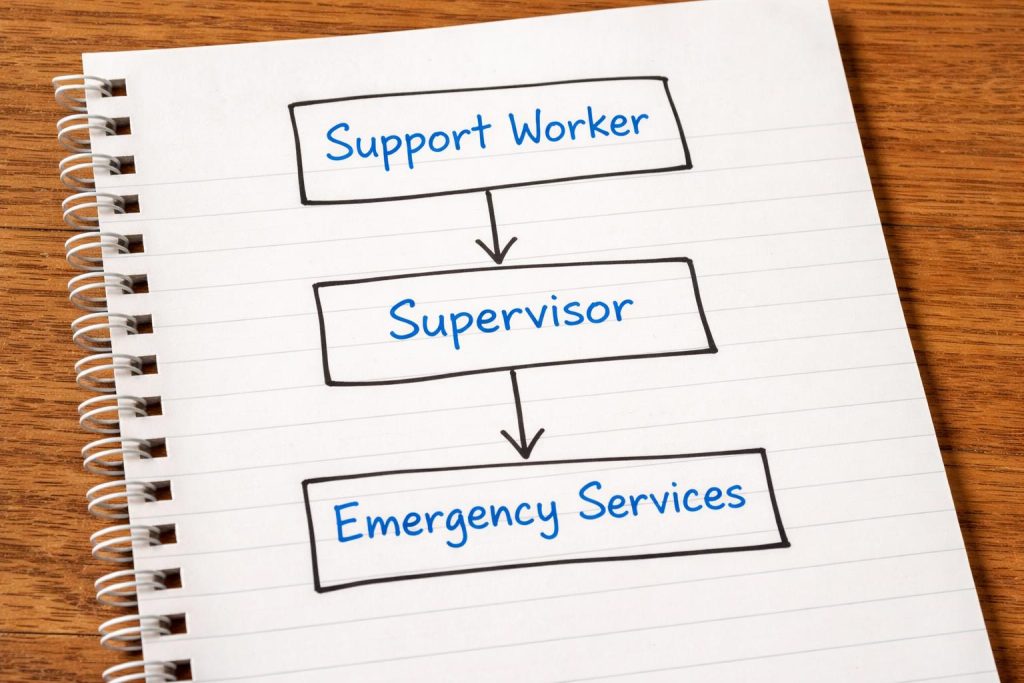
For an NDIS provider, some of the most difficult operational decisions happen when the office is closed.
A support worker may call at 11:30 pm because a participant has fallen. Another may report a medication concern at 2:00 am. A worker might fail to arrive for an overnight shift. A participant may leave their residence unexpectedly. There could be a behavioural escalation, an allegation of abuse, a burst water pipe, a hospital transfer or simply a question that could safely wait until the next morning.
The challenge is not simply having someone available to answer the phone. The real challenge is knowing what needs to happen next.
Should the worker call 000? Does the situation require clinical escalation? Does a senior manager need to know immediately? Can an after-hours responder resolve the operational issue? Does the event potentially meet the definition of a reportable incident? Or can it be documented and handed over to the day team?
A well-designed NDIS escalation process gives workers clear answers to these questions before an incident occurs.
The NDIS Quality and Safeguards Commission states that incidents connected with the delivery of NDIS supports and services need to be identified, assessed, recorded, managed and resolved. It also says an incident management system should define the actions and responsibilities of workers, the provider and other stakeholders.
That makes escalation much more than an administrative process. It is an important part of participant safety, workforce support and operational continuity.
For organisations delivering supports around the clock, the NDIS escalation procedure also needs to work after hours.
This is where After Hours Response can help. Rather than leaving frontline workers with a generic instruction to “call the manager”, an organised after-hours model can provide structured triage, escalation, operational response, documentation and handover based on the provider’s own protocols.
This guide explains how NDIS providers can develop an after-hours escalation matrix that clearly distinguishes emergencies, urgent clinical concerns, incidents, staffing problems, operational issues and matters that can wait until business hours.
What Is an NDIS After-Hours Escalation Matrix?
An after-hours escalation matrix is a practical decision-making framework that tells workers:
- what types of situations require escalation;
- how urgently they need to be escalated;
- who should receive the escalation;
- what immediate actions the worker should take;
- who is responsible for coordinating the response;
- what information needs to be recorded;
- what should happen if the first escalation contact is unavailable; and
- what needs to be communicated to the day team.
It turns a broad NDIS escalation procedure into something workers can actually use at midnight, on a weekend or during a public holiday.
A basic escalation matrix might separate events into categories such as:
Emergency → 000 / emergency services
Urgent clinical concern → emergency services where required and/or designated clinical escalation pathway
Serious incident or safeguarding concern → designated senior escalation pathway
Staffing problem → after-hours operations/on-call response
Non-urgent operational issue → after-hours response or nominated manager depending on protocol
Routine matter → document and refer to the next business day
The exact matrix should always reflect the organisation’s services, participants, risk profile, internal policies, support plans and regulatory obligations.
A Supported Independent Living provider operating 24/7, for example, will usually face a different range of after-hours situations from a provider delivering mainly weekday community participation services.
There should therefore be no assumption that one generic matrix suits every NDIS organisation.
Why “Call the Manager” Is Not an Escalation Procedure
Many organisations begin with an informal system.
Something happens after hours, so the worker phones whichever manager is listed on the roster.
That may work when the organisation is small and after-hours calls are uncommon. As services expand, however, several problems can emerge.
What if the manager does not answer?
What if the manager is unfamiliar with the participant?
What if the issue is clinical rather than operational?
What if two incidents occur simultaneously?
What if the worker does not know whether the situation is serious enough to call?
What if one manager tells workers to call about every minor issue while another expects them to resolve routine problems themselves?
And what happens when nobody clearly owns the documentation and morning handover?
A phone number is not an escalation system.
An effective NDIS on call service needs defined thresholds, responsibilities, backups and documentation requirements.
This becomes particularly important because the NDIS Commission’s Practice Standards include expectations around urgent health situations. The standards state that protocols should be in place for responding to participant medical emergencies, workers should be trained to distinguish urgent from non-urgent health situations, and systems for escalation should be established for each participant in urgent health situations.
For After Hours Response, this distinction is fundamental. The goal of a managed after-hours function is not simply to receive calls. It is to help ensure the correct pathway is activated according to the provider’s agreed procedures.
The Five Main After-Hours Escalation Pathways
A useful starting point is to divide after-hours contacts into five broad pathways.
These categories can then be customised according to the organisation’s operations.
1. Emergency Services – 000
Some situations should never wait for an internal manager to answer the phone.
Where there is an immediate threat to life or safety, emergency services may need to be contacted first.
The NDIS Commission specifically advises providers dealing with an incident to make sure affected people are safe and well and to call 000 where the person requires immediate medical care or where a criminal offence is suspected. Providers should not delay that action.
Depending on the circumstances, examples could include:
- serious or life-threatening injury;
- unconsciousness;
- severe breathing difficulty;
- suspected stroke or heart attack;
- significant uncontrolled bleeding;
- fire;
- immediate threat of serious violence;
- a potentially life-threatening medical event; or
- another situation requiring urgent police, ambulance or fire response.
The escalation matrix should make one principle unmistakably clear:
Internal escalation should not delay emergency assistance.
Workers should not believe that they must first obtain management permission before contacting emergency services where immediate emergency assistance is required.
Internal notifications and documentation can follow according to the provider’s procedure.
2. Clinical Escalation – RN, Clinician or Other Designated Health Pathway
Not every health concern requires an ambulance, but that does not mean every health concern can wait until morning.
This middle category can be difficult for frontline workers.
Examples might include:
- medication concerns;
- changes in a participant’s health status;
- concerns following a fall where emergency criteria are not apparent;
- deterioration in an existing condition;
- concerns involving high-intensity supports;
- uncertainty around an established health management protocol; or
- other situations covered by a participant-specific health plan.
The appropriate response depends on the participant’s individual circumstances, support plan and the provider’s clinical governance arrangements.
This is where access to an established clinical escalation pathway can be valuable.
After Hours Response can support providers with structured after-hours escalation arrangements, including access to Registered Nurse escalation where this forms part of the agreed service model.
The important point is that an RN escalation pathway should not be treated as a substitute for emergency services, a participant’s treating healthcare professionals or the provider’s clinical governance obligations.
The matrix should clearly establish the boundaries.
For example:
Potential emergency → 000
Urgent but apparently non-emergency clinical concern → designated clinical pathway according to participant/provider protocols
Routine clinical matter → document and refer for appropriate daytime follow-up
Workers should not have to invent this distinction during an overnight shift.
3. Senior Management Escalation
Some situations require organisational authority even when they do not require emergency medical treatment.
These might include serious incidents, allegations, significant safeguarding concerns, major service disruptions or circumstances carrying substantial participant, organisational or regulatory risk.
The organisation should nominate specific roles rather than simply writing “management”.
For example:
Level 1: After-hours responder
Level 2: Duty manager or operations manager
Level 3: Senior manager / executive
Clinical: RN or designated clinician
Emergency: 000
This makes the NDIS escalation process much easier to follow.
It should also define when escalation moves from one level to another.
For instance, the after-hours responder might be authorised to organise replacement staffing without contacting an executive. A serious allegation involving participant safety, however, might trigger immediate escalation to designated senior personnel.
That separation prevents managers from being contacted unnecessarily while making sure genuinely serious events reach the appropriate person promptly.
4. Operational After-Hours Response
A large proportion of overnight calls may not require an executive or clinician at all.
They may still require action.
Examples can include:
- worker no-shows;
- late workers;
- unplanned absences;
- inability to access a property;
- roster confusion;
- transport disruption;
- difficulties locating essential information;
- minor property problems;
- communication issues between workers;
- participant or family calls requiring operational assistance; and
- other service-delivery interruptions.
These situations demonstrate the difference between a basic answering service and genuine NDIS after hours support.
Taking a message such as:
“John called at 11:48 pm because the overnight worker hasn’t arrived.”
does not resolve the underlying issue.
Someone may need to verify the roster, contact the worker, identify replacement options, communicate with the affected service and escalate further if continuity of critical supports is at risk.
After Hours Response is designed around this action-oriented model: after-hours calls, actioned — not just answered.
Providers can establish agreed protocols so that common operational problems have predetermined response pathways instead of requiring managers to make every decision from scratch.
5. Next-Business-Day Follow-Up
Not every call needs immediate action.
This category is just as important as the emergency categories.
Without it, frontline workers may escalate everything because they are worried about making the wrong decision.
Examples could include:
- routine administrative questions;
- non-urgent scheduling requests;
- general enquiries;
- requests to update contact information;
- low-priority maintenance matters that present no immediate safety issue;
- non-urgent service feedback; or
- matters that can reasonably be managed by the appropriate daytime team.
These contacts should still be documented and directed appropriately.
A good escalation matrix therefore does not only tell workers when to escalate.
It tells them when escalation is not required.
Example NDIS After-Hours Escalation Matrix
The following is an illustrative framework only. Each provider should develop its own matrix based on its participants, services, risk assessments, policies, support plans and regulatory obligations.
| Situation | Possible immediate pathway | Possible internal pathway | Documentation/follow-up |
|---|---|---|---|
| Life-threatening injury | 000 | Notify designated senior/on-call contact | Incident record and follow-up |
| Fire or immediate physical danger | 000 | Senior/on-call escalation | Incident record |
| Urgent health deterioration | Emergency pathway where required | Clinical escalation according to protocol | Clinical/incident documentation |
| Medication concern | Emergency response if required | RN/clinical pathway according to protocol | Record actions and outcome |
| Suspected abuse or neglect | Immediate safety/emergency response where required | Designated senior/safeguarding escalation | Incident process and assessment of reporting obligations |
| Behavioural escalation | Follow participant plan; emergency assistance if required | Appropriate behaviour/senior escalation pathway | Record incident and actions |
| Missing participant | Follow participant-specific and organisational procedure; police/emergency response where required | Senior/on-call escalation | Document chronology/actions |
| Worker no-show | Assess immediate participant risk | After-hours operational response | Replacement/roster actions and handover |
| Major property emergency | Emergency services/trades as appropriate | After-hours/senior response depending on risk | Record actions |
| Minor maintenance issue | Usually no emergency response | After-hours triage | Day-team follow-up |
| Routine enquiry | None | Log for business hours | Morning handover |
The matrix should not replace professional judgement, participant-specific plans, emergency procedures or legislative requirements.
Instead, it should give workers a clear starting structure.
Scenario 1: A Participant Is Injured After Hours
Consider a support worker assisting a participant at 10:45 pm.
The participant falls.
A weak escalation procedure might say:
“Notify your manager.”
A stronger procedure starts with assessment of immediate safety.
The worker follows their training and the participant’s relevant support and emergency protocols. Where immediate medical care is required, emergency assistance should not be delayed while waiting for management approval.
The internal pathway then depends on factors such as:
- seriousness of the injury;
- whether emergency services attend;
- whether hospital transfer occurs;
- participant-specific risks;
- circumstances surrounding the fall;
- ongoing staffing requirements;
- whether other people are affected; and
- whether the event may trigger incident or reporting requirements.
The after-hours responder may need to coordinate communication while the frontline worker remains focused on the participant.
That separation can be valuable.
The person physically supporting the participant should not necessarily have to spend the next hour making multiple organisational phone calls while also managing an unfolding event.
Scenario 2: Suspected Abuse or Neglect
Allegations or suspected abuse, neglect, exploitation or violence require a clearly defined safeguarding response.
Workers need to understand that an allegation can require action even before all facts have been established.
The first priority is safety.
Depending on the circumstances, emergency services or police may be required, followed by internal escalation to designated personnel.
Registered NDIS providers also have obligations concerning reportable incidents. The NDIS Commission states that registered providers must notify it of reportable incidents that occur, or are alleged to have occurred, in connection with providing NDIS supports or services.
This is another reason the escalation matrix should not simply say:
“Report incidents to management.”
It should identify which role receives a serious safeguarding escalation and what backup pathway applies if that person cannot be reached.
Importantly, frontline workers do not need to become regulatory specialists.
Their responsibility should be clearly defined within the provider’s procedure: protect immediate safety, preserve relevant information where appropriate, report through the correct pathway and document what they observed or were told.
The designated personnel can then assess regulatory notification obligations.
Scenario 3: Behavioural Escalation Overnight
Behavioural situations require particular care because every participant is different.
The worker should follow the participant’s current support arrangements and, where applicable, behaviour support plan and relevant organisational procedures.
The escalation matrix should answer questions such as:
- When does the worker contact the after-hours service?
- When is specialist or senior escalation required?
- What circumstances require emergency assistance?
- What should happen if another participant or worker is at risk?
- What information needs to be documented?
- Who needs to know before the next shift begins?
Where regulated restrictive practices are involved, providers also need to understand the specific NDIS rules and any applicable state or territory requirements. Implementing providers have responsibilities under the NDIS restrictive practices and behaviour support framework.
The escalation matrix should therefore connect workers to existing approved plans and procedures rather than encourage improvised responses.
Scenario 4: Medication Concern at 1:00 am
Medication-related calls are a common example of why after-hours triage needs multiple pathways.
Imagine a worker discovers that a participant may have received medication at the wrong time.
The worker should not be expected to make clinical decisions outside their role or competence.
Instead, the provider’s procedure should tell them:
- what immediate observations or information to gather;
- when emergency assistance is required;
- which clinical escalation pathway is available;
- which organisational personnel need to be notified;
- what documentation is required; and
- what follow-up must occur.
The specific response will depend on the medication, participant, circumstances and clinical advice.
This is an area where After Hours Response’s RN clinical escalation capability can support an organisation’s wider after-hours framework where that service is included in the agreed arrangement.
The key is establishing the pathway before the medication concern occurs, not trying to create one at 1:00 am.
Scenario 5: A Participant Cannot Be Located
A missing or unexpectedly absent participant can range from a relatively low-risk situation to a serious emergency.
The response should therefore be participant-specific.
Factors might include:
- the participant’s usual routines;
- communication ability;
- known destinations;
- vulnerabilities;
- medical needs;
- environmental conditions;
- time elapsed;
- circumstances surrounding the absence;
- relevant support and risk plans; and
- information suggesting immediate danger.
The organisation’s procedure should clearly specify when police or emergency services should be contacted and who internally must be notified.
The after-hours escalation process should also make sure actions are coordinated and documented.
Who checked the participant’s room?
Who contacted them?
What time?
Was family or a nominee contacted according to the agreed procedure?
When were police contacted, if required?
What information was provided?
Who remained available for further communication?
A clear chronology becomes extremely important when several people are involved.
Scenario 6: The Overnight Worker Does Not Arrive
Not every serious after-hours problem is a clinical incident.
A worker no-show can quickly become a participant safety and continuity-of-support issue.
Imagine an active overnight shift beginning at 10:00 pm.
At 10:10 pm, the outgoing worker reports that their replacement has not arrived.
Simply recording the message for the office the following morning is unlikely to be adequate where the participant requires continuing support.
The response may need to include:
- confirming the roster;
- attempting to contact the scheduled worker;
- determining why they have not arrived;
- assessing the participant’s immediate support requirements;
- contacting appropriate replacement workers;
- keeping the current worker informed;
- escalating where coverage cannot be secured; and
- documenting all attempts and outcomes.
The NDIS Practice Standards address continuity of supports and emergency planning, including arrangements intended to protect participants’ health, safety and wellbeing when disruptions occur.
This is precisely the kind of operational problem where After Hours Response can reduce unnecessary management interruption.
Instead of every absence immediately waking a director or senior manager, agreed staffing protocols can allow an after-hours operations function to begin resolving the problem and escalate management only where predetermined thresholds are reached.
Scenario 7: A Property Emergency
Property problems also need to be separated by risk.
A dripping tap and a rapidly flooding bathroom are both maintenance problems, but they clearly do not belong in the same escalation category.
Likewise:
Light bulb failure in a non-critical area: potentially next-day maintenance.
No electricity to essential equipment: potentially urgent.
Broken external door affecting security: potentially urgent.
Fire: emergency.
Gas smell: emergency response according to relevant safety procedures.
Major water leak: potentially urgent property response and escalation depending on safety and impact.
The matrix should define both risk and authority.
Can the after-hours responder contact an approved emergency tradesperson?
Is there an expenditure limit?
Which contractors are authorised?
When must a manager approve a call-out?
Without these rules, a relatively straightforward property issue can turn into multiple phone calls between workers and managers.
Scenario 8: A Routine Enquiry Arrives Overnight
After-hours services may also receive calls that have nothing to do with emergencies.
Someone might ask:
- when a service begins;
- who their support coordinator should contact;
- whether the organisation has capacity;
- when the office opens;
- whether a manager can call them tomorrow; or
- how to update routine information.
These calls still matter.
A prospective participant or referrer calling after hours may represent a valuable enquiry. A participant making a non-urgent request still deserves to have that request recorded accurately.
But neither necessarily requires waking an operations manager.
After Hours Response can capture these enquiries, document the details and direct them into the agreed daytime follow-up process, allowing urgent pathways to remain available for genuinely urgent matters.
Reportable Incidents and After-Hours Escalation
One area requiring particular clarity is the relationship between incident escalation NDIS procedures and regulatory reporting.
Not every internal incident is necessarily a reportable incident to the NDIS Commission.
However, registered providers must notify the Commission about specified reportable incidents.
The Commission identifies reportable incident categories and sets notification timeframes. For most reportable incident categories, an immediate notification is required within 24 hours after key personnel become aware, with further information generally required within five business days. Different notification arrangements apply to certain unauthorised restrictive practices.
This creates an important distinction:
Frontline escalation is not the same as regulatory notification.
A worker’s role may be to recognise a potential incident and escalate it immediately through the provider’s internal process.
An authorised or designated person can then assess whether the event meets the relevant definition and what external reporting obligations apply.
That distinction should be explicit in the matrix.
Otherwise workers may hesitate because they are unsure whether something “counts” as a reportable incident.
A safer internal principle is:
Workers report and escalate according to the provider’s thresholds. Designated personnel determine regulatory notification requirements.
Every Escalation Needs a Documentation Pathway
A successful after-hours response is not complete when the phone call ends.
Documentation matters.
The NDIS Commission says providers need to record incident details and evidence and maintain records in a way that protects privacy and confidentiality. Incident management systems should also specify where and how records are created and stored.
For an after-hours contact, useful records may include:
- date and time;
- participant involved;
- caller;
- nature of the issue;
- immediate risks identified;
- actions already taken;
- advice or instructions provided;
- people contacted;
- escalation times;
- outcome;
- unresolved actions;
- follow-up requirements; and
- information requiring morning handover.
The objective is not to create paperwork for its own sake.
It is to create a reliable chronology.
If the day team arrives at 8:30 am, they should not have to reconstruct the night from missed calls, text messages and several managers’ memories.
After Hours Response places particular emphasis on documentation and morning handover because the overnight response and the next day’s operations should form one continuous process.
The Morning Handover Is Part of the Escalation Matrix
An escalation matrix should therefore include a final column:
What happens next?
Some issues are resolved completely overnight.
Others require follow-up.
For example:
Worker absence: replacement secured, but workforce team needs to investigate the absence.
Hospital transfer: participant is safe, but the service manager needs to coordinate subsequent supports.
Property issue: immediate hazard controlled, but permanent repair is required.
Complaint: immediate concern acknowledged, but the complaints team needs to respond.
Incident: immediate risks managed, but incident review and potential notification remain outstanding.
Routine enquiry: no overnight action required, but someone needs to call the person back.
Morning handover closes the loop.
Without it, after-hours response can become a separate information silo rather than an extension of the organisation’s operations.
Build Escalation Around Severity, Not Just Incident Type
A sophisticated NDIS escalation process should recognise that the same category of event can have very different levels of severity.
Consider a fall.
One participant may stumble without injury and continue normally.
Another may hit their head and require urgent medical assessment.
Likewise, a property problem might be a broken cupboard hinge or a fire.
A staffing issue could involve a worker being ten minutes late or leaving a participant with high support needs without essential overnight coverage.
The matrix should therefore consider dimensions such as:
Immediate danger: Is anyone currently unsafe?
Health impact: Is there an urgent medical or clinical concern?
Safeguarding: Is there suspected abuse, neglect, violence, exploitation or another serious concern?
Service continuity: Will essential supports be interrupted?
Participant-specific risk: Does this participant have circumstances that make the event more serious?
Operational impact: Does the event affect one shift or multiple services?
Regulatory significance: Could additional incident-management or reporting obligations apply?
Authority required: Can the after-hours responder resolve it, or is senior approval necessary?
This is much more useful than a list of incident names.
Establish Clear Escalation Levels
Providers may find it useful to create numbered escalation levels.
For example:
Level 1 – Routine
No immediate participant safety concern.
Document and send for next-business-day follow-up.
Level 2 – Operational
Requires action tonight but can potentially be managed under an approved after-hours procedure.
Examples might include certain roster disruptions or minor service-delivery problems.
Level 3 – Urgent
Significant participant, staffing, property or service concern requiring designated senior or specialist escalation.
Level 4 – Emergency
Immediate threat to health, life or safety requiring emergency response.
These are examples only.
The organisation should establish definitions that suit its own operations.
More importantly, staff need practical examples for every level.
Terms such as “urgent”, “serious” and “critical” mean little unless workers understand how they apply in real situations.
Build a Backup Escalation Path
Every matrix also needs an answer to this question:
What happens if the person does not answer?
Suppose the process says:
Urgent issue → call duty manager.
The worker calls.
No answer.
Now what?
A complete procedure might instead establish:
Primary contact → wait defined period / make defined attempts → secondary contact → senior escalation → emergency pathway where circumstances require.
The appropriate timing will depend on the seriousness of the situation.
For an emergency, of course, workers should not delay emergency assistance while attempting an internal phone tree.
But for other matters, a clear backup structure prevents workers from repeatedly calling the same unavailable person without knowing what to do next.
Give the After-Hours Team Enough Authority to Act
Another common weakness is responsibility without authority.
An organisation establishes an NDIS on call service, but the person answering the call cannot actually do anything.
Every problem still requires a manager.
This defeats much of the purpose of structured after-hours support.
Providers should consider what actions can safely be pre-authorised.
Depending on the organisation, protocols could address matters such as:
- contacting replacement workers;
- communicating approved information;
- contacting nominated emergency contractors;
- accessing relevant participant information;
- activating predefined escalation pathways;
- contacting designated clinical resources;
- recording incidents;
- notifying nominated internal roles; and
- initiating approved contingency processes.
Authority should have clear boundaries.
The aim is not to remove management oversight.
It is to avoid requiring senior approval for routine decisions that could have been predetermined.
This is an area After Hours Response can work through with NDIS providers when establishing their after-hours protocols, helping translate the organisation’s existing policies into practical workflows for the team managing calls outside normal office hours.
Participant-Specific Plans Must Connect With the Matrix
Organisation-wide escalation rules are only one layer.
Some participants require individualised arrangements.
The NDIS Practice Standards state that participant support plans should anticipate and incorporate responses to individual, provider and community emergencies and disasters, and that workers supporting the participant should understand those arrangements.
A participant-specific escalation profile might therefore identify:
- relevant health risks;
- emergency instructions;
- communication requirements;
- approved contacts;
- behaviour support considerations;
- clinical contacts;
- known risk factors;
- circumstances requiring particular escalation; and
- other essential instructions relevant to their supports.
The organisation-wide matrix tells the worker how the system works.
The participant-specific information tells them how it applies to this person.
Both are important.
Train Workers to Use the Escalation Procedure
A beautifully designed matrix is ineffective if it sits in a policy folder nobody opens.
Workers should know:
- where to find it;
- how to use it;
- which number to call;
- what information to provide;
- what constitutes an emergency;
- what they can manage within their role;
- what must be escalated;
- what needs to be documented; and
- what to do if the normal escalation pathway fails.
Scenario-based training can be particularly useful.
Ask workers:
It is 2:15 am and the replacement worker has not arrived. What do you do?
A participant reports that another worker hurt them earlier that day. Who do you contact?
A participant has fallen and appears seriously injured. What happens first?
The washing machine is leaking slowly but there is no immediate safety issue. Does a manager need to be woken?
A family member wants to change next Tuesday’s shift. Is that an urgent escalation?
These exercises reveal ambiguity quickly.
If five workers give five different answers, the procedure probably needs more clarity.
Review the Matrix Using Real After-Hours Data
An escalation matrix should evolve.
Providers can review after-hours contacts to identify patterns.
For example:
How many calls are being received each month?
What time do they occur?
Which services generate the most calls?
How many are emergencies?
How many are clinical?
How many involve staffing?
How many could have waited until business hours?
Which managers are being contacted most frequently?
How often is the first escalation contact unavailable?
Which situations repeatedly create uncertainty?
Are there issues that could be handled under a predefined protocol?
Are the same problems recurring?
This information can improve both the escalation procedure and broader service operations.
If 40 per cent of calls relate to one recurring roster problem, the solution may not simply be better after-hours answering. There may be an underlying workforce process requiring attention.
Similarly, repeated calls asking the same clinical question could indicate that participant-specific documentation or worker training needs improvement.
The NDIS Practice Standards expect incident management systems to support learning and continuous improvement, including reviewing the causes, handling and outcomes of incidents.
After-hours data can contribute valuable information to that process.
Common Mistakes When Designing an NDIS Escalation Procedure
Several problems can make an otherwise sensible system difficult to use.
Making everything urgent
If every issue is labelled urgent, nothing is genuinely prioritised.
Making the procedure too complicated
A worker dealing with an incident at 3:00 am should not need to interpret a 40-page manual before knowing whom to call.
Depending on one person
A single manager is not a resilient escalation system.
Failing to separate clinical and operational issues
A roster problem and a medication concern require different expertise.
Forgetting the backup pathway
The procedure must explain what happens when the first contact cannot be reached.
Failing to define authority
The after-hours responder needs to know what they can resolve without additional approval.
Treating emergency services as an internal escalation level
Emergency response should not be delayed while workers work their way through organisational contacts.
Ignoring documentation
Actions that are not properly recorded create risk, confusion and poor handover.
Forgetting the next morning
Every unresolved issue needs an owner.
Building a generic system without participant-specific information
Organisation-wide procedures should connect with individual support and risk arrangements.
What Should an NDIS Provider’s After-Hours Escalation Matrix Include?
When reviewing your current arrangements, consider whether your matrix clearly answers all of the following:
What constitutes an emergency?
When should 000 be contacted?
What health concerns require clinical escalation?
What is the available clinical pathway?
Which incidents require immediate senior notification?
How are safeguarding concerns escalated?
Who handles staffing disruptions?
Who manages property emergencies?
Which matters can wait until business hours?
Who is the primary on-call contact?
Who is the backup?
What happens if neither answers?
What actions can the after-hours responder take without approval?
Where is the interaction documented?
How are potential incidents recorded?
Who assesses external notification requirements?
How is the day team informed?
Who owns unresolved follow-up?
If several of these questions do not have straightforward answers, the provider may have an after-hours phone number but not yet have a complete after-hours escalation system.
How After Hours Response Can Support a Stronger NDIS Escalation Process
The objective of outsourcing NDIS after hours support should not be to disconnect the provider from its responsibilities.
A strong outsourced model should do the opposite: help make the provider’s procedures operational when its regular office is closed.
After Hours Response works with NDIS providers to establish practical protocols around the situations their teams actually encounter.
That can include pathways for:
- incident and emergency calls;
- roster and staffing problems;
- operational issues;
- participant and family contacts;
- clinical escalation;
- management escalation;
- enquiry capture;
- documentation; and
- morning handover.
The provider still determines its policies, responsibilities, escalation thresholds and governance arrangements.
After Hours Response provides the operational layer that helps those arrangements function after hours.
This distinction matters.
A traditional answering service may receive the call and forward a message.
An action-focused NDIS on call service can work within agreed protocols to determine the appropriate pathway, begin permitted actions, escalate to the appropriate person when necessary and document what occurred.
That can mean managers are contacted when their authority or expertise is genuinely required — rather than every time the phone rings.
From “Who Do I Call?” to “Here Is What Happens Next”
The real test of an NDIS escalation procedure is not how good it looks during an audit or management meeting.
It is whether a support worker can use it confidently at 2:00 am.
A frontline worker facing an unexpected situation should not need to decide which executive might be awake, search through old emails for an emergency number or wonder whether a health concern is important enough to mention.
They need a clear pathway.
At the same time, managers need confidence that significant events will reach them promptly without being interrupted by every routine overnight matter.
Participants need responsive support.
Clinical matters need appropriate clinical pathways.
Emergencies need emergency services.
Incidents need proper management and documentation.
Routine issues need efficient follow-up.
A well-designed NDIS after-hours escalation matrix brings those pathways together.
And when the office closes, the process needs to continue working.
Strengthen Your After-Hours Escalation Process With After Hours Response
If your current procedure still relies heavily on “call the manager”, or your leadership team is regularly dealing with overnight staffing issues, incidents, clinical concerns and operational calls, it may be time to review how your after-hours function is structured.
After Hours Response helps NDIS providers establish a managed after-hours response that works with their existing procedures and escalation protocols. From triage and operational action to RN clinical escalation, documentation and morning handover, the focus is on making sure calls are appropriately actioned — not just answered.
Contact After Hours Response to discuss your current after-hours gaps, escalation pathways and on-call arrangements, and explore how a structured after-hours response could support your participants, frontline workers and management team.