Medication errors can happen to even the most diligent support team – and when they occur outside normal business hours, the stakes are high. Support workers and night-shift supervisors must act quickly to keep participants safe and meet NDIS reporting requirements. This practical guide explains exactly what to do if a dose is missed, given incorrectly, refused or any other medication-related concern arises after hours. We cover the immediate safety steps, escalation to clinical advice (including using After Hours Response’s RN on-call service), documentation, and handover. Wherever possible, we draw on Australian best practice and NDIS rules to give you clear action points and compliance guidance. After Hours Response is staffed by qualified registered nurses 24/7 – we can help your team handle medication incidents and guide you through each step. Read on for a thorough, step-by-step approach.
Why after-hours medication errors need a clear plan
Medication errors are among the most common and serious incidents in disability support. They include anything from a missed or late dose to giving the wrong medicine or amount, an adverse drug reaction, or an unplanned overdose. For example, a recent Australian study of supported accommodation homes found that 37% of medication-related calls to a 24-hour Poisons Information Centre were for missed doses and 20% for accidental double-dosing. Crucially, 73% of those calls happened outside normal business hours. The researchers noted this high after-hours rate highlights “a gap in medication management support for residents and disability support workers” that needs addressing.
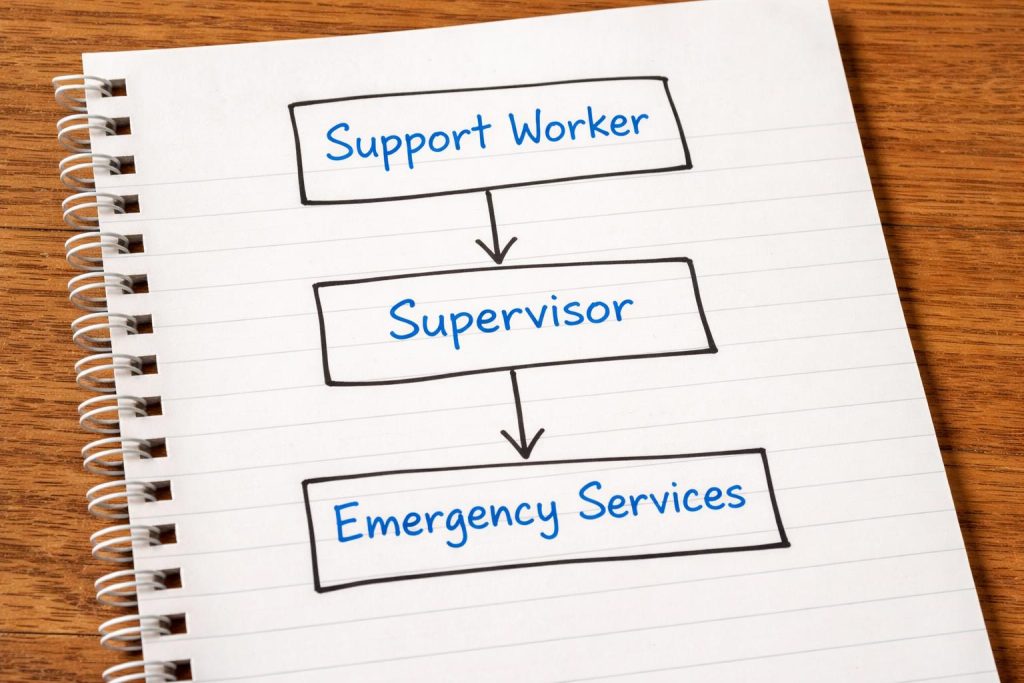
Every NDIS provider must assume that medication incidents can occur at any time. Having a clear, rehearsed after-hours plan is essential. In practice, that means support workers know to keep the participant safe first, then quickly escalate the issue: to emergency services or a qualified clinician (like a registered nurse), and to management. Our experience at After Hours Response shows that swift action can prevent harm and ensure compliance. A well-defined plan also reassures participants, families and auditors that any error will be handled professionally.
Key point: Australian data show that most medication incident calls to the poison line are after hours. That makes it vital for providers to train staff on exactly what to do in a drug error during the night or on a weekend.
Immediate safety steps
When a medication error or concern is discovered (for example, a support worker realises a participant missed a dose, got a double dose, or took the wrong medicine), the first priority is the participant’s safety and wellbeing. Follow these steps immediately:
-
Check the participant’s condition. Sit or stand with them. Are they conscious, breathing normally, and able to communicate? Check for any signs of distress: difficulty breathing, chest pain, severe headache, slurred speech, drowsiness or agitation. Take their pulse or respiratory rate if you can. In any of these cases, you may need urgent medical help.
-
Call Triple Zero (000) if there are emergency signs. If the person is unconscious, having trouble breathing, showing signs of a severe allergic reaction (such as rash or swelling), seizures, or any life-threatening symptoms, dial 000 immediately and ask for an ambulance. Do not hesitate – even if you are unsure, paramedics would rather respond than risk a life. Australian first-aid guidelines and the NSW Poisons Information Centre stress: “Is someone unconscious or not breathing? Call 000, ask for an ambulance, and start CPR if trained”.
-
Use the Poisons Information Centre (13 11 26) for guidance. If the participant appears stable but there is any concern about overdose or poisoning (even by an ordinary medicine), call the Poisons Hotline on 13 11 26 for free expert advice. This service is available 24/7. The NSW Poisons Information Centre advises: “Do not wait for symptoms to occur. Call us on 13 11 26 for advice” if poisoning is suspected. The recent Victorian study noted that disability support workers often call a 24-hour poisons service for medication incidents. Even if the error is “just” a missed or extra dose, the poisons experts can tell you if there is any risk and what symptoms to watch for. Always note the advice and instructions they give.
-
Stay with and monitor the participant. Keep the person comfortable. If you have any first-aid training (e.g. for allergic reaction or basic life support), apply it. Do not give them anything to eat or drink unless instructed. Observe their vital signs periodically (breathing rate, alertness, any changes). The act of calmly explaining what you’re doing can also reassure the participant.
-
Use the “6 Rights” as a quick check (if it helps). As a safeguard, even after an error, you should mentally review the “six rights” of medication administration: right person, right medication, right dose, right route, right time, and right documentation. Make sure you now know exactly which medication was involved, how much was taken, and when. If in doubt about any detail (for example, a blurred label or unknown pill), treat it as an error and handle it accordingly.
After Hours Response can help: If your organisation subscribes to our after-hours support, call our on-call Registered Nurse immediately. Our RN will help assess the situation and advise the best next steps (e.g. whether an ambulance is needed, or what to do symptomatically). Even if you have contacted 000 or 13 11 26, the RN can assist with second opinions, on-call doctor contacts, or extra reassurance.
Escalation and clinical support
Once the participant’s immediate safety is under control, you need to escalate the issue for professional advice and oversight:
-
Contact on-call medical personnel. If the participant is unsettled or showing worrying symptoms, call their treating GP or specialist if you have an after-hours contact number. Many NDIS clients have an assigned GP or a local medical clinic with after-hours telehealth; ring them to explain the situation and follow their advice. If you do not have a specific doctor number, the support worker should contact the shift supervisor or manager.
-
Use an on-call Registered Nurse if available. Ideally, the provider should have access to a nurse 24/7. If your agency uses After Hours Response, dial our RN on-call line now. An experienced nurse can triage the incident by phone, review medications, calculate dosages, and suggest immediate measures. They can tell you things like whether to split a dose, when to withhold the next dose, or when to watch for side-effects. (All staff should ensure the participant’s current medication list and MAR charts are up-to-date and at hand when doing this.) If you have any doubt, calling a clinical nurse is excellent practice. For example, one disability provider’s medication policy explicitly directs support workers to “contact the prescribing Doctor or Poisons Information Line” and senior staff if a dose was missed or wrong. In our service, After Hours Response nurses function as that clinical backup and can liaise with the participant’s doctor or emergency services on your behalf if needed.
-
Family or substitute decision-maker. If it’s not an emergency but the participant is upset (e.g. feels unwell or anxious), you should also notify their family or Nominee. This is both a courtesy and a safeguard: they may have additional information (like other reactions, or past medical history) and can help judge if the participant should go to hospital. If the participant has a Guardian or medical power-of-attorney, inform them at this stage as well.
-
Arrange transport if required. If the participant’s condition is concerning but not life-threatening (for example, mild symptoms of overdose that still need monitoring), consider whether they should visit an after-hours clinic or hospital. When in doubt, call an ambulance; paramedics will typically handle non-urgent cases by consultation line or attending without lights/siren if needed. Follow the clinician’s guidance. For instance, the quoted medication policy says if “a medication overdose is suspected or known, the client must be transported to the nearest Emergency Department. If required, request an ambulance via 000”.
Throughout the escalation, keep communicating. Let the person calling for help (ambulance, poison line, nurse) know exactly what happened: which drug, how much, when, who took it, any symptoms, and any measures already done (e.g. “We removed remaining tablets, attempted to give water, etc.”). That information can be life-saving.
Document the incident immediately
As soon as safety is managed, start recording exactly what happened and what you did about it. Good, contemporaneous documentation is crucial – it helps everyone stay informed, and it is required for compliance. Take these steps:
-
Fill out an incident form or notes right away. Many providers train staff to start an incident report within 1–2 hours of an event. Do this before forgetting details. Use whatever form your agency provides (paper or digital). Include: who was involved or witnessed, what exactly happened (e.g. medication, dose, timing error or refusal), when it happened, where it happened (which house or location), any immediate action taken (first aid given, calls made, etc), and the participant’s condition at each step. Even if the report isn’t finished, getting the basics down is important – a timestamped draft is better than nothing. NDIS guidance emphasises prompt incident logging so that facts aren’t lost.
-
Update the Medication Administration Record (MAR). After administering any medicine, support workers should immediately sign off on the MAR with time, medication name, strength, dose given, and their name. If you discover a dose wasn’t given or was given incorrectly, annotate this on the MAR: cross out or note the mistake clearly, and initial your correction. For example, “Missed dose – Participant refused; notified RN and manager” or “Double dose given by mistake – contacted Poisons”. If a dosage was not given or a pack was tampered with, policy requires you to note that, and then “contact the prescribing Doctor or Poisons Information Line and complete an Incident Record”. In short, your MAR should reflect exactly what occurred, not just the plan.
-
Notify your supervisor or compliance lead. Even overnight, the organisation should have an on-call manager or coordinator. Immediately tell them: “We’ve had a medication error involving [participant] at [time], we’ve [taken action], and now [their state].” This person (often a compliance officer or registered manager) can help decide if the event is reportable to the NDIS Commission. The HealthDoers guide advises: designate someone who decides “whether the 24-hour clock has started” for reporting. Rapid escalation internally ensures no delay later on.
-
Log it in the incident register. In addition to your formal report, make sure the event is entered in the service’s incident register or risk log. If you use a simple central log, put the basic facts in it as soon as possible. This allows managers to keep track of all incidents. (Auditors will cross-check shift notes against the incident register to catch missing events.)
-
Record communications. Keep a brief written note of any advice you get: if Poisons says something specific, write down “Poisons Info advised [action] on [time]”. If a doctor gave orders (“take the client to hospital”), note it. This evidence will help if anyone needs to review the case later.
Policy example: One provider’s Medication Management policy explicitly instructs staff that, upon a missed or incorrect dose, they must “contact the prescribing Doctor or Poisons Information Line and complete an Incident Record”. If there’s any welfare concern, they must also contact senior management. This kind of step-by-step instruction should guide your documentation process.
NDIS reporting obligations
Not every medication error must be reported to the NDIS Commission, but you need to know which ones do. The key is harm and context:
-
No harm occurred: If the participant is completely unharmed (no distress or health impact from the error), it can usually be managed as a “near miss.” In this case, follow internal corrective actions, but you don’t have to notify the Commission. As one compliance expert notes: “No harm → manage it internally: get clinical advice, monitor, review how it happened. Not a Commission notification.”. However, you still document it in your own system.
-
Participant was harmed or hospitalised: If the error caused injury, an adverse reaction, or the person was taken to hospital (even observation), it counts as a serious injury or harm. This must be notified to the Commission within 24 hours of becoming aware. For example, if someone took a double dose of a sedative and fell or became dangerously drowsy, that’s serious. The incident must be reported under “serious injury” rules, and a full report sent in soon after.
-
It involved a controlled medication as restraint: If the medication was intended to manage behaviour (an unauthorised chemical restraint), the rules are stricter. Even if no immediate physical harm happened, using a drug to control behaviour without authorisation is a regulated restrictive practice. That must be reported within five business days (unless it also caused serious harm, then within 24 hours).
-
When in doubt, observe the “24-hour clock.” If you’re unsure whether harm might still occur (say the participant seems okay but could deteriorate), keep them under observation. The Commission guidance says: if you can’t tell whether it will become serious, “monitor closely and, the moment it tips, the 24-hour clock runs from when you became aware”. In practice, discuss borderline cases with your on-call manager or compliance officer right away.
-
Follow NDIS Incident Rules. The NDIS (Incident Management and Reportable Incidents) Rules 2018 lay out these timeframes. As a helpful summary notes, within 24 hours for immediate serious-risk incidents, and within five business days for others, explicitly listing “medication errors causing harm” in that five-day category. So if the error hurt someone but wasn’t life-threatening, expect to notify within five days. A full investigation report (with outcomes and actions) may be due within 30 days or as directed.
Checklist:
- If the participant suffered a serious injury or needed hospital care because of the error, report to the NDIS Commission within 24 hours.
- If no harm but a high-risk med was involved, or harm was mild, file a report within 5 business days.
- Make sure a compliance manager or the NDIS Commission hotline (available 24/7) has been notified according to the rules.
Even if you don’t notify the Commission, you still must investigate internally. Analyse why the error happened (e.g. unclear packaging, staffing lapse, miscommunication) and take corrective actions (such as staff retraining or improved packaging). Good record-keeping helps show auditors and the Commission that you learned from the incident.
Morning handover and follow-up
The next morning or next shift, handover all details of the incident. This ensures continuity of care and that nothing is missed:
-
Prepare a concise handover note. Write down or summarize the key facts for the incoming team. Include the participant’s name, the medication involved, and exactly what happened (dose, time, error type). State the participant’s current status (e.g. “No new symptoms. Vital signs stable” or “Feeling dizzy but breathing normally”). List all actions taken overnight: “Called Poisons Line, gave 500 mL water, monitored blood pressure.” If an ambulance was involved, say so. Note any advice received (“Poison line said watch for vomiting, blood in stool”).
-
List outstanding tasks. Be explicit about what to watch for or do next. For example: “Check blood pressure every 2 hours; follow up with GP today; update doctor on night’s events.” If certain meds are withheld or rescheduled, mention that. If you notified the family, share their name and contact details in case they need to be updated again.
-
Record in shift notes and incident register. According to compliance guidance, shift notes should mention any incident and the follow-up actions. An auditor might cross-check this with the incident form. For example, entries under “What happened tonight” might read: “10:15pm: Participant accidentally given double dose of diazepam. Checked vitals (BP 120/70). Phoned 000 – advised observe only. Notified manager. Monitored through night, no issues. To review GSR lab results at 8am.” Then ensure this is also entered in the incident register or handover book. One expert warns that if a medication error is in the shift note but not in the official incident register, that is a “direct non‑conformance”.
-
Debrief the day team. When the next shift arrives, speak to staff or house managers directly if possible. Double-check that they have all the written info. Encourage them to ask questions or clarify anything unclear. This is also a good time to notify the participant’s usual GP or case manager if they weren’t told yet.
-
Follow up after any hospital or clinical care. If the person did go to hospital or see a doctor, ensure you get a medical report. Update the medication chart if needed (for example, if a dose should be skipped or changed). Capture any new prescription or observation advice.
By taking the time to hand over fully, you close the loop on the incident. The incoming staff will understand exactly where things stand and what to do next. It also builds trust with families and auditors that nothing was swept under the rug.
Preventing future errors
After dealing with the immediate fallout, turn your attention to prevention. No one wants another medication slip-up. Consider these measures:
-
Review the “six rights” training. Ensure all staff are refreshed on verifying the right person, medication, dose, route, time, and documentation. The Im With You guide notes that strict attention to these rights is the best way to prevent errors. Consider a quick team debrief (in the next team meeting or toolbox talk) to discuss the incident in general terms (without blame) and reinforce these principles.
-
Check medication systems. Are you using safety tools like a Medication Administration Record (MAR) properly? The MAR is vital: it “prevents 20% of potential dosing errors by providing a clear, real-time history”. If your agency uses Webster-paks or dose administration aids, verify that each pouch is labelled correctly and that staff are still following the MAR when dispensing. Also, make sure expired medicines are cleared – an expired label can look like a wrong one.
-
Train and supervise. Only trained staff (with the HLTHPS006 “Assist with medication” qualification or equivalent) should give medicines. If new or casual staff are present, ensure they work under supervision. Random audits of medication times or counts can spot errors before they happen.
-
Use clinical backup. Just as isolation rooms in hospitals use call bells, consider a formal on-call system. After Hours Response’s service model exists because phone-in support is so valuable. If you don’t already have an RN on-call, you might find we’re the practical solution. We can help your organisation update policies and train staff on after-hours procedures too.
-
Cultivate an open culture. Encourage staff to report “near misses” or concerns without fear of blame. A tip-over culture is a safety culture: the faster you spot and analyse a near-miss, the less likely a serious error repeats. It also eases reporting – if staff know to call for help right away, instead of hiding mistakes, everyone benefits.
Tip: After any medication incident, conduct a brief root-cause review with supervisors. Was the error due to packaging confusion, poor lighting, understaffing, or something else? Document lessons learned and adjust procedures (for example, better lighting in the med room or double-checks by two staff). Showing the NDIS Commission that you took corrective action is a sign of quality practice.
How auditors view documentation
It’s worth noting that Australian disability auditors will examine your records to ensure this incident was handled properly. They expect clear shift notes and incident forms. For example, NDIS practice standards auditors look for:
- Complete, timely notes: They should see date, time, staff name and role for every entry.
- Incident cross-reference: Any mention of a medication error in shift notes must match an entry in the incident register.
- Follow-up actions in notes: Your shift note should explicitly say what follow-up was done or planned (e.g. monitoring, hospital referral).
- Handover clarity: The outgoing note should include a “handover statement” summarising what the incoming staff must know next.
By covering all these bases, you make life easier for everyone – and demonstrate a strong culture of safety.
Conclusion and where to get help
Medication errors after hours are stressful, but with the right steps they can be managed safely. Remember: check participant safety first (call 000 if needed), then seek expert advice (Poisons Info, doctors, or After Hours Response’s nurse line), document everything, and report appropriately. When the sun comes up, ensure a detailed handover so the next team can continue care seamlessly.
After Hours Response is here to support you through this process. Our dedicated team of registered nurses and coordinators can assist your staff 24/7 if you ever face a medication incident or any other after-hours emergency. We can talk your team through first-aid steps, liaise with doctors, and help with incident reporting. Don’t try to handle a clinical emergency alone – contact After Hours Response for immediate guidance and assistance any time.
By following these guidelines and getting the right support, you will protect your participants and keep your organisation compliant.