A fire starts in a supported accommodation property at 11.40 pm. A severe storm cuts power to a participant’s home overnight. A flood warning changes to an evacuation order on a Sunday morning. Two workers call in sick while roads are closed. A participant who relies on powered equipment is suddenly without electricity. A family member rings at 2 am because the person they support cannot safely remain where they are.
Your organisation may already have an NDIS emergency and disaster management plan.
The more important question is: will that plan actually work when the office is closed?
For NDIS providers, emergency preparedness cannot simply mean having a policy saved in a compliance folder. The NDIS Practice Standards require applicable providers to put measures in place to maintain supports that are critical to participants’ safety, health and wellbeing before, during and after an emergency or disaster. They also require emergency and disaster management plans to be implemented, communicated, tested, reviewed and understood by workers.
That makes after-hours response a central operational issue.
Emergencies do not respect office hours. Bushfires, floods, cyclones, storms, heatwaves, power failures, building evacuations, workforce shortages and unexpected disruptions can develop overnight, on weekends and during public holidays. The NDIA specifically advises providers to have emergency plans ready to enact and to follow advice from the relevant state or territory emergency services during an emergency.
For providers delivering round-the-clock or high-dependency supports, the gap between a written plan and a working response can become particularly significant. At 2 am, somebody still needs to receive the call, understand what is happening, prioritise immediate safety, activate the correct escalation pathway, communicate with the right people, arrange alternative staffing where necessary and create a reliable record of what occurred.
That is where After Hours Response can help. After Hours Response operates a 24/7 operations desk designed specifically for NDIS providers, providing after-hours call handling, incident and emergency management, roster issue management, clinical escalation pathways, documentation and handover. Its responders include Registered Nurses, NDIS-experienced auditors and senior operations professionals, with protocols developed around the provider’s own operating requirements.
This guide explains what effective NDIS emergency and disaster management looks like in practice, how it connects with an NDIS business continuity plan, why participant-specific contingency arrangements matter and how providers can turn an emergency plan from a document into a system that remains operational after everyone else has gone home.
Why an NDIS emergency plan has to work after hours
The NDIS Quality and Safeguards Commission’s emergency and disaster management requirements are fundamentally concerned with outcomes for participants.
Under the Core Module of the NDIS Practice Standards, the intended outcome is that risks to participants’ health, safety and wellbeing arising from emergencies and disasters are considered and mitigated, while supports that are critical to their safety, health and wellbeing continue. The Standards require measures supporting continuity before, during and after the emergency or disaster.
The requirements go considerably further than simply possessing an emergency policy.
Applicable providers are expected to plan for preparing for and responding to emergencies, changing participant supports where necessary, rapidly adapting to interruptions, and communicating changes to workers, participants and their support networks. The governing body must develop the plans, consult participants and support networks, put the plans into operation, establish mechanisms for testing them, review them and ensure workers are trained to implement them.
The formal Emergency and Disaster Management Practice Standard sits within the Core Module of the NDIS Practice Standards. The Commission describes the Core Module as applying to registered NDIS providers delivering higher-risk supports and services, while lower-risk and lower-complexity supports may be assessed against the Verification Module instead. The NDIA nevertheless advises that it expects all registered providers to have emergency plans in place and ready to activate as part of their registration requirements. Providers should therefore confirm the precise standards applicable to their registration groups and audit pathway.
For organisations subject to the Core Module, emergency preparedness also connects directly with several other NDIS Practice Standards.
Continuity of supports requires day-to-day operations to be managed so disruption is avoided, suitably qualified or experienced people to cover worker absences or vacancies, and arrangements to be in place so participant supports continue throughout the service agreement. Where interruptions cannot be avoided, alternative arrangements must be explained and agreed with the participant and delivered in a way that reflects their needs, preferences and goals.
Support planning requires providers to assess how heavily each participant relies on the provider to meet daily living needs and how an interruption to services would affect that person’s health and safety. Participant support plans must also anticipate responses to individual, provider-level and community emergencies and disasters.
Service agreements are expected to set out arrangements for providing supports in an emergency or disaster.
Human resource management includes identifying workers with capabilities useful during an emergency or disaster and having plans to identify, source and induct workers where an emergency creates workforce disruption.
Taken together, these requirements point towards a simple operational reality: your NDIS emergency and disaster management plan needs to function as a live response system, not merely an audit document.
And that live system needs to work when your normal organisational structure is least accessible.
During office hours, a worker may be able to ring the service manager, walk into the rostering office, contact the quality manager, ask a senior clinician for advice and consult several colleagues. At 1.30 am on a public holiday, most of those people may be asleep.
Without a defined after-hours pathway, a frontline worker can be left effectively attempting to recreate your emergency management structure from memory while simultaneously supporting a participant.
That creates obvious operational risks.
Who receives the first call? Who determines whether emergency services are required? Who knows which participant-specific contingency plan applies? Who checks that everyone has been accounted for? Who communicates with families? Who arranges replacement workers? Who can provide clinical escalation when required? Who records what occurred? Who assesses whether the event may also constitute an incident or reportable incident? Who gives management a reliable handover in the morning?
After Hours Response is designed around precisely this operational gap. Its service positions a qualified after-hours desk as a first point of contact for workers, participants and families, with emergency triage, escalation, roster management, Registered Nurse escalation and documented handover forming part of its advertised service model.
The objective is not to replace emergency services, management responsibility or your organisation’s emergency plan. State and territory emergency services remain the first responders in emergencies, and the NDIA expressly advises people to follow local emergency advice.
The purpose of an operational after-hours system is to make sure your plan can actually be activated when the call arrives.
What should an NDIS emergency and disaster management plan actually achieve?
A useful way to assess your emergency plan is to stop asking, “Do we have the required document?” and start asking, “What happens next?”
Imagine a worker rings at 11.15 pm and says:
“There has been a fire in the kitchen. Everyone is outside. Fire and Rescue are coming. The house may not be habitable tonight. What do I do now?”
A policy may contain several pages about fire prevention, evacuation and organisational responsibilities.
An operational plan, however, needs to produce immediate answers.
The Commission advises that where a participant experiences a critical breakdown in services that places them at immediate safety risk, 000 should be called. More generally, the Commission’s incident-management guidance also directs providers to prioritise immediate safety and call 000 where urgent medical assistance is required or a criminal offence is suspected.
Once immediate danger has been addressed, the provider still needs to manage the consequences.
Can the participant return to the property? Is temporary accommodation needed? What essential supports must continue through the night? Does the participant require medication, mobility equipment, communication aids, modified food or clinical supports? Is another worker required? Does a new worker have the necessary competencies? Does a family member or guardian need to be informed? Is another NDIS provider involved? Are there transport requirements? What happens to the morning roster?
The NDIS Practice Standards deliberately link emergency management with individual support planning. Providers are required to consider how dependent each participant is upon their services and what would happen to the person’s health and safety if those supports were disrupted. Support plans must anticipate emergencies at the individual, provider and community level, and those plans must be understood by workers supporting the participant.
That means a generic organisational plan is only one layer.
A strong approach usually requires participant-specific contingency information that makes the organisational plan actionable.
For example, consider two participants experiencing the same six-hour power failure.
One participant may be able to remain safely at home using battery lighting, with only minor changes to the normal evening routine.
Another may rely on powered equipment, temperature-sensitive medication, an electric bed, charging for communication equipment or other supports for which loss of power rapidly becomes a significant health or safety risk.
The hazard is identical. The consequence is not.
That is why the Standards focus on participant needs, individual risks, reliance on services and the effect of service disruption rather than treating emergency management as a one-size-fits-all exercise.
Australia’s disaster-resilience guidance similarly emphasises disability-inclusive emergency management. The Australian Institute for Disaster Resilience notes that people with disability face disproportionate disaster risk and identifies inclusive planning, accessible information and inclusive practice as key areas for emergency management. Its guidance emphasises tailored preparedness, collaboration between emergency, community and disability services, accessible warnings and involvement of people with disability in planning.
The NDIA also points participants and providers towards the Person-Centred Emergency Preparedness, or P-CEP, approach developed by the University of Sydney as a resource for creating emergency arrangements tailored to an individual’s needs.
For an NDIS provider, that translates into a practical principle:
Your organisational emergency plan tells people how the organisation responds. Your participant-specific contingency arrangements tell them how to keep each person safe while it responds.
The two must work together.
An effective NDIS emergency and disaster management plan should therefore enable the organisation to answer, in real time:
What has happened?
The first responder needs enough accurate information to understand the immediate hazard, location, people involved and current safety status.
Is anyone in immediate danger?
Life safety comes before internal administration. Where emergency services are required, the plan must make that pathway unmistakable.
Which participants are affected?
The provider needs a method of accounting for affected participants and understanding their individual risks.
Which critical supports cannot stop?
The Commission specifically requires measures that enable continuity of supports critical to each participant’s health, safety and wellbeing before, during and after emergencies and disasters.
What needs to change?
The Standards expressly contemplate making changes to participant supports and rapidly adapting to interruptions.
Who has authority to make decisions?
The broader governance standards require documented delegation of responsibility and authority to an appropriate person where the usual position holder is absent.
Who needs to know?
Communication arrangements should cover affected workers, participants and their support networks, with participant information and support arrangements communicated in accessible and appropriate ways.
How will staffing be maintained?
The Standards require planning for workforce disruption, including identifying, sourcing and inducting workers where an emergency affects the workforce.
What needs to be recorded?
Emergency events may overlap with the provider’s incident-management system, which requires incidents to be identified, recorded, managed and resolved and relevant evidence to be maintained securely.
Those are operational questions, not policy-writing questions.
After Hours Response can support this layer by operating from agreed protocols, escalation contacts, rosters and business rules. Its published service model includes receiving calls, escalating incidents, addressing overnight roster gaps, providing an on-call Registered Nurse pathway where required and documenting events for handover.
For providers whose emergency plan currently depends on “ring the manager”, establishing a structured after-hours response pathway can help turn a single individual dependency into a defined operational process.
Where NDIS emergency plans tend to break down after 5 pm
The weakest point in many emergency systems is not necessarily the written procedure.
It is the handoff between policy and action.
A plan may be completely reasonable when read at a desk on Tuesday morning. The weaknesses only become obvious when the same plan is activated at midnight.
Consider some common failure points.
The escalation pathway relies on one person.
The emergency plan may state that all serious matters must be escalated to a director, operations manager or service manager.
But what happens when that person does not answer?
The NDIS governance standards require documented systems for delegated responsibility and authority where the usual position holder is absent.
Operationally, that means the escalation tree should not end at one unanswered mobile phone.
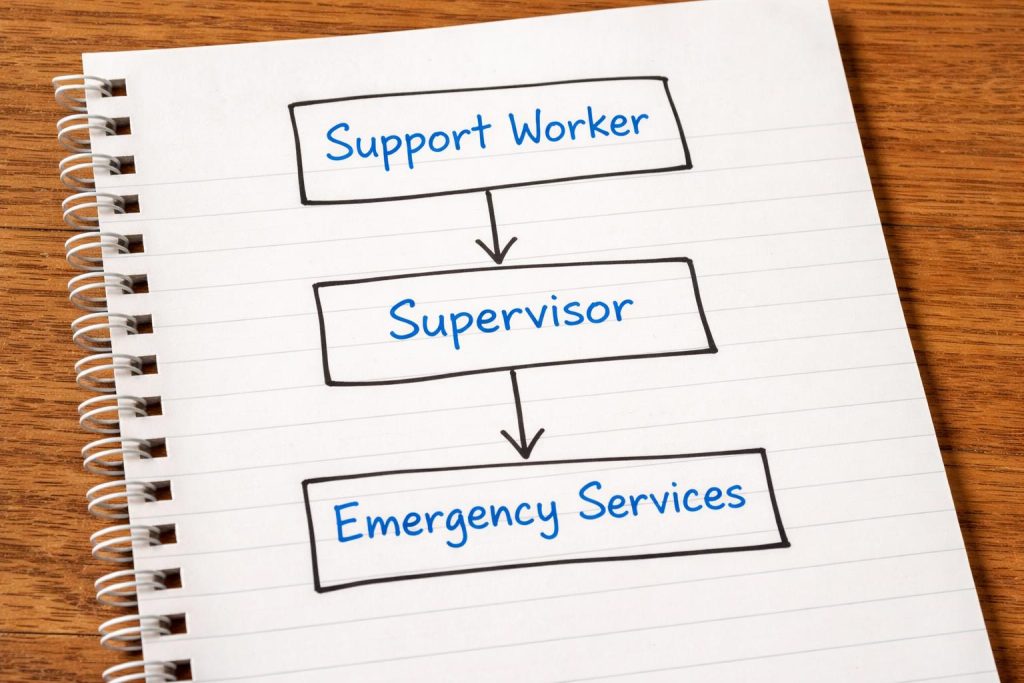
A practical pathway might identify a primary decision-maker, secondary decision-maker, clinical escalation contact where applicable and an executive-level fallback for predetermined categories of event. Escalation criteria should also make clear when workers are expected to contact emergency services immediately rather than waiting for internal approval.
The worker does not know which document to open.
During a high-pressure event, a frontline worker should not need to search through multiple policy libraries to locate emergency information.
The NDIS Practice Standards require support plans to be readily accessible to participants and workers, and emergency responses contained in the participant’s plan must be understood by workers supporting that person.
Operational information should therefore be easy to locate, current and usable.
A participant emergency profile might contain critical communication needs, mobility requirements, medication considerations, important contacts, health escalation information, evacuation support requirements and pre-agreed alternative support arrangements. The exact contents should reflect the participant’s individual circumstances, consent, applicable clinical plans and your organisation’s policies.
The emergency plan assumes normal staffing levels.
A bushfire, flood, severe storm, pandemic or transport shutdown can affect workers at the same time it affects participants.
Workers may be unable to reach a location. Roads may be closed. Public transport may stop. Several workers may call in unavailable simultaneously.
The NDIS Practice Standards address this directly by requiring providers to identify relevant workforce capabilities and maintain plans for identifying, sourcing and inducting a workforce when an emergency or disaster causes workforce disruption.
A realistic NDIS business continuity plan should therefore address not only buildings and technology, but also workforce capacity.
Who can cover essential shifts? Which workers have the required participant-specific training? What happens when your preferred replacement list is exhausted? Who manages outbound calls to available workers? Who notifies the participant and family of unavoidable changes?
After Hours Response includes shift and roster issue management in its after-hours service. Its stated process can include working from a provider’s roster, call-out list and business rules, contacting replacement staff in priority order, confirming coverage and documenting the result for the day team.
That can be particularly valuable during an emergency because the person coordinating the safety response should not necessarily also be making twenty calls trying to fill tomorrow morning’s roster.
Nobody owns communications.
During an emergency, communication can rapidly become fragmented.
A frontline worker speaks to a family member. A manager texts another manager. Someone updates the roster. A support coordinator receives an email. Another staff member contacts an external provider. Meanwhile, nobody has one chronological record showing who was told what and when.
The NDIS emergency and disaster management quality indicators explicitly require planning for communicating changes to supports to workers, participants and their support networks.
A functioning response plan should therefore identify a communication pathway.
Who contacts the participant’s nominated representative? Who updates incoming workers? Who contacts another provider where coordination is required and consent permits it? Which communication channels are used if the normal system is unavailable? Who records each communication?
AIDR’s disability-inclusive disaster guidance also highlights the importance of accessible, understandable and actionable emergency communication for people with disability.
The plan ends when the immediate danger ends.
Emergency response is not finished simply because the fire is extinguished or the storm has passed.
The NDIS standard expressly addresses continuity of critical supports before, during and after an emergency or disaster.
Recovery questions may include accommodation, restoring normal staffing, replacement equipment, temporary support changes, transport, participant wellbeing, family communication, follow-up appointments, incident review and reassessment of risk.
A good emergency plan therefore includes a clear transition from response to recovery.
Documentation is treated as tomorrow’s problem.
This is one of the most important after-hours risks.
The Commission’s incident-management guidance requires incidents connected with NDIS supports to be identified, assessed, recorded, managed and resolved. Providers must preserve incident details and evidence while maintaining privacy and confidentiality.
An emergency does not automatically become an NDIS reportable incident. However, depending on what occurs, an emergency may involve a reportable incident such as the death or serious injury of a person with disability, or circumstances involving abuse or neglect. Registered providers must notify the Commission of specified reportable incidents, and the Commission currently requires death, serious injury, abuse or neglect and several other serious categories to be reported within 24 hours of the provider becoming aware of the incident.
That makes contemporaneous documentation particularly important.
At 8.30 am the next morning, management should not have to reconstruct a serious overnight event from text messages, missed calls and people’s memories.
After Hours Response specifically provides documentation and handover as part of its service model, with calls and events recorded and handed over before the client’s day team starts work.
For emergency management, a timestamped chronology can help the incoming team understand what happened, what actions were taken, who was contacted, what remains unresolved and whether further incident-management or regulatory action needs to be considered.
Building an after-hours emergency response process that actually works
A practical NDIS emergency response plan should make the first few minutes of an event easier, not harder.
One effective model is to design the process around a simple operational sequence.
Receive. Assess. Protect. Escalate. Maintain. Communicate. Document. Handover.
The details will differ between providers and participants, but the underlying logic is widely applicable.
Receive the call through a clearly defined pathway.
Workers should know exactly who to contact after hours.
Not “try the office”.
Not “message the group chat”.
Not “ring whichever manager normally answers”.
There should be a clear first point of contact communicated during induction and reinforced through training.
The NDIS Practice Standards require workers to be trained in implementing emergency and disaster management plans.
After Hours Response can fulfil the role of an external first point of contact where that arrangement is built into a provider’s agreed protocol. Its service is marketed specifically as a 24/7 first point of contact for staff, participants and families.
Assess what is happening.
The initial call should establish information such as:
the location and nature of the emergency; whether anyone is injured or in immediate danger; which participants and workers are affected; whether emergency services have been contacted; the immediate status of accommodation or service delivery; and whether the caller requires additional guidance.
This is not the point for a lengthy administrative interview. The purpose is to obtain enough information to act safely and activate the correct pathway.
Protect life and immediate safety first.
Where there is immediate danger, emergency services take priority.
The NDIA states that local emergency services are first responders and advises participants and providers to follow local emergency advice. The Commission has also instructed providers to call 000 where a participant experiences a critical breakdown in services that places them at immediate safety risk.
An internal escalation process should never create delay where urgent emergency assistance is required.
Escalate according to predetermined criteria.
After immediate safety is addressed, the after-hours responder needs to know who has organisational authority for the situation.
Your escalation matrix might distinguish between routine operational disruption, participant health concerns, serious incidents, property emergencies, evacuation, multiple-site emergencies and events requiring executive involvement.
The NDIS governance standards require provider responsibilities, authority and accountability to be clearly defined, including documented delegation where a normal position holder is unavailable.
After Hours Response can work within provider-specific escalation protocols rather than relying on a generic call-centre script. The company states that its protocols are built collaboratively with each provider and signed off before implementation.
Maintain critical participant supports.
Once immediate danger is controlled, attention turns to continuity.
Ask: what does this participant need over the next hour, overnight and into the next shift?
The answer may include safe accommodation, personal care, medication support, food and fluid arrangements, communication support, behavioural support strategies, mobility assistance, transport, access to essential equipment or a qualified replacement worker.
The Commission’s continuity standards require arrangements to avoid interruption and appropriate alternative arrangements where disruption is unavoidable.
This is where a well-developed NDIS business continuity plan connects directly with individual participant support plans.
The NDIS Standards do not require providers to use a particular commercial “business continuity plan” template. Rather, the regulatory framework requires emergency and disaster plans, risk-management systems, continuity measures, workforce contingencies, participant-specific support planning and operational arrangements that collectively achieve safe continuity.
In practical terms, a provider may use an NDIS business continuity plan as the organisational framework that connects these obligations.
Communicate deliberately.
The response plan should identify who needs information and who is responsible for providing it.
This can include participants, families or other nominated support-network members, incoming workers, managers, clinicians, accommodation providers, support coordinators or other service providers, depending on the circumstances and appropriate consent arrangements.
The Standards explicitly require providers to plan how changes to participant supports will be communicated to workers, participants and support networks.
Document as the event unfolds.
An emergency record should establish a reliable chronology.
Useful information can include when the call was received, what was reported, immediate safety actions, emergency-service involvement, participant status, escalation attempts, decisions made, people contacted, roster changes, alternative arrangements and unresolved actions requiring follow-up.
Where the circumstances meet the definition of an NDIS incident or reportable incident, the provider’s incident-management requirements apply in addition to the emergency response.
After Hours Response’s model is particularly relevant here because it combines response with documentation rather than simply taking a message for the next business day. The business states that its after-hours service includes incident escalation, Commission-aligned reporting support and documented handover.
Handover with clear ownership.
Morning handover should not consist of “There was an issue overnight — please check your emails.”
A strong handover should distinguish completed actions from outstanding actions.
Management should be able to see what happened, who was affected, what temporary arrangements remain in place, whether follow-up with participants or families is required, whether an incident review is underway, whether any regulatory notification may be required and when the emergency arrangement should next be reviewed.
This creates continuity between the after-hours response and the organisation’s normal governance processes.
Participant-specific contingency planning and continuity of supports
One of the most important improvements an NDIS provider can make is to stop treating continuity as a purely organisational concept.
Continuity of supports under the NDIS is participant-specific.
The Practice Standards require support planning to consider how much a participant relies on the provider to meet daily living needs and what effect disruption would have on their health and safety.
This is particularly important for providers supporting people with complex or high-dependency needs.
A four-hour disruption may be a minor inconvenience for one participant and a serious health risk for another.
Emergency contingency planning should therefore begin with the participant rather than the hazard.
For each participant, consider questions such as:
Which supports are genuinely critical?
Which activities cannot safely be delayed? Which can be modified temporarily? Which can be delivered in another way?
What happens if the usual worker cannot attend?
Can another worker provide the support? Does the replacement worker require participant-specific competencies, clinical training or behaviour-support knowledge?
The continuity standard requires a suitably qualified or experienced person to perform a role where worker absence or vacancy occurs.
What happens if the usual location is unavailable?
Can supports move elsewhere? Is temporary accommodation appropriate? What equipment or medication would need to move with the participant?
What happens during a power, telecommunications or IT outage?
Can staff still access essential participant information? Is there an alternative communications pathway? Does the participant rely on powered equipment or communications technology?
How does the participant communicate during an emergency?
Are instructions available in the participant’s preferred communication format? Can unfamiliar emergency personnel understand how to communicate with them?
The NDIS Practice Standards require participant information and support plans to be communicated using appropriate language, modes and terms, while AIDR guidance stresses that emergency information should be accessible, understandable and actionable for people with disability.
Who forms the participant’s emergency support network?
With appropriate consent and agreement, this might involve family, informal supports, clinicians, other providers or a support coordinator.
The NDIS Standards require consultation with participants and support networks in emergency planning and review, and support plans may be communicated to support networks, other providers and relevant government agencies where appropriate and with consent.
What has the participant agreed should happen?
Continuity arrangements should not be designed solely around organisational convenience. The Standards require alternative arrangements to be explained and agreed with participants and delivered in ways appropriate to their needs, preferences and goals.
This is also why emergency and disaster planning should not be reduced to an evacuation diagram.
A fire evacuation plan is important.
But an effective NDIS emergency and disaster management plan needs to go further.
For a participant receiving daily personal support, evacuation may only be the first ten minutes of an emergency that continues for several days.
Where will the person sleep tonight?
Who is working tomorrow morning?
Can their medication be accessed?
Does the replacement worker know their plan?
Can essential equipment be transported?
Has the family been told?
What if the building remains inaccessible for a week?
What if three other participants are affected at the same time?
Those are continuity questions.
After Hours Response can help NDIS providers operationalise these arrangements outside normal business hours by working from the provider’s pre-agreed instructions, participant information, escalation pathways, roster rules and contacts. Its stated after-hours functions include worker and participant calls, emergency and incident escalation, clinical escalation through Registered Nurses where required, roster gap management and handover documentation.
The value is greatest when the provider has already done the participant-centred planning.
An outsourced after-hours desk should not be expected to invent an emergency strategy at 2 am. It should be given a clear, tested framework that tells qualified responders what your organisation has agreed should happen.
That makes preparation before go-live critical.
For example, After Hours Response states that its protocols are developed collaboratively with the client organisation before service commencement.
A provider implementing such an arrangement should consider mapping participant risk categories, contact hierarchies, emergency escalation thresholds, roster call-out arrangements, clinical escalation procedures, incident pathways and morning handover requirements.
That turns outsourcing from simple phone answering into part of a broader continuity of supports NDIS strategy.
Testing your NDIS business continuity plan before a real emergency does it for you
One of the clearest requirements in the Emergency and Disaster Management Practice Standard is that providers must not merely write their plans.
They must test them.
The Standards require mechanisms that allow the governing body to actively test emergency and disaster management plans and adjust them in the context of particular types of emergency or disaster. They also require periodic review points, regular plan reviews, consultation with participants and support networks and worker training in implementation.
That means an emergency plan that has sat unchanged in a policy library for several years should prompt questions even if the document itself appears comprehensive.
Testing does not always require a full-scale evacuation exercise.
Providers can use scenario-based exercises to identify operational weaknesses before a real event exposes them.
For example:
Scenario: severe storm and power outage at 1 am
Ask the night worker to follow the actual after-hours pathway.
Can they locate the correct number?
Does somebody answer?
Can the responder access the participant’s relevant contingency information?
Who determines whether the person can safely remain at home?
How is the manager notified?
What happens if the nominated manager does not respond?
Can the organisation contact a replacement worker if the morning worker cannot travel?
How are actions recorded?
At the end of the exercise, you have learnt considerably more than you would from simply rereading the policy.
Scenario: evacuation during a public holiday
Assume the normal office, roster team and service manager are unavailable.
Can the organisation account for participants and staff?
Who coordinates temporary support arrangements?
What information goes with the participant?
Who contacts family or representatives?
How is the next shift covered?
Who takes control until management becomes available?
Scenario: simultaneous worker absences during a flood
Test your workforce contingency assumptions.
The NDIS Standards specifically require plans to source and induct workers when an emergency or disaster causes workforce disruption.
How many replacement calls can your organisation realistically manage?
Does your replacement list contain current information?
Are workers listed as available actually trained to support the relevant participants?
At what point is the interruption escalated because safe support cannot be maintained?
Scenario: serious participant incident during an emergency
An evacuation or service interruption can sometimes coincide with a participant injury or other incident.
The provider then needs its emergency plan and incident-management system to operate together.
Registered providers must notify the NDIS Commission of specified serious reportable incidents. Current Commission guidance states that death, serious injury, abuse or neglect, unlawful sexual or physical contact or assault, and sexual misconduct against or in the presence of a person with disability are generally subject to a 24-hour notification timeframe calculated from when the registered provider became aware of the incident.
The test should therefore ask whether the after-hours process captures the time of awareness, relevant facts and actions accurately enough for management to make appropriate incident-management and notification decisions.
Testing also needs evidence.
The NDIS Practice Standards use quality indicators that approved quality auditors rely on when assessing compliance.
Practical evidence of an operational emergency-management system may include current plans, participant consultation records, staff training records, drill or exercise records, documented plan reviews, corrective actions following tests, updated contact lists and records showing how real disruptions were managed.
The important point is not to create paperwork for paperwork’s sake.
It is to establish a feedback loop:
Plan → train → test → identify gaps → improve → test again.
A real after-hours event should feed into the same process.
Suppose a worker calls at 3.05 am during a severe weather event and the responder discovers that the participant’s emergency contact is no longer current.
That is not simply an administrative inconvenience.
It is information about the effectiveness of your system.
Correct the contact record, determine whether other participant records need checking and consider whether your review process is frequent enough.
If an escalation manager does not answer despite three attempts, review the escalation hierarchy.
If replacement workers cannot be found because your call-out list is outdated, review workforce continuity planning.
If staff cannot access participant support plans while the office system is offline, review information continuity.
If family members receive conflicting information, review communication ownership.
This reflects the wider NDIS quality-management approach, which requires providers to use risk-related data, evidence-informed practice and participant and worker feedback to support continuous improvement.
After Hours Response can contribute useful operational evidence because its service is designed around documenting after-hours calls, escalations and handovers rather than leaving the day team to reconstruct events retrospectively.
Over time, that information can help providers identify recurring after-hours vulnerabilities: particular sites with frequent roster disruption, common escalation bottlenecks, participant plans that require clarification or events that repeatedly reach senior management because the operating protocol is unclear.
The goal is not merely to survive an audit.
It is to know, before the next emergency occurs, that somebody will pick up the phone and know what happens next.
Is your after-hours emergency plan genuinely operational?
A provider can often assess the maturity of its emergency arrangements with one simple exercise.
Pick a realistic scenario and imagine it happens tonight at 2 am.
Do not assume that the director is awake.
Do not assume that the operations manager checks their phone.
Do not assume that the roster coordinator is available.
Do not assume that the office systems are accessible.
Do not assume that the worker involved has managed this type of incident before.
Now work through the response.
Can the worker immediately find the after-hours number?
Does a real person answer?
Can that person distinguish an emergency requiring 000 from an internal operational issue?
Can they identify which participant is involved and access the relevant support information?
Can they see who should be contacted?
Is there a second escalation contact if the first does not answer?
Can they manage a roster gap?
Is clinical escalation available where required?
Can they communicate with the participant’s approved support network?
Can they record each action accurately?
Can they recognise when the situation also needs to enter your incident-management process?
Can they provide the day team with a complete handover?
If any answer is “we would work that out at the time”, that is a useful indicator that part of the plan may still exist mainly on paper.
The NDIS Practice Standards expect considerably more than passive possession of an emergency document. They require applicable providers to maintain critical supports, prepare and respond, adapt rapidly to disruption, communicate changes, consult participants, test and review plans and train workers to implement them.
The Standards also expect participant support plans themselves to anticipate individual, provider and community emergencies, and service agreements to address arrangements for support during emergencies and disasters.
That makes after-hours readiness part of a much wider governance framework.
A well-designed NDIS business continuity plan should therefore connect at least five operational layers:
Participant continuity: what each participant needs to remain safe when normal support arrangements change.
Workforce continuity: how qualified workers will be found when the normal roster fails.
Decision continuity: who has authority when ordinary managers are unavailable.
Communication continuity: how information flows between workers, participants, support networks and management.
Information continuity: how critical participant information, decisions and actions remain accessible and are documented throughout the event.
After Hours Response can provide the after-hours operational layer connecting these systems.
The company’s current service offering includes 24/7 call handling for NDIS providers, incident and emergency management, sick-call and roster management, Registered Nurse clinical escalation, documentation and handover. After Hours Response describes itself as action-focused rather than a message-taking service, with provider-specific protocols established prior to go-live.
For a participant house fire, for example, After Hours Response describes its process as prioritising life safety, confirming participant status, notifying the nominated on-call manager, communicating with next of kin in accordance with the provider’s protocol and establishing a timestamped incident chronology.
For a clinical concern overnight, its advertised pathway includes access to a Registered Nurse for triage and escalation, including onward referral to a participant’s GP or emergency services where required.
For simultaneous worker absences, its roster-management service can operate from the provider’s roster, priority call-out list and business rules to seek replacement coverage and document the outcome.
And for each of those situations, the objective is the same:
the event is acted on while it is occurring rather than simply being left as a message for management the next morning.
That distinction matters.
An answering service can tell you that somebody called.
An operational after-hours response system should tell you what happened and what was done about it.
Turn your NDIS emergency and disaster management plan into a response system with After Hours Response
The best NDIS emergency and disaster management plan is not necessarily the longest plan.
It is the plan your organisation can actually activate when something goes wrong.
It should protect participants when normal conditions disappear.
It should tell workers exactly who to contact.
It should provide clear escalation authority.
It should anticipate interruptions to participant supports.
It should incorporate participant-specific risks and agreed alternatives.
It should address workforce disruption.
It should keep participants, families and relevant workers informed.
It should preserve a reliable chronology of the response.
And it should still work at midnight, on Christmas Day or in the middle of a flood evacuation.
That is consistent with the direction of the NDIS Practice Standards, which require applicable providers to establish continuity measures before, during and after emergencies; plan for rapid changes to supports; communicate changes; involve participants and support networks; train workers; and actively test and review their emergency arrangements.
The regulatory framework is also fundamentally participant-centred. Support planning must consider the participant’s reliance on the provider and the consequences of disruption, while alternative continuity arrangements need to reflect the individual’s needs, preferences and goals.
For many organisations, the remaining question is operational:
Who is actually managing all of this after hours?
If the answer is currently “the director”, “whichever manager answers”, or “the night worker rings around until someone picks up”, it may be time to strengthen that part of your NDIS business continuity plan.
After Hours Response can help NDIS providers create a dependable operational bridge between their documented emergency procedures and what happens in the real world after the office closes.
After Hours Response provides a 24/7 operations desk built specifically for NDIS providers, supported by Registered Nurses, NDIS-experienced auditors and senior operations professionals. Services include after-hours call handling and response, incident and emergency management, clinical escalation, sick-call and roster management, documentation and handover. Provider-specific protocols are agreed before commencement so the after-hours response can operate within the organisation’s own escalation structure and business rules.
For organisations reviewing their NDIS emergency and disaster management, NDIS business continuity plan, continuity of supports arrangements or general after-hours support for NDIS providers, After Hours Response can help identify where the written plan may not yet translate into a reliable overnight response.
Contact After Hours Response to discuss your current after-hours arrangements, emergency escalation pathways and continuity risks. The company can map your after-hours requirements and explain how a managed operations desk could integrate with your existing emergency, incident, clinical and rostering procedures. After Hours Response can be contacted on 03 7058 0720 or info@ahresponse.com.au, and an information pack and pricing enquiry are available through the company’s website.
Because the real test of emergency preparedness is not whether your plan looks complete when an auditor reads it.
It is whether, at 2 am, the right person answers — and knows exactly what to do next.
This article provides general information about NDIS emergency and disaster management and operational preparedness. It is not legal, clinical or regulatory advice. Providers should consider the NDIS Practice Standards and other requirements applicable to their registration groups, services, participants and jurisdiction, and obtain professional advice where necessary.