NDIS-registered providers are responsible for the safety and wellbeing of their participants 24/7 – even when the office is closed. Complaints or serious concerns from participants or their families can arrive at any time: a support worker might report a worry at 10pm, or a parent may call over the weekend if something feels wrong. It’s vital that providers treat these after-hours complaints as seriously as daytime issues. Having clear procedures for managing urgent concerns outside business hours is not only best practice, but a regulatory obligation under the NDIS Practice Standards. In this guide, we explain exactly what to do when a complaint comes in after hours – from the first call through to handover – and how services like After Hours Response can help you stay compliant and keep participants safe.
Complaints vs. Incidents: Understanding the Difference
First, recognise that a complaint and an incident are not the same thing. A complaint is an expression of dissatisfaction – for example, a family member complaining that evening staff didn’t follow the support plan, or a participant upset about a delay in transport. An incident, by contrast, is something that actually happened (for instance an injury, an error, a missing participant, or an allegation of abuse). Most complaints are service-quality or process issues that call for feedback and resolution. However, if a complaint involves serious harm or breaches of duty, it may cross into the realm of reportable incidents. For example, a participant’s complaint that a support worker yelled at them or neglected their basic needs might flag abuse or neglect – in which case the provider must immediately follow incident reporting rules (including notifying the NDIS Commission if it’s a notifiable incident). The key is to triage each concern: treat it as a complaint by default, but be ready to escalate to an incident investigation if risk or harm is apparent. Keeping these pathways separate avoids confusion and ensures both complaints and incidents get the appropriate response.
First Steps: Acknowledge and Assess the Complaint
As soon as an after-hours complaint comes in (by phone, email or portal), the first step is to acknowledge it quickly. Even though it’s late, the complainant needs to know you have heard them. Answer the call or message promptly, thank them for raising the concern, and let them know you will investigate it as soon as possible. NDIS guidelines stress that complaints must be handled “quickly, wisely and fairly”, and best practice is to have a standard acknowledgement time (for example, within 1 business day). If you use an after-hours service like After Hours Response, the operator will immediately confirm receipt and provide a reference number or case ID so the caller knows their issue is being tracked.
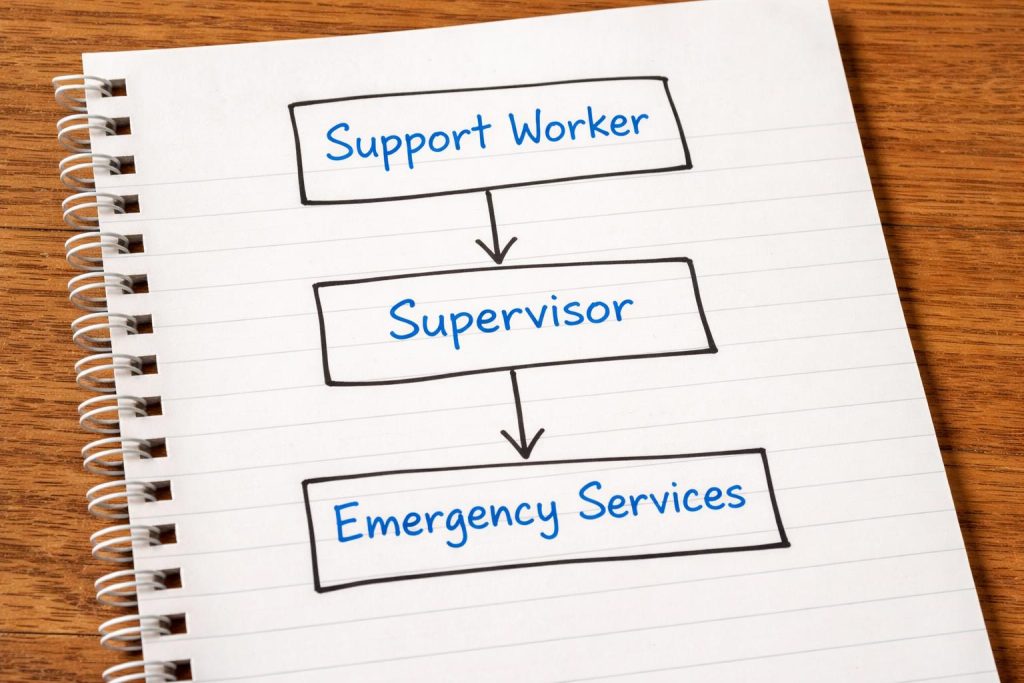
While acknowledging, also assess safety. Ask: Is the participant safe right now? If the complaint suggests any immediate risk (e.g. thoughts of self-harm, violence, medical emergency, or a breakdown of essential supports), you must act to safeguard the person. For example, if a participant rings and says they feel unsafe or unwell, your priority is to get help – call emergency services (000 in Australia) or the NDIS After Hours Crisis Service if appropriate. Providers have a duty of care at all times: we never wait until morning if someone’s health or safety is in danger. In practice, this means After Hours Response staff are trained to pause the formal complaint process if they hear urgent safety issues. They will secure immediate assistance (police, ambulance, or a crisis referral) and stay with the caller until help is on the way. Always ensure the participant is safe before moving on to other steps.
Once safety is established, gather key information about the complaint. Use a systematic approach to capture the facts (who, what, when, where, how). This might include: the participant’s name and age, the family member or support worker who complained, date and time of the concern, and a concise description of what happened. The NDIS complaints practice advice is to document as much context as possible: e.g. “participant J. missed medication dinner” or “support worker called about missing shift”. Write down: dates/times, location (which home or service), anyone involved (staff, family, other providers), what exactly occurred and how it affected the participant. Even though it’s after hours, record this information carefully in your complaints log. In many services, a company like After Hours Response will enter all of this into an incident management system on the spot. The aim is to capture every complaint in writing, no matter how informal the report. This ensures nothing is forgotten and provides a clear trail of the issue.
Prioritising Participant Safety (Urgent Safeguarding)
Safety must always come first. If at any point you identify immediate danger, stop and take urgent action. This could be calling 000, the National Disability Abuse & Neglect Hotline, or any crisis response line. For example, if a parent says their son with complex behaviours has run out of medication and is becoming aggressive, that is a clear medical/safety risk. The After Hours Response nurse on call would quickly guide the caller to the nearest hospital or ambulance for urgent care. Even though a complaint might normally follow a formal process, it cannot wait if someone could be hurt. Remember, the NDIS Commission talks about “urgent safeguarding” for participants at risk – this is as relevant at 2am as it is at 2pm.
After dealing with any life-threatening issue, reassure the participant or family that you will follow through. Explain (calmly) any immediate steps taken and that a senior manager will follow up when business hours resume. The key is to make the person feel heard and supported. After Hours Response staff are trained to provide this support 24/7, including by offering simple advice (for example on cooling aggressive behaviour, or calming a distressed participant) and by contacting on-call clinicians if needed. But they also make it clear that if the problem is urgent, they are contacting emergency help. In all cases, document the safety actions you took (who was called, when, and what advice was given) in the complaint notes.
Documenting Complaints and Communication
Accurate documentation is the foundation of good complaints management. As soon as a complaint is received, it should be logged in a register or incident system. This record should include at least: the date and time received, the complainant’s name and relationship to the participant, the participant’s name, and a brief description of the issue. According to best practice, even an offhand remark (“I’m not happy with my morning shower”) is a complaint and should be logged. Many organisations use a simple spreadsheet or database (sometimes provided by external services) to track complaints. The act of logging reinforces that every complaint matters – in fact, as one expert notes, “a provider with no complaints on record… is usually a provider that isn’t capturing them”.
In the documentation, note every action taken: acknowledgements, advice given, and any referrals. For example, if the caller was given a reference number or sent an email confirmation, record that. If after-hours staff spoke to the participant or a clinician, summarize those conversations. Use bullet points or clear notes to capture the “trail” of what happened. Every step should be dated and initialled. This written trail is evidence that the complaint was handled properly, and it ensures nothing is overlooked by the morning team.
Since this is after hours, handover is crucial. The complaint details must be included in the overnight shift log or handover note. For services like Supported Independent Living (SIL), NDIS rules explicitly require that handover notes include any incidents and “complaints raised by the participant or family”. Even if your service doesn’t use SIL templates, the principle holds: make a clear note in the handover about the complaint. State what happened, who was involved, and whether any immediate measures were taken. Good handover notes, using tools like SBAR (Situation-Background-Assessment-Recommendation), ensure the daytime supervisor reads about the complaint as soon as they arrive.
In summary, after-hours documentation should include:
- Complaint log/register: Date, person raising it, summary of issue, reference number.
- Call notes: Full narrative of the conversation and initial actions.
- Shift handover note: A concise entry for the incoming team (see below).
- Related records: If medical or police were involved, include incident report numbers or referrals.
By logging and documenting everything, you create transparency and accountability. It also safeguards the provider – if regulators review your files, they will see that no matter the hour, issues are treated seriously.
Investigating Complaints with Procedural Fairness
After the initial response, the complaint enters the formal resolution process. Even if it happened after hours, the provider should follow the same investigation steps you would by day – but with clear timelines. Typically, this means assigning the complaint to a manager or complaints officer for review on the next business day. However, the investigation mindset starts immediately:
-
Gather Evidence – Collect any records related to the complaint. This might include staff rosters, medication charts, CCTV if available, or notes from the night staff. Interview the participant or family (if appropriate) and anyone involved. With After Hours Response, the on-call team often begins this evidence-gathering by asking targeted questions during the call and filling out the report.
-
Listen to All Sides – Procedural fairness means everyone concerned gets a chance to speak. If a staff member or support worker is implicated by the complaint, let them provide their account once they are available (often the next day). Keep the complainant informed of progress as well. The NDIS Practice Standards explicitly require that the person who made the complaint (and any participant affected) “be informed of the complaint’s progress” and “be appropriately involved in the resolution”. In practice, that might mean sending an email or making a call the next morning to update the family: “We have your complaint logged and are investigating. We will contact you by [date] with an outcome.”
-
Follow Your Policy – Most providers have a written complaints policy (as required by NDIS rules). This policy will outline steps like who investigates the complaint, how long it should take, and how outcomes are communicated. Stick to that policy even for after-hours complaints. If your policy says investigations should conclude within, say, 10 business days, plan your timeline accordingly. Keep notes on all interviews and decisions – these become part of the complaint record.
-
Implement Fair Resolution – Once you have investigated, decide on action. This may include retraining a staff member, adjusting schedules, compensating a participant, or simply apologizing. Importantly, communicate the outcome to the complainant. Closing the feedback loop is key: Auditors expect that when a complaint is resolved internally, the person who complained hears what was done. Even after-hours, ensure that a manager follows up quickly in the morning with a phone call or letter summarizing the findings and next steps.
Throughout the process, maintain confidentiality and impartiality. Don’t allow the fact that it was after hours to penalize anyone unfairly or to excuse any mistakes. Treat all parties with respect and without bias. Remember, the NDIS Code of Conduct requires honesty and integrity – so be transparent and fair in your investigation.
Escalation Pathways and Regulatory Requirements
Not all complaints can be resolved in-house. You must recognise when to escalate. If the participant is dissatisfied with your response, or if the complaint involves serious misconduct (like abuse, financial exploitation or major negligence), participants have the right to take it to the NDIS Commission. It’s good practice to remind them of this option, while assuring them you’ll do your best to resolve the issue. Under NDIS rules, providers must tell participants how to make a complaint, including contacting the Commission.
In parallel, consider whether the complaint triggers any mandatory reporting. For example, allegations of abuse or neglect by staff may be reportable incidents that must be notified to the Commission (24-hour and 5-day timeframes apply). Even if it’s only a complaint, if you suspect actual harm, call the Commission’s hotline first thing on the next weekday. (Remember: outside business hours the Commission isn’t available, so your staff or after-hours service must decide to act if needed – for instance, by calling police or hospital.)
Also think about other agencies. Serious criminal behavior (e.g. theft of NDIS funds, physical assault) should involve police. Health issues might involve calling a doctor or ambulance. As a tip, we advise providers to have an internal “decision tree” so after-hours staff know when to involve which agency. For example, if a participant refuses medication and becomes combative, the flowchart might say “call on-call RN” or “call GP/emergency”. After Hours Response can integrate these pathways into their scripts so nothing is missed.
Finally, keep the NDIS Commission in the loop as required. Any critical incident that arises from the complaint must be recorded and reported according to your incident management policy. The Commission’s own guidelines emphasize that “incidents in NDIS supports… must be identified, assessed, recorded, managed and resolved while making sure the person with disability feels safe”. Complaints that reveal systemic issues (like medication errors) will often lead providers to proactively improve their systems, which is exactly what the Commission expects.
Handover to the Day Team: Continuity of Care
One of the biggest risks with after-hours complaints is a communication gap. When the clock strikes 8am, your daytime supervisors must know exactly what happened overnight. A structured handover is essential. In practice, this means writing up a clear note (and ideally giving a quick verbal briefing if there is an overlap). Use a format that captures the essentials – for instance, the SBAR approach (Situation, Background, Assessment, Recommendation) from healthcare works well. The Situation section might say: “Participant John Doe’s mother called at 11pm complaining that John had not received his evening medication and was very agitated.” The Background would list context (John’s diagnosis, usual meds, relevant behavior history). The Assessment notes what the overnight staff did (e.g. “Staff ensured safety, attempted to administer meds, no adverse reaction noted; John calmed by 11:30pm.”). Finally, Recommendations spell out the next steps (e.g. “Follow up first thing: doctor to review missed dose, and case manager to debrief with family at 9am.”).
A simple checklist can help. For example, an effective overnight-to-morning handover might include:
- Current Status/Abnormalities: Any problems right now (e.g. participant upset, injury, missing medicines, or unresolved complaint).
- Open Actions: Tasks in progress (e.g. “GP call pending”, “Awaiting family response”) and who owns them.
- Upcoming Events: Scheduled appointments, medication times, or visitors for the day.
- Staff/People: Who worked last night, who might follow up (include contact names).
- First Actions: What the day team must do immediately (for example, “check participant’s behavior at 8am, contact family, arrange interview with night staff”).
By ensuring that any overnight complaint appears in this handover note – ideally in an “Incidents/Complaints” section – you make it visible to the day staff. As one resources site points out, missing or poorly written handover notes are a common audit finding in SIL services. Don’t let that happen to you: an After Hours Response log would explicitly note the complaint under “Incidents, Hazards & Follow-Up” as shown in the SIL example, complete with any instructions for the morning team.
Learning from Complaints: Continuous Improvement
A complaint isn’t just a problem to fix — it’s also a chance to improve your service. After resolving the issue, review what went wrong and how to prevent it in future. Did staff need more training? Was a policy unclear? For example, if a support worker repeatedly missed doses, the follow-up might include revising your medication system or staffing plan. Best practice is to treat patterns of complaints as system issues. If multiple participants raised the same concern (say, communication gaps), look at underlying causes rather than treating each complaint in isolation.
Document the outcome of each complaint and feed it back into your quality framework. NDIS expectations are that providers will “demonstrate continuous improvement” in complaints handling. In practical terms, this means keeping statistics on complaints, reporting on them in management meetings, and updating policies annually based on feedback. For instance, you might find that most after-hours complaints are about medication or staff communication – then you can institute extra staff meetings or refresher training on those topics. After Hours Response can assist by providing analytics on the calls we receive: we can spot trends in your after-hours issues and suggest process changes. Ultimately, handling complaints well will lead to better participant outcomes and fewer emergencies – which is the goal of the NDIS Practice Standards.
How After Hours Response Can Help
Managing complaints after hours is challenging, but you don’t have to do it alone. After Hours Response specialises in 24/7 call support for NDIS providers. Our experienced team of registered nurses and support staff are trained in NDIS rules, so when a complaint comes in at midnight, they know exactly what to do. We provide the immediate acknowledgement and risk assessment, and we document every detail into your system. We also escalate clinical or safety issues to on-call nurses or doctors when needed, ensuring participants get timely help.
With After Hours Response handling your after-hours concerns, you gain a compliant complaints management process at all hours. Instead of managers or nurses being on stand-by at home, our flat-rate service answers every call and follows your policies to the letter. We use structured handover notes (SBAR format) so that by morning the day team has all the information they need. Plus, because we log all calls in our system, you automatically build the complaint register and evidentiary trail that auditors require.
If you’d like to strengthen your after-hours complaint handling, contact After Hours Response. We can help you tailor an escalation pathway, train your team on complaint procedures, and provide the 24/7 coverage you need to keep participants safe and uphold NDIS standards. Reach out today to learn more about our services and ensure your organisation is always ready to respond – no matter the time or day.
A strong after-hours complaints process also gives providers greater confidence that urgent concerns will not disappear between shifts. When staff know exactly who to contact, what information to record and when to escalate, they can respond consistently even during nights, weekends and public holidays. This consistency supports participant trust and reduces the risk of important details being missed. After Hours Response can help providers create a dependable bridge between the person raising the concern and the daytime management team, ensuring each matter is acknowledged, documented, assessed for risk and handed over with clear next steps for timely follow-up and resolution.