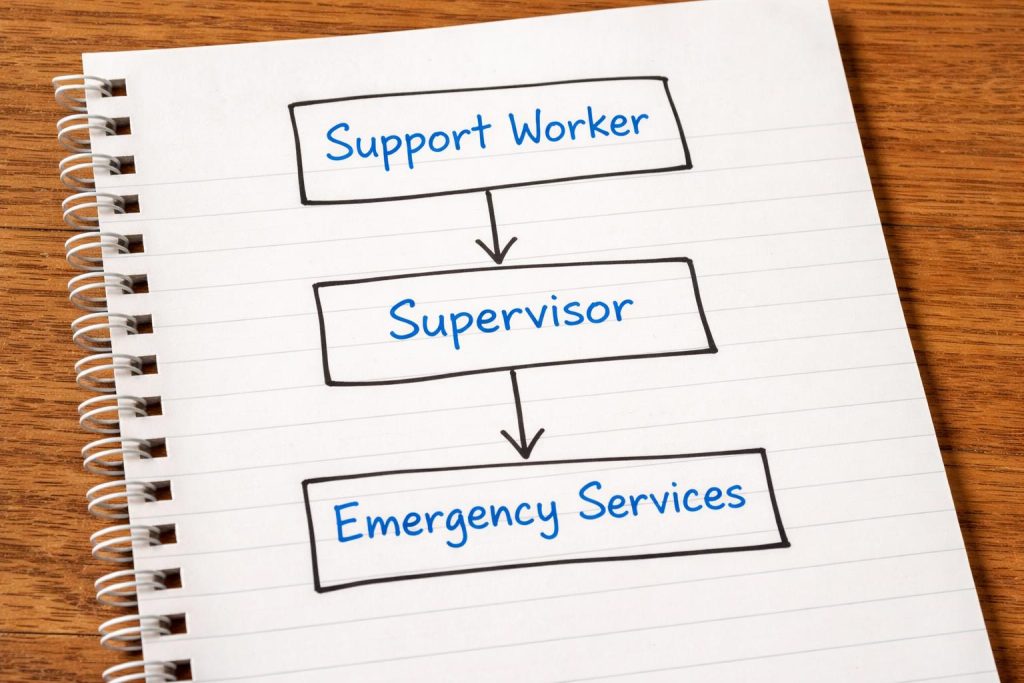
For many NDIS providers, the question is no longer whether someone needs to be available after hours.
The more difficult question is who should be responsible for that coverage.
Should directors, service managers, coordinators or other senior employees rotate through an internal on-call roster? Or should the organisation use outsourced after hours support to handle calls, incidents, roster problems and escalation outside normal office hours?
There is no single answer that suits every provider.
A small organisation with relatively few overnight issues may be able to manage an internal NDIS on call service effectively. A larger provider operating supported accommodation, complex supports, community services or multiple locations may find that the volume, complexity and operational interruption make a dedicated external after-hours function more practical.
The important point is to compare the two models properly.
Simply comparing the monthly price of an outsourced service with an internal on-call allowance rarely gives an accurate picture. Providers need to consider the real workload created by after-hours calls, how reliably issues can be resolved, the effect on managers, clinical escalation requirements, incident documentation, roster disruptions and what happens when call volumes increase.
For providers considering this decision, After Hours Response offers a dedicated 24/7 operations desk designed specifically for NDIS organisations. Rather than functioning as a traditional message-taking call centre, After Hours Response can handle operational matters such as incidents, sick calls, roster issues, clinical escalation and documentation according to agreed organisational protocols.
This guide compares the two approaches so directors and operations managers can work out which model best fits their organisation.
The Short Answer: In-House or Outsourced After-Hours Support?
An in-house on-call model can work well where:
- after-hours contact volume is low;
- calls generally require senior organisational knowledge;
- one or two managers can comfortably share the workload;
- clinical escalation is already available;
- roster disruptions are relatively uncommon;
- documentation is consistently completed; and
- the organisation has reliable backup when the primary on-call person is unavailable.
Outsourced after hours support may be more suitable where:
- calls occur frequently or unpredictably;
- directors and senior managers are regularly interrupted overnight;
- sick calls and roster gaps need active resolution;
- incidents require structured triage and escalation;
- support workers need access to a defined clinical escalation pathway;
- multiple sites, services or regions require coverage;
- documentation quality varies between managers;
- after-hours responsibilities are becoming difficult to sustain; or
- the organisation wants a more predictable cost structure.
For some providers, the best solution is a hybrid model: an external service handles the first response and routine operational work, while nominated internal leaders remain available only for matters that genuinely require executive or organisational authority.
That is broadly how After Hours Response can be structured. The external desk becomes the first point of contact, actions the issues within its authority and only escalates matters internally when the provider’s agreed protocol requires it.
Why After-Hours Coverage Matters for NDIS Providers
NDIS organisations operate in an environment where participant support does not neatly stop at 5 pm.
Support workers may be delivering services in participants’ homes, Supported Independent Living environments or community settings throughout the evening, overnight, on weekends and on public holidays.
Problems can include:
- a support worker calling in sick;
- an employee failing to arrive for a shift;
- a participant becoming unwell;
- medication concerns;
- an allegation involving abuse or neglect;
- a behavioural incident;
- a family member raising an urgent concern;
- an emergency affecting participant safety;
- uncertainty about whether an incident needs escalation;
- an unexpected hospital transfer;
- a roster gap for an early-morning shift;
- a new referral calling outside office hours; or
- a frontline worker simply needing direction.
These situations can quickly become more than telephone calls.
Someone may need to assess the situation, ask further questions, contact another worker, find replacement staff, consult a participant’s plan, escalate to management, contact emergency services, access clinical advice or document what happened.
That difference is important when comparing an internal roster with an NDIS call answering service.
A service that simply says, “We have taken your message and someone will call you tomorrow”, is fundamentally different from an after-hours operations function capable of taking agreed actions.
After Hours Response positions its service around this distinction: after-hours calls are actioned, not simply answered. Its current service scope includes call handling, incident and emergency management, roster issue management, clinical escalation, documentation and handover, and enquiry capture.
NDIS Compliance Does Not Stop When the Office Closes
After-hours coverage is partly an operational issue, but it can also intersect with an organisation’s safeguarding and compliance systems.
The NDIS Quality and Safeguards Commission states that incidents occurring in connection with NDIS supports need to be identified, assessed, recorded, managed and resolved. Registered providers must maintain an incident management system, and all NDIS providers have responsibilities when responding to incidents arising during support delivery.
Certain reportable incidents must also be notified to the NDIS Commission within specified timeframes. For example, incidents involving death, serious injury, abuse or neglect, and certain other reportable events generally require notification within 24 hours of the registered provider becoming aware of the incident.
This does not mean every after-hours incident must be reported to the Commission within 24 hours.
It does mean providers need a reliable pathway for determining what happened, protecting the participant, escalating the issue internally and making sure the appropriate person has enough information to decide what happens next.
The Commission’s Practice Standards also address continuity of supports. They expect day-to-day operations to be managed in a way that avoids disruption and, where a worker is absent or a position becomes vacant, for a suitably qualified or experienced person to perform the role.
That makes the effectiveness of an after-hours model an important operational consideration — especially for providers delivering services where an unfilled shift can directly affect participant support.
In-House On-Call vs Outsourced After-Hours Support: At a Glance
| Area | Internal On-Call Roster | Outsourced After-Hours Support |
|---|---|---|
| Initial response | Manager or nominated employee | Dedicated external responder |
| Knowledge of organisation | Usually very high | Built through protocols, onboarding and procedures |
| Management interruption | Can be significant | Routine matters can be filtered before management |
| Sick-call handling | Depends on individual manager | Can be built into agreed operational scope |
| Incident escalation | Depends on manager experience | Structured protocol can standardise response |
| Documentation | May vary between individuals | Standardised templates and handover processes |
| Clinical escalation | Requires internal clinical availability | Can be included where provider offers clinical pathways |
| Scalability | Requires more people or larger roster | Capacity can generally be expanded through service scope |
| Cost structure | Allowances, overtime, management hours and hidden costs | Often fixed or contracted service cost |
| Organisational knowledge | Immediate | Requires thorough onboarding |
| Control | Entirely internal | Requires carefully defined delegated authority |
| Best suited to | Low-volume or highly specialised environments | Growing or operationally complex providers |
Neither column is automatically better.
The correct choice depends on the provider’s actual workload.
1. Staffing Coverage: Who Is Really Available at 2 am?
The first question should be straightforward:
Who answers when something happens?
Unfortunately, many informal internal systems become dependent on whoever is most reliable.
A provider may technically have an on-call roster, but operationally the system becomes:
“Call the service manager. If they don’t answer, try the operations manager. If it is serious, call the director.”
That may work when the organisation has ten participants and receives one after-hours call every fortnight.
It becomes much more difficult when the business grows.
Consider:
- multiple Supported Independent Living properties;
- dozens of frontline workers;
- weekend services;
- sleepover and active overnight shifts;
- early-morning community supports;
- participants with complex health needs;
- services across several geographical areas.
As operations expand, after-hours demand usually becomes less predictable.
The important metric is not simply the number of calls.
It is whether a reliable responder is available every time they are needed.
Internal coverage
An internal model normally depends on:
- one primary on-call employee;
- one backup person;
- a roster defining responsibility;
- documented escalation procedures; and
- clear remuneration arrangements.
The system becomes vulnerable where several people who normally provide backup are simultaneously unavailable, on leave, sick or already managing another issue.
Outsourced coverage
A properly structured outsourced model places the first-response function with a service that is specifically staffed for after-hours operations.
After Hours Response, for example, provides 24/7 coverage for NDIS providers rather than relying on a single manager carrying an organisation’s telephone overnight.
The key question for providers assessing any external service is therefore:
Are we buying telephone answering, or are we buying operational coverage?
That distinction affects almost every other part of the comparison.
2. Management Interruption: The Cost That Rarely Appears in the Budget
One of the biggest hidden costs of internal on-call arrangements is management interruption.
Suppose a service manager receives three calls overnight.
Each conversation may only take ten minutes.
On paper, that appears to represent 30 minutes of work.
In practice, the effect can be considerably larger.
The manager may need to:
- wake up;
- understand the issue;
- check systems;
- call another employee;
- wait for a response;
- contact a participant or family member;
- record what happened;
- monitor the situation;
- return to sleep; and
- begin their normal management role the following morning.
A 10-minute call is therefore not always a 10-minute operational cost.
This is particularly important when directors or senior managers carry the phone because they are expensive organisational resources.
Their normal job may include:
- staff supervision;
- quality management;
- participant oversight;
- business development;
- audit preparation;
- recruitment;
- complaints;
- financial decisions;
- service delivery oversight; and
- organisational governance.
Every night spent managing routine sick calls or roster changes can affect the next day’s work.
The Right to Disconnect Also Needs to Be Considered
Australian employers should also ensure their on-call arrangements are consistent with current workplace relations requirements.
Employees now have a statutory right to refuse to monitor, read or respond to contact outside their working hours unless that refusal would be unreasonable. However, this is not a blanket prohibition on properly structured on-call work. Fair Work guidance specifically notes that employees who are working overtime or are on call can still be required to monitor or respond to communications depending on the applicable circumstances, award or agreement.
Providers should therefore make sure internal expectations are formally documented rather than assuming a manager is permanently available because “they have always carried the phone”.
Relevant employment contracts, awards, enterprise agreements, allowances, overtime provisions and workplace policies should be checked with appropriate workplace relations advice.
Outsourcing does not remove every internal responsibility, but it can substantially reduce the number of issues reaching senior staff.
With After Hours Response, protocols can be designed so routine matters are handled externally while defined high-risk, clinical, operational or executive issues are escalated to the provider’s nominated people.
3. Sick Calls and Roster Gaps: Answering Is Not the Same as Solving
A common after-hours call sounds simple:
“I’m sick and can’t do my 7 am shift.”
But receiving the message is only the first step.
Someone then needs to work out:
- which participant is affected;
- how critical the shift is;
- who is suitably trained;
- whether replacement workers are available;
- whether particular worker-participant matching requirements apply;
- who should be contacted first;
- whether overtime may apply;
- whether another service arrangement is possible;
- whether the participant needs to be informed; and
- what needs to be handed over to the daytime scheduler.
If a manager receives a sick call at 5:15 am and then spends 45 minutes ringing workers, the cost is not the original telephone call.
It is the entire resolution process.
That is why providers comparing an internal system with an outsourced after hours support service should ask what the external provider is authorised to do.
A conventional NDIS call answering service may record:
“Sarah called in sick. Please contact her tomorrow.”
That provides little value when Sarah’s participant expects support in 90 minutes.
An action-focused service may instead work through an agreed replacement list, contact available employees, confirm coverage and record the outcome.
After Hours Response includes sick-call and roster issue management within its current service offering and can work from provider-defined rosters, call-out lists and business rules.
For many organisations, this is one of the biggest practical differences between message-taking and genuine after hours support for NDIS providers.
4. Escalation Capability: Does Every Manager Make the Same Decision?
Internal on-call systems frequently rely on individual judgement.
One manager might immediately escalate an event.
Another may decide it can wait until morning.
A third may not be sure whether it meets the organisation’s incident criteria.
This creates inconsistency.
The problem is not necessarily that managers lack skill. It is that they may be:
- tired;
- handling the issue alone;
- unfamiliar with that participant;
- interrupted during personal time;
- dealing with several calls simultaneously; or
- relying on memory rather than a structured process.
A mature after-hours system needs more than a telephone number.
It needs escalation architecture.
That may include:
Level 1 — Routine Operational Matter
Examples:
- basic roster query;
- worker notifying a delay;
- general participant enquiry;
- non-urgent family call.
The responder can usually manage the matter without senior escalation.
Level 2 — Operational Escalation
Examples:
- unfilled critical shift;
- repeated employee no-show;
- property problem affecting support;
- participant support disruption.
The responder takes agreed actions and escalates to the appropriate operational contact when required.
Level 3 — Incident or Safeguarding Escalation
Examples:
- suspected neglect;
- participant injury;
- allegation against a worker;
- missing participant;
- possible unauthorised restrictive practice;
- serious behavioural incident.
Participant safety comes first, followed by the provider’s incident pathway and required documentation.
Level 4 — Clinical Escalation
Examples might include:
- change in participant presentation;
- medication-related concerns;
- deterioration in health;
- uncertainty about escalation to urgent medical care.
This requires an appropriately defined clinical pathway rather than expecting an operations manager to provide clinical advice.
Level 5 — Emergency
Where immediate medical, police, fire or other emergency assistance is required, 000 is the appropriate emergency pathway.
A strong model tells employees which level they are dealing with and what happens next.
After Hours Response can help providers translate existing procedures into clear after-hours protocols so responders know what they may resolve, what they must escalate and who needs to be contacted.
5. Documentation: What Will Your Morning Team Actually Receive?
Documentation is one of the areas most easily overlooked when calculating after-hours workload.
Imagine a manager solves a roster problem at 4 am.
They find a replacement and return to sleep.
At 9 am, the scheduler asks:
- Who called in sick?
- What time?
- Which workers were contacted?
- Who accepted the shift?
- Was the participant informed?
- Did overtime get approved?
- Is the change reflected in the roster?
- Does HR need follow-up?
Now consider an incident.
The information required may be considerably more important.
The NDIS Commission states that incident management systems should address identifying, responding to, recording, reporting, assessing and resolving incidents. Records must capture relevant details and evidence while maintaining privacy and confidentiality.
A telephone conversation is therefore only part of the work.
Internal documentation
Internal on-call documentation can be excellent where organisations have:
- standard templates;
- strong manager training;
- mandatory handovers;
- electronic incident systems;
- clear deadlines; and
- regular quality review.
However, consistency can deteriorate when different managers have different habits.
One may produce detailed chronological notes.
Another may write:
“Call from house. Issue resolved.”
Those records are not equivalent.
Outsourced documentation
A major advantage of structured outsourcing can be standardisation.
Each interaction can follow the same:
- intake questions;
- categorisation;
- escalation matrix;
- time recording;
- action log;
- outcome documentation; and
- handover process.
After Hours Response specifically includes compliance, documentation and morning handover within its service model, with events documented before the provider’s daytime team begins work.
This can be particularly useful for growing organisations that want their after-hours records to follow one consistent process rather than relying on the writing style of whichever manager carried the phone that evening.
6. Clinical Access: What Happens When the Question Is Not Operational?
Not every after-hours concern is administrative.
A frontline disability support worker may say:
“Something doesn’t look right, but I’m not sure what I should do.”
An operations manager may be highly experienced in disability services but may not be a nurse.
That creates a different category of risk.
Providers supporting participants with complex health requirements should consider what clinical escalation pathway frontline workers can access outside business hours.
The important distinction is that an after-hours nurse should not be viewed as a replacement for emergency services, a participant’s treating medical professionals or appropriate clinical assessment.
Instead, a defined clinical escalation service may provide an additional pathway when a worker needs qualified guidance about the next appropriate action within the service’s scope.
After Hours Response includes Registered Nurses on-call within its clinical escalation pathway. Its stated model allows frontline workers to escalate clinical concerns for triage and guidance, with onward referral to a participant’s GP or emergency services where appropriate.
For providers comparing internal and external models, ask:
- Do we already have nursing staff available 24/7?
- Who does a worker call at 3 am if they need clinical guidance?
- Does our manager have the qualifications required to answer?
- When should the issue be escalated to emergency services?
- Are participant-specific clinical plans accessible?
- How is the conversation documented?
- Who reviews the issue the following day?
For organisations delivering lower-complexity supports, this capability may rarely be needed.
For providers supporting people with high-intensity or complex needs, its value may be much greater.
7. Scalability: What Works for 20 Participants May Not Work for 200
Internal on-call systems often develop organically.
When the organisation is small, the founder carries the phone.
Then the service manager helps.
Then two coordinators join the rotation.
Eventually there may be:
- a weekday on-call roster;
- a weekend roster;
- a backup roster;
- clinical escalation contacts;
- separate roster escalation;
- regional managers;
- incident escalation;
- executive escalation.
At some point, what began as “someone carries the phone” becomes its own operating function.
This is often the moment providers should deliberately reassess the model.
Ask:
If our participant numbers doubled over the next 18 months, would the existing system still work?
Internal coverage can certainly scale.
But scaling may require:
- more managers;
- larger allowances;
- additional training;
- more backup arrangements;
- a formal overnight operations role;
- clinical resources;
- additional systems; and
- increased supervision.
Outsourcing can offer a different scaling model because infrastructure is shared across an external operations function.
After Hours Response’s model is designed so the provider’s agreed service scope can expand as organisational requirements change rather than requiring every increase in after-hours workload to translate directly into another senior employee joining the internal roster.
8. Predictable Costs: The Difference Between Price and Total Cost
Cost is usually the decisive factor.
It is also the area most likely to be calculated incorrectly.
A provider might say:
“Our managers already do on-call, so it doesn’t really cost anything.”
Unless those managers place zero value on their time, this is unlikely to reflect the true organisational cost.
A more realistic calculation should include both visible and hidden expenses.
How to Calculate the Real Cost of an Internal NDIS On-Call Service
Start with at least eight to twelve weeks of actual after-hours data.
If possible, collect:
- number of calls;
- time of each call;
- caller type;
- reason;
- duration;
- number of follow-up calls;
- management involvement;
- clinical escalation;
- roster work;
- incident documentation;
- next-day follow-up time; and
- unresolved matters handed to the morning team.
Then divide the workload into categories.
Category A: Simple Calls
Examples:
- basic information;
- minor delay;
- non-urgent question.
Record both call duration and follow-up time.
Category B: Rostering
Include:
- sick calls;
- no-shows;
- shift cancellations;
- finding replacements;
- participant notification;
- roster updates.
Category C: Incidents
Include:
- initial call;
- safety response;
- manager escalation;
- participant/family communication;
- documentation;
- Commission assessment or preparation where relevant;
- morning review.
Category D: Clinical Issues
Include:
- frontline worker conversation;
- nursing or clinical consultation;
- escalation;
- participant documentation;
- follow-up.
Category E: Enquiries and Referrals
Include after-hours calls from:
- potential participants;
- families;
- support coordinators;
- referral partners.
Some providers exclude these from their after-hours calculation even though unanswered enquiries may have commercial consequences.
A Practical Internal Cost Formula
Use the following framework:
- Internal After-Hours Cost
- On-call remuneration
- actual after-hours work/overtime
- management time spent resolving matters
- payroll on-costs
- morning documentation and handover time
- backup coverage
- training and supervision
- clinical escalation resources
- systems and telephone costs
- administrative management of the on-call roster
The exact treatment of allowances, overtime and availability will depend on your workforce arrangements, applicable industrial instruments and employment contracts, so these should be reviewed appropriately rather than using a generic industry assumption.
Don’t Forget the “Interruption Cost”
There is another cost that is harder to put into a spreadsheet.
Call it interruption cost.
Suppose your operations manager spends two hours overnight dealing with a serious problem.
The accounting system may record two hours.
But what happens the next morning?
Perhaps they:
- start late;
- cancel a supervision meeting;
- delay an audit task;
- make slower decisions;
- postpone a participant review; or
- spend another hour reconstructing what occurred.
These effects are difficult to price accurately, but they are still relevant to the outsourcing decision.
For this reason, directors should look at both:
Direct Cost
What are we paying for the on-call function?
and
Organisational Cost
What is carrying the on-call function preventing our management team from doing?
That second question is often more important.
Calculating the Real Cost of Outsourced After-Hours Support
The external calculation is usually simpler:
- Outsourced After-Hours Cost
- service fee or retainer
- implementation/onboarding cost if applicable
- internal escalation time still required
- any variable call or incident fees
- internal oversight and review time
Not all outsourced providers price services the same way.
Some charge:
- per call;
- per minute;
- per incident;
- by call volume;
- according to service tier;
- through a monthly retainer; or
- through a combination of fixed and variable charges.
After Hours Response uses a flat monthly retainer based on the organisation’s agreed environment and protocols rather than invoicing separately for every individual incident or call within the agreed service model. Its website describes the approach as a flat monthly fee with no per-incident invoicing and customisable scope.
That structure can make budgeting easier, but providers should still compare it against their real internal workload rather than simply choosing whichever headline number is lower.
Build Your Own Break-Even Analysis
A useful decision framework is:
Step 1: Calculate Monthly Internal Cost
For example:
On-call allowances + overtime + management resolution hours + documentation + clinical availability + administrative overhead
Step 2: Estimate How Much Work Outsourcing Removes
Outsourcing rarely eliminates all management escalation.
The question is:
What proportion of after-hours issues could be resolved without involving our senior team?
If the answer is 70%, compare the outsourced service against the cost and impact of that 70%, not against the assumption that managers disappear from the process entirely.
Step 3: Compare Predictability
Look at your busiest and quietest three months.
Does internal workload fluctuate significantly?
If so, ask whether predictable external costs have value even if one quiet month might theoretically cost less internally.
Step 4: Add Risk and Resilience
Ask:
- What happens if the on-call manager is sick?
- What if two incidents happen simultaneously?
- What if a clinical question arises?
- What if the manager misses the call?
- What if documentation is incomplete?
- What if the organisation doubles in size?
You cannot reduce every risk to a dollar value, but it should still appear in the decision.
A Simple After-Hours Workload Scorecard
Give your organisation one point for each statement that applies.
- We receive after-hours calls several times each week.
- Senior managers regularly carry the on-call phone.
- Managers complain about overnight interruption.
- Sick calls require active replacement work.
- We operate overnight supports.
- We support participants with complex health needs.
- Different managers document incidents differently.
- We have experienced missed or delayed calls.
- Our participant numbers are growing.
- Our services operate across multiple locations.
- Our current system depends heavily on one or two people.
- We do not have an easily accessible clinical escalation pathway.
- Morning teams regularly need to reconstruct overnight events.
- On-call duties affect managers’ daytime work.
- We expect after-hours volume to increase.
There is no formal NDIS threshold attached to this scorecard.
It is simply an operational assessment.
However, the more statements that apply, the stronger the argument for formally reviewing whether your current model remains sustainable.
When Keeping After-Hours Support In-House Makes Sense
Outsourcing should not be treated as automatically superior.
Internal on-call coverage can be an excellent option for some organisations.
It may be appropriate where:
After-Hours Volume Is Very Low
If the provider receives only a few genuine calls each month, building an external system may offer limited operational benefit.
Calls Require Highly Specific Organisational Knowledge
Some services may be so specialised that almost every issue requires a particular senior practitioner or organisational leader.
Managers Are Already Formally Rostered and Remunerated
Where on-call duties are properly structured and employees are comfortable with the arrangement, there may be little reason to change.
Strong Backup Exists
A mature internal system should continue operating when the primary responder is unavailable.
Documentation Is Consistent
If every manager already follows the same process reliably, outsourcing may offer less improvement in this area.
Clinical Support Is Already Available
Organisations with their own 24-hour nursing or clinical resources may not need an additional external pathway.
The objective is not to outsource because outsourcing sounds more modern.
It is to select the model that delivers the safest, most reliable and financially sensible outcome.
When Outsourced After-Hours Support May Make More Sense
The case for outsourcing becomes stronger when the organisation’s problem is no longer “answering the phone”.
It is operating the organisation after hours.
Common signals include:
Directors Are Still Taking Routine Calls
A director dealing with replacement-worker calls at 4 am may indicate that operational processes have not kept pace with organisational growth.
The On-Call Roster Is Becoming Difficult to Fill
If managers are increasingly reluctant to participate, the model may be approaching its sustainable limit.
Calls Require Significant Follow-Up
When ten calls generate five hours of work, measuring only call volume hides the problem.
Service Growth Is Increasing Complexity
More participants generally mean more staff, locations, incidents, roster changes and communication pathways.
The Organisation Wants Consistency
A central external desk can create one after-hours intake and documentation pathway.
Clinical Questions Are Reaching Non-Clinical Managers
A structured nursing escalation option may provide a clearer pathway.
Managers Need Fewer Interruptions
Under a hybrid model, the external desk can handle routine matters while internal leaders remain available only for issues requiring their authority.
These are exactly the kinds of operational gaps After Hours Response is designed to help NDIS providers address.
The Hybrid Model: Often the Most Practical Option
The comparison does not need to be binary.
Many organisations should not completely remove internal on-call capability.
Instead, they can change what “on call” means.
Traditional model:
Worker → Manager
Every issue goes directly to management.
Hybrid model:
Worker → After-hours operations desk → Internal manager only if escalation criteria are met
This model retains organisational authority while reducing unnecessary interruptions.
For example:
A worker reports sick.
The external desk checks the roster and replacement list, calls available workers and fills the shift.
No manager required.
A worker reports a serious participant safeguarding concern.
The external desk confirms immediate safety, follows the provider’s incident process, records the information and contacts the nominated senior manager.
Manager required.
A worker has a clinical concern.
The external clinical escalation pathway is activated, with emergency or treating health services used where appropriate.
Clinical escalation required.
This is closer to the model After Hours Response offers: routine matters are actioned within pre-agreed protocols while the provider keeps control of decisions requiring senior authority.
What Outsourcing Does Not Remove
Providers should also understand what an outsourced service cannot do.
Outsourcing a function does not transfer away the provider’s underlying governance responsibilities.
Management still needs to:
- approve procedures;
- maintain appropriate oversight;
- ensure participant information is current;
- provide accurate escalation contacts;
- maintain workforce information;
- review incidents;
- investigate matters where required;
- make reportable-incident decisions where applicable;
- monitor service quality;
- update protocols;
- follow up workforce issues; and
- maintain appropriate organisational governance.
The NDIS Practice Standards emphasise that registered providers need governance and operational systems proportionate to their size, scale and service complexity.
A good external service supports those systems.
It does not replace them.
Questions to Ask Any Outsourced NDIS After-Hours Provider
Before signing a contract, ask more than:
“How quickly do you answer?”
Response speed matters, but capability matters more.
Ask:
- Who actually answers the calls?
- What experience do responders have with NDIS organisations?
- Can they take action or only record messages?
- How are sick calls handled?
- Can they contact replacement staff?
- How are incidents triaged?
- How are emergencies handled?
- Is clinical escalation available?
- Who provides clinical guidance?
- How are participant-specific instructions stored and accessed?
- How are calls documented?
- What information appears in the morning handover?
- How are privacy and information security managed?
- What happens if several calls arrive simultaneously?
- How are protocols updated?
- Which matters automatically escalate to our management team?
- Can authority levels be customised?
- What are the fees during high-volume periods?
- Are there additional per-call or per-incident charges?
- How does the service scale if our organisation grows?
These questions separate a general telephone answering provider from a genuine NDIS after hours support function.
What Should an NDIS After-Hours Protocol Include?
Whether support remains internal or is outsourced, providers should define their expectations clearly.
A practical protocol should identify:
Who Can Call
For example:
- employees;
- contractors;
- participants;
- nominees;
- families;
- emergency services;
- support coordinators;
- external health professionals.
What the Responder Can Do
Examples:
- provide approved information;
- contact replacement workers;
- notify participants;
- activate incident procedures;
- contact internal managers;
- initiate clinical escalation;
- contact emergency services where required.
What Requires Management Approval
Examples might include:
- significant financial decisions;
- suspension of an employee;
- major service changes;
- high-risk safeguarding decisions;
- media communication;
- organisational crisis management.
Escalation Order
For example:
- Operations Manager
- Service Delivery Manager
- Clinical Lead
- Director
Participant-Specific Requirements
Relevant information may include:
- communication requirements;
- known risks;
- health management plans;
- behavioural support information;
- emergency contacts;
- important participant preferences.
Documentation Requirements
Every significant interaction should make clear:
- when contact occurred;
- who called;
- what happened;
- what actions were taken;
- who was contacted;
- what remains outstanding; and
- what the morning team needs to do.
After Hours Response can work with NDIS providers to translate their internal processes into this type of structured after-hours workflow rather than applying a generic script to every organisation.
How to Decide Which Model Fits Your Organisation
A useful board or executive discussion should consider four areas.
1. Cost
What does the current internal model really cost once every associated activity is included?
2. Coverage
Can the current model reliably respond every night, weekend and public holiday?
3. Capability
Can the person answering handle roster issues, incidents, safeguarding concerns and clinical escalation appropriately?
4. Sustainability
Could the existing model still work if:
- the organisation grew by 50%;
- a key manager resigned;
- call volume doubled;
- several managers took leave at the same time; or
- two serious events occurred simultaneously?
If your current system performs well across all four areas, keeping the function in-house may be entirely appropriate.
If weaknesses consistently appear, it may be time to compare external alternatives.
Internal On-Call vs Outsourced Support: The Decision Matrix
Rate each factor from 1 to 5 for your current internal system.
| Factor | Score 1 | Score 5 |
|---|---|---|
| Reliable 24/7 coverage | Frequently vulnerable | Highly reliable |
| Management disruption | Very high | Minimal |
| Sick-call resolution | Mostly messages | Consistently resolved |
| Incident escalation | Inconsistent | Highly structured |
| Documentation | Variable | Standardised |
| Clinical escalation | No clear pathway | Clear 24/7 pathway |
| Backup capability | Depends on individuals | Multiple backups |
| Scalability | Difficult | Easy |
| Cost predictability | Highly variable | Highly predictable |
| Staff sustainability | Significant burden | Sustainable |
Low scores do not automatically mean outsourcing is required.
They show where investment is needed.
The organisation can then compare two options:
Option A
Strengthen the internal system.
Option B
Transfer some or all of the function to an external NDIS on call service.
Whichever solution achieves the required standard at an acceptable cost is the rational choice.
Why a Standard Call Answering Service May Not Be Enough
When searching for help, providers may encounter terms such as:
- after-hours answering service;
- NDIS call answering service;
- outsourced reception;
- virtual receptionist;
- NDIS after hours support;
- after-hours call centre; and
- NDIS on call service.
These services can be very different.
A receptionist-style service may be ideal for general enquiries.
But operational after-hours support requires another level of capability.
For example:
Caller: “One of our overnight staff hasn’t arrived.”
A message-taking service may record the issue.
An operations service should understand what it has authority to do next.
That might include:
- checking the shift;
- contacting the missing worker;
- working through replacement options;
- notifying relevant people;
- escalating if coverage cannot be found; and
- documenting the outcome.
After Hours Response has deliberately built its service around this distinction. Its responders include NDIS-experienced operational staff and access to Registered Nurses for clinical escalation, while the service scope covers roster issues, incidents, documentation and handovers in addition to telephone answering.
Frequently Asked Questions
Is outsourced after hours support cheaper than keeping an internal on-call roster?
Not necessarily.
It depends on call volume, manager remuneration, overtime, allowances, time spent resolving roster issues, documentation requirements, clinical resources and how much management interruption the current model creates.
Providers should calculate their total internal cost rather than comparing an external quote only against the on-call allowance.
Can an NDIS provider outsource its after-hours service?
Operational functions can be supported by external providers, but outsourcing does not eliminate the NDIS provider’s own governance, safeguarding or regulatory responsibilities.
The provider should maintain oversight, clearly defined protocols, appropriate escalation arrangements and processes for reviewing significant events.
What is the difference between an NDIS call answering service and NDIS after hours support?
A call answering service generally focuses on receiving calls, gathering information and forwarding messages.
A broader NDIS after hours support service may also undertake authorised actions such as handling staff sick calls, working through roster issues, escalating incidents, accessing clinical escalation pathways and preparing structured documentation.
Providers should confirm the precise scope before choosing a service.
Should directors remain on call after outsourcing?
Not necessarily for every issue.
Many providers retain a nominated senior escalation contact while allowing the external desk to handle routine operational matters independently under agreed protocols.
This means management remains available for serious or exceptional decisions without being the first person contacted about every sick call or minor problem.
What happens if an incident occurs after hours?
Immediate participant safety comes first.
The provider’s incident management process should then guide assessment, internal escalation, documentation and any external notifications required.
The NDIS Commission requires providers to maintain appropriate incident management arrangements, and specified reportable incidents have formal notification timeframes.
Can an outsourced provider manage sick calls?
This depends on its scope.
A basic answering service may simply record the worker’s absence.
After Hours Response can manage sick calls and roster issues according to agreed provider protocols, including working through replacement arrangements and documenting the outcome.
Can After Hours Response provide clinical escalation?
Yes. After Hours Response’s current service includes Registered Nurses on-call as an escalation point for frontline workers requiring clinical guidance, with onward referral to appropriate health or emergency services where required.
Does After Hours Response charge per call?
After Hours Response currently describes its pricing model as a flat monthly retainer based on the provider’s scope and agreed protocols, rather than per-incident invoicing. Providers should contact After Hours Response for current pricing based on their individual requirements.
Compare the Function, Not Just the Phone Bill
The real decision between an in-house NDIS on call service and outsourced after hours support is not:
“Who can answer our phone cheapest?”
It is:
“Which operating model gives our participants, workers and organisation reliable support outside business hours at a sustainable cost?”
For a small provider with low call volumes and experienced managers who are comfortable sharing formal on-call responsibilities, internal coverage may remain the best option.
For a growing provider dealing with frequent roster issues, incidents, complex supports, clinical questions and management fatigue, an outsourced or hybrid model may provide greater consistency and resilience.
Most importantly, providers should measure their existing workload before making the decision.
Track:
- calls;
- resolution time;
- roster work;
- incident work;
- clinical escalation;
- management interruptions;
- documentation;
- morning follow-up; and
- total internal cost.
Once those figures are visible, comparing the two models becomes much easier.
Considering Outsourced After-Hours Support for Your NDIS Organisation?
After Hours Response provides a dedicated 24/7 operations desk built specifically for NDIS providers.
Our service is designed to do more than take messages. Depending on your agreed protocols and service scope, After Hours Response can help with:
- after-hours call handling and response;
- incident and emergency escalation;
- worker sick calls;
- shift and roster issues;
- Registered Nurse clinical escalation;
- structured documentation and morning handover; and
- after-hours enquiry and referral capture.
We work with your organisation to define what our responders can action directly, what needs clinical escalation and what should be referred to your nominated managers.
The result is an after-hours model designed around your organisation rather than a generic call centre script.
If you are currently relying on directors, managers or coordinators to carry the on-call phone, contact After Hours Response to discuss your current workload and compare the cost, coverage and operational impact of your existing model with a managed after-hours service.
You can use the conversation to map what happens after hours today, identify which tasks could be managed externally and determine whether an internal, outsourced or hybrid model makes the most sense for your organisation.
After-hours calls, actioned — not just answered.