An NDIS provider can have a comprehensive after-hours policy and still have a serious after-hours problem.
The document may explain that workers should report incidents. It may contain emergency contact numbers, an escalation chart and instructions about worker absences. It may describe responsibilities for managers, frontline workers and clinical personnel.
On paper, everything appears organised.
Then the phone rings at 2:07 am.
A support worker says the participant they are supporting has had a fall. At another service, the overnight worker has not arrived. The manager carrying the on-call phone is not answering. A third worker has a medication question and does not know whether it can wait until morning.
This is where the difference between an NDIS after hours procedure and a functioning after-hours operating system becomes obvious.
A policy tells people what should happen.
An operational system makes sure somebody can actually make it happen.
For NDIS providers, this distinction matters because current NDIS Practice Standards address incident management, workforce management, continuity of supports, risk management and emergency and disaster management. Among other requirements, the standards emphasise arrangements to avoid disruption, provide appropriate replacement workers when absences occur and maintain continuity of supports. They also require workers to understand relevant procedures and emergency arrangements.
The NDIS Commission also describes an incident management system as a set of processes and procedures defining the actions and responsibilities of workers, providers and other stakeholders when an incident occurs.
The important word is system.
An effective NDIS on call policy cannot simply say “contact the on-call manager”. It needs to answer practical questions:
Who answers?
What can they do?
What must be escalated immediately?
What happens when the first person does not answer?
Who handles clinical concerns?
Who finds replacement workers?
Who communicates with participants and families?
Where are actions recorded?
What reaches the day team?
And how does the provider know the entire process will actually work at 2:00 am?
For providers reviewing these questions, After Hours Response can provide a managed operational layer between frontline workers and the provider’s management, clinical and daytime teams. Rather than simply taking messages, the aim is to help ensure after-hours calls enter an agreed pathway and are appropriately actioned, escalated, documented and handed over.
This guide explains how to turn an after-hours policy into a practical operating system.
What Is an NDIS After-Hours Procedure?
An NDIS after hours procedure sets out what should happen when participants, workers, families or other relevant people need assistance outside the provider’s normal office hours.
Depending on the organisation, “after hours” might include:
-
evenings;
-
overnight periods;
-
early mornings;
-
weekends;
-
public holidays; and
-
other periods when the normal office team is unavailable.
The procedure should reflect the services the provider actually delivers.
A provider delivering weekday community access may have relatively limited after-hours exposure.
A Supported Independent Living provider operating 24 hours a day may need a significantly more developed system covering incidents, emergencies, clinical escalation, worker absences, roster problems, property issues and participant contacts throughout the night.
There is therefore no single after hours policy for an NDIS provider that suits every organisation.
The system should be proportionate to the provider’s size, services, participant needs, operating model and risk profile.
The NDIS Practice Standards themselves take this kind of proportionate approach. For example, continuity arrangements are expected to be relevant and proportionate to the scope and complexity of supports being delivered.
The goal is not to create the longest possible procedure.
It is to create one that workers can actually use.
Why a Written NDIS On-Call Policy Is Not Enough
Policies are important.
They establish responsibilities, boundaries and organisational expectations.
But after-hours operations expose weaknesses that may not be obvious during policy development.
Consider an instruction such as:
“For urgent matters, contact the on-call manager.”
It sounds reasonable.
But what does “urgent” mean?
Which manager?
What number should the worker call?
What happens if the manager does not answer?
How long should the worker wait?
Is there a backup?
Should the worker call 000 first in an emergency?
What happens if the concern is clinical?
Can the manager organise a replacement worker?
Where is the call documented?
Who checks the incident the next morning?
The procedure needs to answer these questions before the situation occurs.
A useful test is to remove the names of your most experienced managers from the scenario.
Imagine a relatively new support worker is alone at 2:00 am.
Could that person use your procedure without relying on undocumented organisational knowledge?
If the answer is no, the organisation may have a policy but not yet have a reliable NDIS after hours support system.
Start With the Entry Point: Who Answers the After-Hours Number?
The first design decision sounds simple:
Who answers?
There are several possible models.
A provider may rotate the on-call phone between managers.
A dedicated internal operations person may cover it.
A third-party call centre may answer and take messages.
Or a specialist after-hours operations service may receive calls and act according to agreed provider protocols.
Whichever model is used, the provider should define the function of the person answering.
Are they simply receiving information?
Are they triaging calls?
Can they resolve operational problems?
Can they access relevant information?
Can they activate escalation pathways?
Can they arrange replacement staffing?
Can they contact clinical support?
Can they make specified decisions?
The answers fundamentally change the effectiveness of the system.
A provider might technically offer a 24-hour phone number, but if every caller is told:
“We’ll leave a message for the office tomorrow,”
that is not necessarily an effective response to an urgent staffing, incident or participant-support problem.
After Hours Response is designed around a different model: after-hours calls can be handled according to agreed operational protocols so the focus is on calls being actioned — not just answered.
Define What the First Responder Is Authorised to Do
Authority is one of the most overlooked parts of an NDIS on call policy.
Imagine the after-hours responder receives a call saying the overnight worker has not arrived.
The responder checks the roster and identifies an appropriate available replacement.
Can they offer the shift?
Or must they call the operations manager first?
Now imagine there is a significant water leak at a participant’s home.
Can the responder contact an approved emergency plumber?
Or does the director need to approve the call-out?
What if a participant needs urgent clinical escalation?
Can the responder activate the designated clinical pathway?
If the person answering the phone cannot take any meaningful action, almost every issue will still interrupt management.
Providers should therefore establish delegated authority.
Depending on the organisation, the after-hours responder might be authorised to:
-
contact scheduled workers;
-
contact predetermined replacement workers;
-
activate approved staffing processes;
-
notify nominated managers;
-
access specified operational information;
-
activate an RN or clinical escalation pathway;
-
contact approved emergency contractors;
-
communicate approved information to participants or relevant contacts;
-
document incidents and actions;
-
capture enquiries; and
-
prepare morning handovers.
There should also be explicit limits.
For example, certain expenditure, serious incidents, significant service changes or safeguarding matters may require senior management involvement.
The objective is not unlimited authority.
It is pre-agreed authority.
After Hours Response can work with providers to translate existing policies into practical protocols that clarify what the after-hours team can action and when management involvement is required.
Separate Emergency Response From Internal Escalation
An NDIS escalation procedure should make one point unmistakable:
Emergency assistance should not be delayed while workers try to contact management.
The NDIS Commission’s incident-management guidance tells providers to make sure people affected by an incident are safe and well and to call 000 where immediate medical care is needed or a criminal offence is suspected. It specifically says not to delay that action.
This should be reflected clearly in the provider’s after-hours procedure.
For example:
Immediate threat to life, health or safety → emergency response first.
Internal notification → follows according to procedure.
Workers should not believe they need permission from the on-call manager before calling an ambulance in a genuine emergency.
The same principle applies to other urgent emergency-service responses.
Internal escalation remains important, but it should support emergency action rather than obstruct it.
Define What Frontline Workers Must Escalate Immediately
One of the biggest weaknesses in an after-hours procedure is vague language.
Terms such as:
-
urgent;
-
serious;
-
significant;
-
critical; and
-
concerning
may be interpreted differently by different workers.
Instead, give practical examples.
Immediate or urgent escalation categories might include circumstances such as:
-
serious participant injury;
-
ambulance attendance;
-
significant deterioration in health;
-
suspected abuse or neglect;
-
allegations of violence or assault;
-
participant missing or unexpectedly absent where risk thresholds are met;
-
serious behavioural incidents;
-
medication incidents requiring urgent clinical input;
-
emergency-service attendance;
-
major property emergencies affecting participant safety;
-
essential worker no-show where continuity of support is threatened;
-
a worker becoming unable to continue a critical shift;
-
serious safeguarding concerns; or
-
another event meeting the provider’s defined escalation threshold.
These categories should be aligned with participant-specific plans and the provider’s broader incident-management system.
The NDIS Commission requires registered providers’ incident-management systems to include written procedures addressing how incidents are identified, recorded and reported, who they must be reported to and who is responsible for notifying the Commission of reportable incidents.
The after-hours procedure should connect directly with that system.
It should not exist as an unrelated document.
Also Define What Does Not Need Immediate Escalation
This is equally important.
If the policy tells workers to call about everything, the on-call system can become overloaded.
Managers may receive calls about:
-
routine scheduling requests;
-
non-urgent maintenance;
-
general enquiries;
-
requests that can safely wait until business hours;
-
minor administrative matters; and
-
questions already covered by standard procedures.
Eventually, people may begin treating every call as equally important.
That makes genuine emergencies harder to distinguish.
A mature NDIS after hours procedure therefore has at least two dimensions:
What must be escalated now?
and:
What can be documented for tomorrow?
After Hours Response can help triage this distinction according to provider-approved protocols, allowing non-urgent matters to be captured for follow-up while genuinely urgent issues enter the appropriate escalation pathway.
Build a Backup Path: What Happens If the Primary Person Does Not Answer?
Every on-call system needs redundancy.
Suppose the procedure says:
Call the duty manager.
The worker calls.
No answer.
They call again.
No answer.
Now what?
Without a backup pathway, the procedure has failed at exactly the point it was needed.
A stronger structure might look conceptually like:
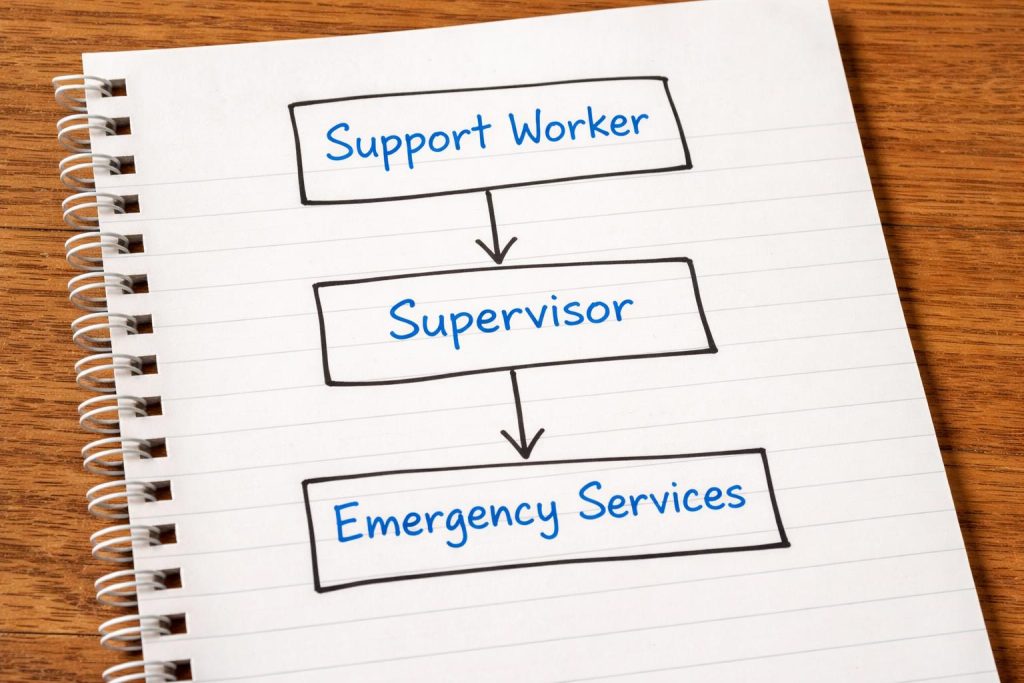
After-hours responder → primary duty manager → secondary manager → senior escalation
with emergency services or specialist pathways activated independently whenever the circumstances require them.
The provider should determine:
-
how many attempts are appropriate;
-
which communication methods are used;
-
how long to wait;
-
who the second contact is;
-
when escalation moves to a senior person; and
-
what the responder can do while waiting.
Timing should be proportionate to urgency.
A routine operational matter may tolerate a reasonable callback period.
A serious participant-safety concern may require immediate movement through the escalation structure.
An emergency requiring 000 should not wait for internal callbacks at all.
After Hours Response can follow a defined escalation tree on the provider’s behalf, reducing the risk that a frontline worker is left repeatedly ringing an unavailable manager without knowing what to do next.
Do Not Make One Manager the Entire After-Hours System
A common model, particularly in growing providers, is:
“The operations manager carries the phone.”
This can work temporarily.
But it creates a significant dependency on one person.
The manager may be:
-
asleep;
-
driving;
-
attending another incident;
-
unwell;
-
on leave;
-
without mobile coverage; or
-
already dealing with several calls.
There is also the cumulative impact of being repeatedly interrupted overnight and then expected to perform a full management role the following day.
The solution is not necessarily removing management from after-hours escalation.
Senior managers will still need to be involved in appropriate situations.
The objective is to make sure not every call needs to start with them.
A structured NDIS after-hours system can provide an operational layer below management.
Routine roster problems can begin being actioned.
Information can be gathered before escalation.
Clinical issues can go to the appropriate pathway.
Non-urgent matters can be documented for the morning.
Serious matters can still reach management promptly.
This is one of the core reasons providers consider After Hours Response: to create a managed operations desk between frontline calls and senior leadership rather than using senior managers as the first-line call centre.
Create a Separate Clinical Escalation Pathway
Clinical concerns require particular attention.
An operations manager is not automatically the right person to answer a medication or health question.
Likewise, a generic call handler should not provide clinical advice outside their qualifications and role.
The provider’s NDIS escalation procedure should therefore distinguish:
Emergency medical issue
from:
Urgent but non-emergency clinical concern
from:
Routine health matter that can be followed up through the appropriate daytime pathway.
The correct response will depend on the participant’s individual health plans, provider procedures and circumstances.
Potential after-hours clinical situations might include:
-
medication concerns;
-
changes in participant health;
-
post-fall concerns;
-
questions relating to high-intensity supports;
-
deterioration in an existing condition;
-
uncertainty about participant-specific health protocols; or
-
other health issues covered by the provider’s clinical governance arrangements.
The procedure should specify:
-
when 000 should be called;
-
what information the worker needs to provide;
-
who provides clinical escalation;
-
when management also needs notification;
-
where clinical advice or actions are documented; and
-
what follow-up is required.
Where included in the service arrangement, After Hours Response can provide access to Registered Nurse escalation, giving workers a defined pathway for applicable clinical concerns.
That RN pathway does not replace emergency services, treating practitioners or the provider’s clinical governance responsibilities.
It provides an additional structured layer within the overall after-hours system.
Decide Who Handles Replacement Workers
Worker absence is one of the most common practical tests of an after-hours procedure.
Imagine an active overnight shift begins at 10:00 pm.
At 9:50 pm, the scheduled worker calls in sick.
Who handles it?
Does the worker phone the service manager?
Does the manager call around for replacements?
Does the roster coordinator have an after-hours role?
Can the after-hours responder access the roster?
Who knows which workers have the necessary competencies?
Who checks fatigue or scheduling implications?
Who communicates with the participant or household?
Who decides what happens if nobody is available?
The NDIS Practice Standards explicitly address continuity of supports. They state that day-to-day operations should be managed to avoid disruption and ensure continuity, and that where a worker is absent or a vacancy occurs, a suitably qualified and/or experienced person should perform the role. Arrangements should also be in place to provide support without interruption throughout the service agreement.
An effective after hours policy for an NDIS provider should therefore connect directly with rostering and workforce-continuity procedures.
It might specify:
-
how the absence is reported;
-
who verifies the affected shift;
-
who can access the approved replacement pool;
-
which competencies need to be checked;
-
who can offer or confirm the shift;
-
when the current worker may need to remain temporarily;
-
when management must be escalated;
-
what happens if coverage cannot be secured; and
-
how the outcome is documented.
After Hours Response can support this process under agreed protocols, helping providers move from “someone called in sick” to an organised response aimed at maintaining continuity of support.
Build Participant-Specific Information Into the Process
An organisation-wide procedure is only one layer.
The after-hours responder may also need participant-specific information.
The NDIS Practice Standards state that participant support plans should anticipate and incorporate responses to individual, provider and community emergencies and disasters, and workers supporting the participant should understand those arrangements.
Depending on the participant and provider, relevant after-hours information could include:
-
important support requirements;
-
communication preferences;
-
emergency arrangements;
-
health-management information;
-
behaviour-support considerations;
-
approved contacts;
-
escalation instructions;
-
known risks;
-
staffing requirements;
-
relevant clinical contacts; and
-
other information necessary for safe continuity of support.
Access must, of course, be appropriately controlled and consistent with privacy and information-management requirements.
The objective is not to give everyone unrestricted access to participant information.
It is to make sure authorised people can access the information they genuinely need when responding after hours.
Decide Who Communicates With Participants and Families
Communication is another area where vague procedures create problems.
Suppose the overnight worker will be two hours late because a replacement is being sourced.
Who tells the participant?
Suppose a participant has been transported to hospital.
Who contacts their nominated person where appropriate?
Suppose severe weather means tomorrow morning’s support may need to change.
Who communicates the change?
If the procedure does not define communication responsibilities, several problems can occur.
Nobody calls.
Three different people call.
The participant receives conflicting information.
A worker shares information they were not authorised to disclose.
Or a family member calls several managers because nobody can provide an update.
The NDIS on call policy should therefore establish:
-
who can communicate routine operational updates;
-
which communications require management involvement;
-
what consent and participant preferences need to be considered;
-
which contacts are authorised;
-
what information can be shared;
-
how communication is documented; and
-
who handles follow-up.
The NDIS Practice Standards’ emergency and disaster management provisions specifically include planning for communication of changes to participant supports to workers, participants and support networks.
After Hours Response can assist with agreed communications within provider protocols, while sensitive or high-level matters can remain with designated management personnel.
Document Every Call and Every Material Action
If an after-hours system relies heavily on telephone conversations, documentation becomes essential.
Consider a single incident:
1:14 am: Worker calls.
1:18 am: After-hours responder gathers information.
1:23 am: RN escalation activated.
1:31 am: Duty manager contacted.
1:42 am: Replacement worker contacted.
2:05 am: Family or nominated contact updated according to protocol.
2:20 am: Situation stabilised.
If those actions exist only across phone logs and individual memories, the day team may have difficulty understanding what happened.
A good documentation system should create a reliable chronology.
Depending on the event, records may include:
-
time of initial contact;
-
caller;
-
participant or service involved;
-
reason for call;
-
immediate risk;
-
actions already taken;
-
advice or instructions provided;
-
emergency-service involvement;
-
clinical escalation;
-
managers contacted;
-
attempts to contact people;
-
staffing actions;
-
communications with relevant stakeholders;
-
outcome;
-
unresolved issues; and
-
required follow-up.
The NDIS Commission states that incidents need to be recorded and that incident records should be stored in a way that maintains privacy and confidentiality. It also expects incident-management procedures to explain how incidents are identified, recorded and reported.
After Hours Response places particular emphasis on documentation because the overnight response should be visible to the people taking responsibility the next day.
Do Not Confuse the Call Log With the Incident Record
This distinction is useful.
The after-hours operations log records the response process.
The provider’s formal incident-management system records the incident according to organisational and regulatory requirements.
Sometimes information will overlap.
But the two are not necessarily identical.
For example, an after-hours log may show:
-
three attempts to contact a manager;
-
calls to two replacement workers;
-
time RN escalation occurred;
-
time a worker arrived;
-
communication with a household; and
-
outstanding morning actions.
The formal incident record may require additional information, review, participant involvement, investigation, corrective actions or assessment of reportable-incident obligations.
The after-hours procedure should specify how information moves from one system into the other.
Otherwise, important details may remain trapped in the after-hours call log.
Connect the Procedure to NDIS Incident Management
The after-hours process cannot operate separately from the provider’s incident-management system.
The NDIS Commission describes an incident as an act, omission, event or circumstance that has or could have caused harm to a person with disability, or a situation where a person with disability has caused serious harm or risk of serious harm to another person. Incidents connected with NDIS supports and services need to be identified, assessed, recorded, managed and resolved.
Workers therefore need clear instructions about:
-
what should be treated as an incident;
-
what requires immediate escalation;
-
who receives the internal report;
-
who assesses whether external notification is required;
-
where the formal incident record is created; and
-
what happens after the immediate response.
Frontline workers should not have to become regulatory specialists at 2:00 am.
A sensible structure is for them to identify and escalate incidents according to clear internal thresholds.
Appropriate designated personnel can then assess any regulatory notification requirements.
The key is making sure serious matters reach those people promptly.
Integrate the After-Hours Procedure With Business Continuity
Worker absence is not the only interruption an after-hours procedure should anticipate.
Other possibilities include:
-
power outages;
-
severe weather;
-
telephone failure;
-
IT outages;
-
inaccessible properties;
-
vehicle breakdowns;
-
emergency-service activity;
-
major property damage;
-
multiple simultaneous incidents; and
-
unavailable managers.
Current NDIS Practice Standards require emergency and disaster management arrangements that support continuity of critical supports before, during and after emergencies or disasters. They also require planning for changes to participant supports, rapid responses to interruptions, communication and active testing of emergency and disaster plans.
The Commission’s emergency-management guidance describes business continuity through prevention, preparedness, response and recovery.
The after-hours procedure should therefore be one of the mechanisms through which the provider’s wider continuity arrangements actually operate.
A business continuity plan saying “contact management” is not enough if management cannot be reached overnight.
Build a Simple Escalation Matrix
A practical matrix can make a lengthy NDIS escalation procedure much easier for workers to use.
For example:
| Situation | First action | After-hours pathway | Further escalation |
|---|---|---|---|
| Immediate threat to life or safety | Emergency response/000 | Notify after-hours service | Senior management as required |
| Serious participant injury | Emergency response where required | Incident escalation | Manager/key personnel |
| Urgent clinical concern | Emergency response if required | Clinical escalation pathway | Manager according to protocol |
| Medication concern | Follow participant/clinical procedure | RN/clinical pathway where applicable | Management as required |
| Suspected abuse or neglect | Protect immediate safety | Urgent incident escalation | Designated senior personnel |
| Worker no-show | Assess participant continuity risk | Staffing pathway | Manager if unresolved/high risk |
| Worker calls in sick | Identify affected service | Replacement-worker process | Manager if coverage unavailable |
| Major property issue | Protect safety | Operational response | Manager/emergency pathway |
| Routine enquiry | Record details | No urgent escalation | Business-hours follow-up |
| Non-urgent administrative matter | Record | No immediate action | Day-team handover |
This is illustrative only.
The actual matrix needs to reflect the provider’s services, participant risks, organisational roles and policies.
Its purpose is simplicity.
A worker should be able to look at it and quickly understand where the issue goes.
Create a Morning Handover Process
An after-hours response does not finish when the phone stops ringing.
At some point, the day team resumes responsibility.
The handover between those two periods needs to be deliberate.
A useful morning handover should answer:
What happened overnight?
Which participants or services were affected?
What actions were taken?
Who was contacted?
Were emergency or clinical pathways activated?
Were roster changes made?
Is the situation resolved?
What temporary arrangements are in place?
What remains outstanding?
Who needs to follow up today?
This is one of the areas where After Hours Response can help create continuity between the night and day teams.
Rather than managers arriving to a collection of missed calls and fragmented messages, the provider can receive structured information about overnight activity and outstanding actions.
Separate “Resolved” From “Safe Until Morning”
This is an important distinction.
Suppose a burst water pipe occurs overnight.
The emergency plumber stops the leak.
The issue is safe, but the permanent repair may not be complete.
A worker no-show occurs.
A replacement worker covers until 8:00 am.
The immediate roster gap is resolved, but the workforce team may still need to investigate the absence and cover subsequent shifts.
A participant attends hospital.
The immediate emergency has been managed, but the provider may need to coordinate discharge or subsequent supports.
The morning handover should therefore categorise matters as:
Resolved
Temporarily stabilised
Outstanding
Requires urgent daytime follow-up
This prevents temporary overnight solutions from being mistaken for completed actions.
Test the Procedure Under Realistic Conditions
The NDIS Practice Standards require emergency and disaster management plans to have mechanisms for active testing and adjustment, and workers need to be trained in implementing those plans.
Providers can apply the same operational mindset to their broader after-hours arrangements.
Do not test the procedure only by asking managers:
“Does everyone understand the policy?”
Run scenarios.
For example:
Scenario A: Worker no-show
It is 10:05 pm.
The incoming active-night worker has not arrived.
The outgoing worker needs to leave.
What happens?
Scenario B: Clinical concern
It is 1:30 am.
A support worker reports a medication concern.
Who answers?
Who decides which pathway applies?
Scenario C: Manager unavailable
A serious incident occurs at midnight.
The primary manager does not answer.
What happens next?
Scenario D: Two calls simultaneously
One service reports a worker absence while another reports an injured participant.
Can the system triage both?
Scenario E: IT failure
The roster platform is unavailable.
Can the after-hours responder still access the information needed to maintain essential supports?
Scenario F: Morning handover
Several issues occurred overnight.
Can the 8:30 am team determine in five minutes what happened and what needs action?
These tests reveal operational gaps quickly.
Test the People, Not Just the Document
A procedure can be technically correct and still fail because people do not know how to use it.
Ask frontline workers:
What number do you call after hours?
What constitutes an immediate escalation?
When should you call 000?
What happens if nobody answers the on-call number?
Where do you document an incident?
Who handles a medication concern?
What happens when your replacement does not arrive?
Ask managers:
Which issues should reach you overnight?
Which should be resolved without you?
Who is your backup?
What decisions can the after-hours responder make?
How quickly are you expected to respond?
If the answers vary significantly, the system may need clarification.
Use After-Hours Data to Improve the Procedure
Once an after-hours system is operating, providers can learn from actual calls.
Useful questions include:
-
How many calls occur each week or month?
-
Which services generate the most calls?
-
What percentage involve staffing?
-
How many are incidents?
-
How many involve clinical concerns?
-
How many require management escalation?
-
How many could safely wait until business hours?
-
How often does the primary manager fail to answer?
-
How long does replacement staffing take?
-
Which situations repeatedly cause confusion?
-
Are certain workers calling disproportionately often?
-
Are recurring issues revealing a training or process problem?
This turns after-hours support into a source of operational insight.
For example, repeated medication questions may suggest the need for stronger worker training or participant-specific guidance.
Frequent overnight roster gaps may indicate a broader workforce issue.
High volumes of routine calls to senior management may mean delegated authority is too narrow.
Repeated confusion about the same incident type may indicate that the NDIS on call policy is unclear.
The NDIS Practice Standards also emphasise learning from incident management through regular review of policies, causes, handling and outcomes, together with participant and worker feedback.
Common Reasons NDIS After-Hours Procedures Fail
The policy is too vague
“Contact management where necessary” does not tell a worker what to do.
Nobody has clear authority
Every decision still requires a director.
There is only one escalation contact
The system fails when that person is unavailable.
Emergency and internal escalation are confused
Workers should understand when emergency assistance comes first.
Clinical and operational issues use the same pathway
Different problems require different expertise.
Replacement staffing is not operationalised
Knowing that a replacement is needed is not the same as having a process for finding one.
Participant communication is undefined
Nobody knows who should provide updates.
Calls are logged but actions are not
The organisation knows someone called but cannot see what happened next.
There is no structured morning handover
The day team has to reconstruct events.
Nobody tests the procedure
Weaknesses are discovered during real incidents.
The system depends on organisational memory
Experienced managers know what to do, but newer workers do not.
The procedure does not reflect actual services
A generic policy has been adopted without considering the provider’s participants, operating hours and risks.
A Practical Checklist for Reviewing Your NDIS On-Call Policy
When reviewing your current arrangements, ask whether the procedure clearly answers the following:
Entry point
Is there one clearly understood after-hours contact pathway?
Coverage
Who answers evenings, overnight, weekends and public holidays?
Authority
What can the responder do without further approval?
Emergencies
Do workers understand when 000 should be contacted without delay?
Incident escalation
Which incidents require immediate internal escalation?
Clinical concerns
Is there a clearly defined clinical pathway?
Staffing
Who handles sick calls and worker no-shows?
Replacement workers
Who can contact and confirm replacement staff?
Management
Which matters genuinely need senior management involvement?
Backup
What happens if the primary manager does not answer?
Participant communication
Who can provide operational updates to participants and appropriate contacts?
Information access
Can authorised responders access what they need to manage the situation?
Documentation
Where are calls, actions and outcomes recorded?
Incident management
How does the after-hours record connect with the formal incident-management system?
Business continuity
What happens if normal systems, workers or managers are unavailable?
Handover
What information reaches the day team?
Follow-up
Who owns unresolved actions?
Testing
When was the procedure last tested under realistic after-hours conditions?
If several answers are unclear, the provider may have an on-call policy without having a complete on-call operating system.
What a Mature NDIS After-Hours System Looks Like
A mature after-hours system does not mean managers never receive overnight calls.
Nor does it mean every problem is outsourced.
It means each issue reaches the appropriate level.
A routine administrative question can wait.
A roster gap can enter a staffing process.
A clinical concern can enter the clinical pathway.
A serious incident can reach the appropriate manager.
An emergency can receive emergency assistance immediately.
A participant or family communication can be handled by the person authorised to provide it.
Every meaningful action can be documented.
And the next morning, the day team knows what happened.
That is a fundamentally different model from one mobile phone being passed between managers every week.
How After Hours Response Can Help Turn Policy Into Practice
A provider’s policies, governance arrangements and regulatory responsibilities remain its own.
The purpose of After Hours Response is not to replace them.
It is to help make them operational when the normal office is closed.
After Hours Response works specifically with NDIS providers that need a structured way to manage after-hours activity.
Depending on the provider’s agreed arrangements, this can include:
-
after-hours call handling;
-
incident and emergency escalation;
-
worker sick calls;
-
roster and shift issues;
-
operational problem-solving;
-
RN clinical escalation;
-
participant and family contacts;
-
enquiry and referral capture;
-
documentation; and
-
morning handover.
Before an effective service begins, the important work is defining the protocols.
What should the team action?
What needs escalation?
Who gets called?
What happens if they do not answer?
What information can be accessed?
What authority does the team have?
What should be handed over in the morning?
Those decisions turn a policy into a workflow.
Once those workflows are established, frontline workers no longer need to decide from scratch whom to wake up whenever something unexpected happens.
Managers can remain available for the matters that genuinely require their involvement.
Clinical concerns can follow the appropriate clinical pathway.
Operational problems can begin being resolved.
Routine matters can be recorded for business hours.
And overnight actions can be documented for the day team.
That is the difference between having an NDIS after hours procedure and having an after-hours operation.
Your Procedure Should Work for the Worker Who Calls at 2am
There is a simple way to judge an NDIS on call policy.
Do not judge it by how comprehensive the document looks.
Judge it by what happens when a worker actually needs it.
At 2:00 am, that worker should be able to answer four questions quickly:
Who do I contact?
What do I need to tell them?
What happens next?
What do I do if the normal pathway fails?
Behind those four questions should sit a much stronger organisational system.
Someone answers.
That person knows their authority.
Emergency thresholds are clear.
Clinical concerns have a clinical pathway.
Staffing problems have an operational pathway.
Serious incidents have an escalation pathway.
Managers have backups.
Actions are documented.
Participants and relevant contacts receive appropriate communication.
The day team receives a handover.
And the provider regularly tests whether the system still works.
Current NDIS Practice Standards reinforce the importance of this broader operational thinking: incident management must be maintained and understood by workers, continuity arrangements should protect participants from interruptions, workforce disruptions need planning, and emergency and disaster arrangements need to be communicated, tested and reviewed.
An after-hours procedure should therefore be much more than a phone number at the bottom of a policy.
It should be a functioning part of the provider’s operational and risk-management system.
Strengthen Your NDIS After-Hours Procedure With After Hours Response
If your current NDIS after hours procedure still relies heavily on “call the manager”, it may be worth testing what would actually happen if that manager did not answer tonight.
Likewise, if your management team is routinely being woken for roster changes, non-urgent calls and issues that could be handled through an agreed protocol, there may be an opportunity to create a more structured system.
After Hours Response helps NDIS providers turn their existing policies and escalation requirements into practical after-hours workflows.
We can help establish clear pathways around incidents, staffing problems, operational issues, clinical escalation, management escalation, participant and family contacts, documentation and morning handover.
The aim is not simply to put another person on the end of the phone.
It is to build an after-hours function where calls can be appropriately actioned — not just answered.
That means your frontline workers have a clear pathway when something happens at 2:00 am, your managers are escalated when their involvement is genuinely required, and your day team starts the morning knowing what happened overnight.
Contact After Hours Response to discuss your current on-call arrangements, identify gaps in your after-hours procedures and explore how a managed after-hours operations desk can support your participants, workers and management team.