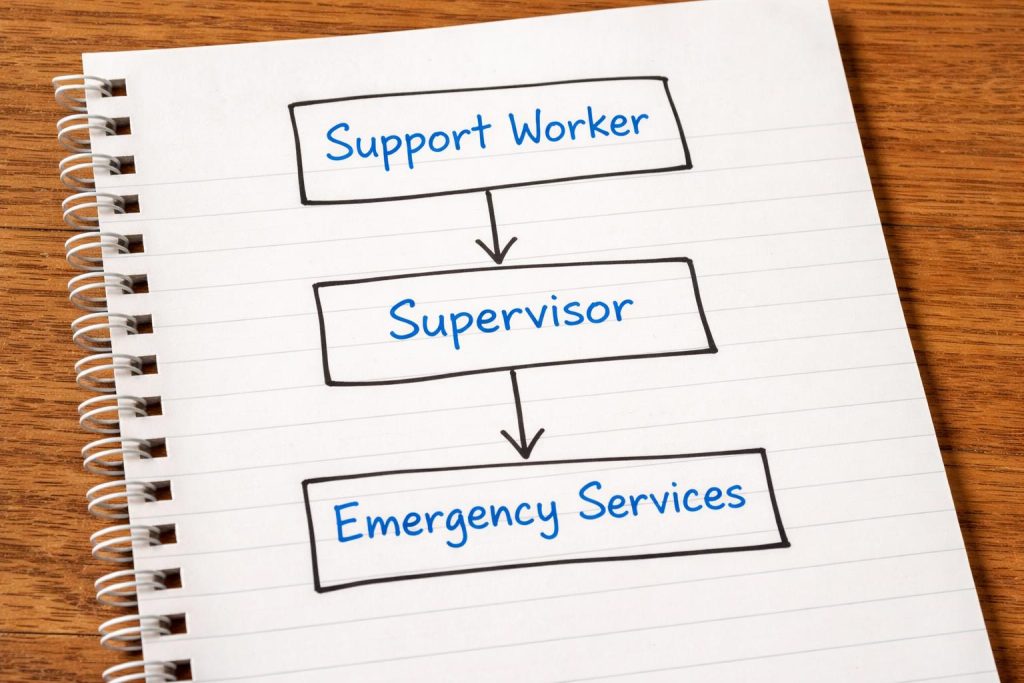
Most NDIS providers have thought about business continuity.
There may be an NDIS business continuity plan stored in the organisation’s policy system. There may be emergency contacts, evacuation procedures, workforce contingency arrangements, disaster-response protocols and participant-specific risk information.
But there is a practical question that deserves much more attention:
Does your business continuity plan still work at 2:00 am?
It is one thing to have a plan that can be activated at 10:00 am on a Tuesday when the operations manager, service manager, rostering team, HR team and senior leadership are available.
It is another situation entirely when severe weather hits at midnight, two workers call in sick, the rostering system cannot be accessed and the manager who normally coordinates emergencies is asleep or unavailable.
For NDIS providers delivering supports outside ordinary business hours, continuity planning cannot stop when the office closes.
The NDIS Practice Standards place clear emphasis on continuity of supports. Registered providers operating under the relevant standards are expected to have arrangements to help ensure participants receive appropriate supports without interruption, including when worker absence or vacancies occur. Emergency and disaster management requirements also focus on maintaining supports that are critical to participants’ health, safety and wellbeing before, during and after an emergency or disaster.
The standards specifically contemplate preparing for emergencies, making changes to participant supports, responding rapidly to interruptions and communicating those changes to participants, workers and support networks.
They also require emergency and disaster management plans to be tested, reviewed and communicated, with workers trained in their implementation.
That creates an important operational question for every provider:
Who actually activates those arrangements after hours?
This is where After Hours Response can help.
After Hours Response works with NDIS providers that need more than somebody answering a phone when the office is closed. A structured after-hours function can help triage incidents, respond to roster disruptions, activate agreed escalation pathways, coordinate operational actions, access Registered Nurse escalation where applicable, document what occurred and provide the day team with a clear handover.
Because real business continuity is not simply about having a plan.
It is about making sure the plan can actually be activated when normal operations fail.
What Is an NDIS Business Continuity Plan?
An NDIS business continuity plan establishes how an organisation intends to continue critical operations when normal service delivery is disrupted.
Depending on the provider and the supports it delivers, disruptions might include:
-
severe weather;
-
bushfires;
-
floods;
-
power outages;
-
telecommunications failures;
-
IT or rostering-system outages;
-
cyber incidents;
-
workforce shortages;
-
illness outbreaks;
-
transport disruption;
-
inaccessible accommodation;
-
building damage;
-
supplier failures;
-
unavailable managers;
-
simultaneous incidents across several services; or
-
another event that prevents normal operations from continuing.
Business continuity is closely connected with emergency and disaster management, but the concepts are not identical.
An emergency plan may explain how the organisation responds to an immediate event.
Business continuity asks another question:
How does the organisation continue delivering the services people depend on while the disruption is happening and as operations recover?
For an NDIS provider, that distinction matters.
A storm might last 30 minutes.
Its consequences might affect services for two days.
A power outage might not itself constitute a participant emergency, but it could become one if a participant depends on electrically powered equipment.
A worker calling in sick is an everyday workforce problem. But three overnight workers becoming unavailable simultaneously could create a serious continuity-of-support issue.
A business continuity plan therefore needs to consider not only the triggering event but also its impact on participants and the provider’s ability to continue delivering essential supports.
NDIS Continuity of Supports Is About More Than Disasters
When people hear “business continuity”, they often imagine major disasters.
Bushfires.
Floods.
Cyclones.
Pandemics.
Major IT outages.
Those situations certainly matter, but NDIS continuity of supports is also relevant to smaller operational disruptions.
The NDIS Practice Standards state that day-to-day operations should be managed efficiently and effectively to avoid disruption and ensure continuity of supports. They also address worker absence or vacancy and require arrangements to help ensure supports are provided without interruption throughout the service agreement, with alternative arrangements where unavoidable changes or interruptions occur.
The emergency and disaster management requirements go further by addressing supports critical to participant health, safety and wellbeing before, during and after an emergency or disaster.
This means continuity planning needs to work at two levels:
Large-scale events that affect multiple participants, workers or locations.
And:
Everyday operational failures that could interrupt an individual participant’s essential support.
After Hours Response is particularly relevant to that second layer because many continuity failures begin with what initially appears to be an ordinary after-hours call.
A worker is sick.
A vehicle breaks down.
A participant cannot enter their home.
A property loses power.
A support worker cannot access the rostering platform.
A manager does not answer.
Each event may appear manageable in isolation.
But without a clear after-hours response pathway, a minor disruption can develop into a much more serious problem.
The 6 pm–6 am Business Continuity Gap
Many providers have strong daytime operational structures.
During business hours, a frontline worker experiencing a problem might contact:
-
their team leader;
-
a service manager;
-
rostering;
-
HR;
-
administration;
-
quality and compliance;
-
a clinical lead;
-
an operations manager; or
-
an executive.
There are multiple people available to make decisions and coordinate resources.
At night, that structure may collapse into one phone number.
Sometimes that number belongs to a manager carrying the on-call phone.
Sometimes calls are redirected to a generic answering service.
Sometimes workers are expected to call whichever manager they believe is appropriate.
The organisation technically has a continuity plan, but the operational capacity to activate it is dramatically reduced.
That creates the after-hours continuity gap.
A strong NDIS emergency management plan should therefore answer not only:
What should we do?
It should also answer:
Who will actually do it when the normal office is closed?
Scenario 1: Severe Weather Develops Overnight
Consider a provider supporting participants across several residential locations.
At 11:30 pm, severe weather intensifies.
Roads begin flooding.
Workers finishing their shifts are concerned they may not be able to leave safely. Workers scheduled for overnight or early-morning shifts may not be able to reach participants.
One property loses power.
Another worker reports water entering a building.
A participant’s family calls asking whether tomorrow morning’s support will still proceed.
This is no longer a single phone call.
It is an operational event requiring coordination.
The provider’s NDIS emergency management plan might already explain what should happen during severe weather.
But somebody still needs to:
-
receive information from multiple locations;
-
determine which participants may be affected;
-
identify immediate safety concerns;
-
activate emergency pathways where required;
-
check staffing implications;
-
contact workers;
-
communicate approved changes;
-
escalate serious issues;
-
record actions;
-
prioritise competing problems; and
-
maintain a chronology for the day team.
This is where an organised NDIS after hours support function can become part of business continuity.
After Hours Response can operate according to predetermined provider protocols so that information is centralised rather than fragmented across individual managers’ phones.
The aim is not to replace emergency services, provider management or emergency-management responsibilities.
It is to provide an operational point from which the provider’s agreed after-hours processes can be activated and coordinated.
Scenario 2: A Power Outage Affects Participant Supports
Power failures demonstrate why business continuity needs to be participant-specific.
For one participant, losing power may primarily mean inconvenience.
For another, electricity may be important to equipment, environmental controls, communication technology or other supports connected with their health and wellbeing.
The NDIS Practice Standards require participant support plans to anticipate and incorporate responses to individual, provider and community emergencies and disasters, with workers understanding those arrangements.
An effective NDIS business continuity plan should therefore connect organisational procedures with participant-specific risk information.
When a power outage is reported after hours, the responder may need to establish:
-
which location is affected;
-
which participants are present;
-
whether anyone faces an immediate health or safety risk;
-
whether emergency services are required;
-
whether participant-specific emergency arrangements need activation;
-
whether backup power or equipment is available;
-
whether relocation needs to be considered;
-
who has authority to approve alternative arrangements;
-
which stakeholders need communication; and
-
how the event will be documented.
The answer cannot simply be:
“Wait until the electricity comes back.”
Nor should frontline workers be expected to invent a continuity plan during the outage.
After Hours Response can help providers put practical escalation pathways around these events so that workers know whom to contact and the after-hours responder knows which agreed actions and escalation points apply.
Scenario 3: Phone Systems or IT Fail Overnight
Modern disability services depend heavily on technology.
Rosters may be digital.
Participant information may be stored electronically.
Contact lists may sit inside cloud platforms.
Incident forms may be online.
Shift notes may be entered through an app.
Internal communication may depend on Microsoft Teams, email, messaging platforms or VoIP phone systems.
Now imagine that the main system fails at 10:00 pm.
Can workers still determine where they are meant to be?
Can the on-call person access participant information?
Can the provider locate emergency contact details?
Can replacement workers be contacted?
Can incidents still be recorded?
Can managers communicate with services?
A robust emergency plan for an NDIS provider should account for the possibility that the system normally used to manage the emergency is itself unavailable.
That may require secure and appropriately controlled fallback arrangements, such as:
-
alternative communication channels;
-
current emergency contact lists;
-
predefined system-outage procedures;
-
backup access to critical operational information;
-
manual documentation processes;
-
clear authority structures; and
-
procedures for entering relevant records into normal systems once restored.
Information-management, privacy and security requirements still apply during disruptions. Business continuity should not become an excuse for uncontrolled access to participant information.
The goal is resilience: ensuring essential operations do not depend on one system working perfectly at all times.
Scenario 4: The Manager Who Normally Handles Emergencies Is Unavailable
One of the simplest tests of any business continuity plan is this:
What happens if the person who wrote the plan cannot be reached?
Many smaller and growing NDIS providers become highly dependent on particular people.
One operations manager knows every participant.
One rostering coordinator knows which workers can cover each service.
One director approves emergency expenditure.
One clinical manager knows which health concerns need escalation.
During ordinary operations, this may feel efficient.
During an after-hours disruption, it creates a single point of failure.
Imagine the duty manager does not answer at 1:00 am.
Does the worker know whom to call next?
How long should they wait?
Who is the secondary contact?
What decisions can somebody else make?
Can replacement staff be organised?
Can emergency accommodation or transport be approved?
Can an urgent contractor be contacted?
Who can authorise changes to service delivery?
A genuine NDIS business continuity plan needs redundancy in decision-making.
That means establishing:
-
primary contacts;
-
secondary contacts;
-
escalation timeframes;
-
delegated authority;
-
decision thresholds;
-
emergency exceptions; and
-
clear rules about when senior management must become involved.
After Hours Response can help operationalise this structure.
Instead of relying on workers to repeatedly ring an unavailable manager, the after-hours team can follow a defined escalation tree, take permitted actions under agreed protocols and move issues to the next appropriate level when necessary.
Scenario 5: Sudden Workforce Shortages
Workforce disruption is one of the most important continuity risks for disability providers.
The NDIS Practice Standards specifically require planning to identify, source and induct a workforce when workforce disruptions occur in an emergency or disaster.
They also state that, in the event of worker absence or vacancy, a suitably qualified and/or experienced person should perform the role.
Now consider what that means operationally at 11:00 pm.
A worker scheduled for an active overnight shift calls in sick.
At 11:10 pm, another worker reports they cannot attend their early-morning shift because flooding has blocked the road.
At 11:25 pm, a third service reports a worker has had to leave unexpectedly because of a family emergency.
Three staffing problems have appeared within 25 minutes.
The issue is no longer simply finding “someone available”.
The provider needs to consider:
-
which participants require uninterrupted support;
-
which shifts carry the highest immediate risk;
-
what competencies workers require;
-
whether participants have preferences or support requirements relevant to replacement staffing;
-
who is actually available;
-
travel time;
-
worker fatigue;
-
whether existing staff can safely remain;
-
what alternative arrangements exist;
-
who has authority to approve them; and
-
when management escalation is required.
This is exactly where an NDIS after hours support function needs to be action-oriented.
After Hours Response can work within a provider’s approved protocols to help manage sick calls and roster disruptions, contact appropriate workers where agreed, document attempts to secure coverage and escalate when continuity cannot be maintained through the normal pathway.
A message-taking service might tell management at midnight:
“Worker has called in sick.”
A managed operational response asks:
“What needs to happen now to protect continuity of support?”
That distinction matters.
Prioritise Participants by Consequence of Service Failure
Business continuity should not assume that every disrupted shift has the same impact.
When resources are limited, providers need a predetermined way to identify which supports are most critical.
Relevant considerations may include:
-
whether the participant can safely remain without support;
-
health and medical needs;
-
personal care requirements;
-
communication needs;
-
behavioural support requirements;
-
mobility;
-
overnight supervision requirements;
-
medication support;
-
risks associated with being alone;
-
informal supports available;
-
environmental risks; and
-
participant-specific emergency arrangements.
This does not mean making arbitrary decisions about who “deserves” support.
It means understanding the consequence of interruption before the interruption occurs.
Continuity planning should therefore be connected to individual support planning and risk assessment.
If the provider waits until three workers call in sick during a storm to determine which services are critical, the continuity planning has started too late.
Scenario 6: Accommodation Becomes Inaccessible
Consider a participant returning home after an evening activity.
A burst water pipe has significantly damaged the property.
Or a fire has made the residence unsafe.
Or emergency services have restricted access to the street.
Or a security incident means the participant cannot safely return.
The immediate emergency response may be clear.
The continuity question is harder:
Where does the participant receive support now?
Depending on the circumstances and the provider’s responsibilities, relevant questions may include:
-
Is the participant currently safe?
-
Are emergency services involved?
-
Is temporary relocation necessary?
-
What participant-specific needs must be considered?
-
Are medications or essential equipment accessible?
-
Who needs to be contacted?
-
What alternative accommodation arrangements exist?
-
Who has authority to activate them?
-
Does another provider or service need involvement?
-
How will workers be redirected?
-
How will transport be organised?
-
What information needs to follow the participant?
-
Who coordinates the situation overnight?
For providers involved in residential supports, these scenarios should not be left to improvised decision-making.
The NDIS Practice Standards require emergency planning to consider changes to participant supports and the need to adapt and respond rapidly to interruptions.
After Hours Response can provide the operational coordination layer between the frontline worker and the provider’s designated escalation contacts, following the organisation’s established protocols rather than expecting one worker to manage every phone call alone.
Scenario 7: Transport Fails
Transport disruption can also affect NDIS continuity of supports.
Examples include:
-
a provider vehicle breaking down;
-
a worker being unable to reach a participant;
-
severe weather closing roads;
-
a participant being stranded after an activity;
-
public transport disruption;
-
an accessible vehicle becoming unavailable; or
-
an emergency relocation requiring transport.
The appropriate response depends on the participant, service and circumstances.
But the continuity plan should establish:
-
available alternatives;
-
authorised transport providers;
-
accessibility requirements;
-
approval thresholds;
-
emergency contacts;
-
escalation points; and
-
communication procedures.
A transport failure at 2:00 pm may be handled by several office-based teams.
The same problem at 2:00 am may depend entirely on the on-call system.
That is why after-hours operational capacity should be tested as part of business continuity, not treated as a separate issue.
Scenario 8: Several Incidents Happen at Once
One of the most useful business-continuity exercises is to stop testing incidents individually.
Real disruptions often create clusters of problems.
Imagine a severe storm at 1:00 am.
At 1:05 am, one property loses electricity.
At 1:12 am, a worker calls to say flooding prevents them reaching their next shift.
At 1:17 am, another service reports water entering a residence.
At 1:25 am, a participant’s family calls asking for an update.
At 1:31 am, a support worker at another location reports a participant has fallen.
At 1:38 am, the duty manager still has not answered.
Can the provider’s system manage all of those events simultaneously?
This is where continuity planning becomes a capacity question.
The organisation needs to know:
-
who triages incoming calls;
-
which situation receives priority;
-
who maintains the event log;
-
which issues require emergency services;
-
which need clinical escalation;
-
which can be handled operationally;
-
which require senior management;
-
who communicates with affected services; and
-
how information is consolidated.
A system designed around one manager carrying one phone may become overwhelmed quickly.
After Hours Response can provide a centralised after-hours operations function capable of receiving, triaging and documenting multiple contacts while following predetermined escalation pathways.
That does not remove the provider’s management responsibilities.
It helps protect the provider’s ability to exercise those responsibilities when several things are happening at once.
Your NDIS Business Continuity Plan Needs an Activation Trigger
A common weakness in continuity planning is that organisations describe what they will do during a disruption but not when the continuity plan is formally activated.
Not every worker absence requires business-continuity activation.
Not every power outage becomes a major incident.
Providers can therefore benefit from defining activation thresholds.
For example, escalation could increase when:
-
essential participant supports cannot be filled;
-
multiple services are affected;
-
a critical system becomes unavailable;
-
normal escalation contacts cannot be reached;
-
an event is expected to continue for an extended period;
-
participant relocation becomes necessary;
-
emergency services are involved across one or more locations;
-
staffing capacity drops below a predetermined level; or
-
the disruption exceeds the authority of the normal after-hours responder.
The exact thresholds should reflect the provider’s size, services, participants and risk profile.
The important point is that somebody after hours needs to recognise when an ordinary operational problem has become a broader continuity event.
Define Who Is in Charge Overnight
Every NDIS emergency management plan should make the after-hours command structure clear.
Workers should not have to guess whether they need to call the CEO, operations manager, clinical lead or rostering coordinator.
The structure might include different levels such as:
Frontline worker
Identifies the problem, protects immediate participant safety and contacts the designated after-hours pathway.
After-hours operations responder
Receives information, triages the issue, follows approved protocols, initiates authorised actions and documents the response.
Clinical escalation
Provides the designated clinical pathway for applicable health concerns.
Duty or senior manager
Makes decisions outside the after-hours responder’s delegated authority.
Executive/emergency management lead
Coordinates significant organisation-wide events where required.
Emergency services
Respond to immediate threats to life, health or safety where appropriate.
This structure should also include backups.
A continuity plan that depends on one person answering their phone is inherently fragile.
Delegated Authority Matters During a Disruption
Having somebody answer the phone is not enough if that person has no authority to act.
Consider a worker shortage.
The responder finds an appropriate replacement worker.
Can they confirm the shift?
Or must they wake a manager for approval?
Consider an urgent property problem.
Can they contact an approved contractor?
Consider a transport disruption.
Can they authorise a predetermined alternative?
Consider a clinical concern.
Do they know how to activate the designated RN escalation pathway?
Providers should decide in advance which actions can be taken under agreed parameters and which require management approval.
This is one of the areas After Hours Response can work through with providers when establishing after-hours protocols.
The aim is not to give an external team unlimited authority.
It is to clearly define:
What can be actioned immediately?
What requires escalation?
Who provides approval?
What happens when the approver cannot be reached?
These decisions are far easier to make at 2:00 pm during planning than at 2:00 am during an emergency.
Build Communication Failure Into the Plan
A continuity plan should assume that normal communication channels may fail.
Ask:
What happens if the office phone system is unavailable?
What happens if internet access fails?
What happens if staff cannot access the rostering platform?
What happens if email is unavailable?
What happens if the manager’s phone battery is flat?
What happens if mobile coverage is affected by the emergency?
What happens if workers cannot access participant information through the usual system?
Alternative arrangements should be secure, practical and understood by the relevant workers.
The NDIS Commission’s emergency-management guidance emphasises communication during emergencies, including understanding relevant emergency alerts and how changes to supports will be communicated.
Communication resilience therefore deserves its own section in the NDIS business continuity plan rather than being treated as an assumption.
Keep Participant Communication at the Centre
Business continuity is not only an internal operational exercise.
Participants and, where appropriate, their support networks need to understand changes that affect their supports.
The NDIS Practice Standards explicitly address communicating changes to participant supports during emergencies and disasters.
Communication should be appropriate to the participant’s needs.
Depending on the circumstances, that may include explaining:
-
what has happened;
-
whether their support will change;
-
who will support them;
-
whether the timing will change;
-
what alternative arrangements are being made;
-
what they should do next; and
-
who they can contact.
The goal should be to reduce uncertainty while respecting privacy, choice and control.
After Hours Response can assist with communications that fall within a provider’s agreed after-hours protocols, while matters requiring specific management authority remain escalated appropriately.
Documentation Becomes More Important When Normal Operations Fail
Disruptions create information quickly.
Calls.
Texts.
Roster changes.
Emergency-service attendance.
Worker replacements.
Clinical escalation.
Participant movements.
Property issues.
Management instructions.
Temporary arrangements.
If this information remains scattered across personal phones and individual memories, the organisation may struggle to reconstruct what occurred.
Every continuity response therefore needs a reliable documentation process.
An after-hours event log might record:
-
time the issue was reported;
-
caller;
-
participant or service affected;
-
nature of disruption;
-
immediate risk;
-
actions taken;
-
emergency services contacted;
-
workers contacted;
-
staffing changes;
-
managers notified;
-
clinical escalation;
-
participant/support-network communications;
-
decisions made;
-
unresolved matters; and
-
required daytime follow-up.
After Hours Response places strong emphasis on documentation because continuity is not achieved simply by getting through the night.
The morning team needs to know exactly what happened.
Morning Handover Is Part of Business Continuity
At 8:30 am, the normal office may reopen.
But the continuity event may not be over.
The night team may have secured temporary staffing.
The workforce team still needs to resolve tomorrow’s roster.
A property may have been made temporarily safe.
Facilities staff still need to organise permanent repairs.
A participant may have been transported to hospital.
The service team needs to coordinate subsequent support.
An IT outage may have required manual records.
Those records now need reconciliation.
A participant may have been temporarily relocated.
Management needs to determine what happens next.
The handover should therefore clearly separate:
Resolved overnight
from:
Temporary workaround in place
and:
Outstanding action required
This helps prevent a common continuity failure: the overnight problem appears “solved”, but the temporary arrangement expires several hours later and nobody has taken ownership.
Test Your NDIS Business Continuity Plan at Night
The NDIS Practice Standards require mechanisms for emergency and disaster plans to be actively tested and adjusted.
For providers delivering supports around the clock, testing should include the conditions under which the plan may actually be needed.
Do not only run an exercise with every manager sitting around a meeting table.
Test scenarios such as:
11:45 pm: Two workers call in sick.
12:20 am: The rostering platform becomes unavailable.
1:10 am: A participant residence loses power.
1:25 am: The primary duty manager does not answer.
2:00 am: A second participant experiences an unrelated incident.
Now ask:
Who answers?
What happens first?
Who has authority?
Where is participant information located?
How is the workforce contacted?
What happens when the main system is unavailable?
Who decides which support is prioritised?
Who maintains the event log?
Who communicates with participants?
What happens if clinical escalation is required?
What information reaches the day team?
This kind of exercise exposes practical weaknesses that a written policy review may never identify.
Ten Questions to Ask About Your After-Hours Continuity Arrangements
Providers reviewing their NDIS business continuity plan should consider ten practical questions.
1. Who receives the first call after hours?
There should be a clear and reliable entry point.
2. What happens if that person cannot be reached?
Every critical role needs an alternative.
3. Which participant supports cannot safely be interrupted?
Criticality should be understood before a disruption occurs.
4. Who can organise replacement workers?
Responsibility without authority creates delays.
5. What happens if your rostering or IT system fails?
Critical processes need secure fallback arrangements.
6. How are urgent clinical concerns escalated?
The clinical pathway should be separate from ordinary operational escalation.
7. Who coordinates several simultaneous incidents?
A major disruption can overwhelm a single informal on-call arrangement.
8. How are participants and support networks informed?
Communication is part of continuity planning.
9. Where are overnight decisions documented?
The organisation needs a reliable chronology.
10. What does the morning team receive?
Continuity continues beyond the end of the night shift.
If these questions cannot be answered quickly, there may be a gap between the organisation’s written continuity plan and its actual after-hours capability.
Common Weaknesses in NDIS After-Hours Business Continuity
A plan that only works during office hours
If activating the plan requires the operations manager, HR manager, roster coordinator and service manager to all be immediately available, it may not be an effective overnight plan.
Too much dependence on one manager
A key person can become a single point of failure.
No delegated authority
The on-call person receives problems but cannot resolve them.
No prioritisation framework
When multiple services are affected, nobody knows which problem should be addressed first.
Participant information is inaccessible
Critical information should remain appropriately accessible to authorised people during disruptions.
Clinical and operational escalation are mixed together
A roster problem and an urgent health concern require different pathways.
Technology is assumed to work
The continuity system needs to survive failure of normal systems.
No backup communications
Internet and telephone outages should be considered.
Poor documentation
Important decisions disappear into calls and text messages.
No structured morning handover
Temporary overnight fixes become unresolved daytime risks.
Business Continuity Should Be Proportionate to Your Organisation
Not every NDIS provider needs the same after-hours structure.
A provider delivering limited weekday supports will have a different risk profile from an organisation operating Supported Independent Living services around the clock.
The NDIS Practice Standards recognise that continuity arrangements should be relevant and proportionate to the scope and complexity of supports being delivered.
Providers should therefore consider factors such as:
-
number of participants;
-
operating hours;
-
geographic spread;
-
types of supports;
-
participant complexity;
-
high-intensity supports;
-
residential services;
-
workforce size;
-
reliance on casual staff;
-
clinical requirements;
-
transport responsibilities;
-
technology dependencies; and
-
consequences if a particular support is interrupted.
The objective is not to build the largest possible emergency-management system.
It is to build one that reliably matches the risks of the organisation.
How After Hours Response Fits Into an NDIS Business Continuity Plan
A provider remains responsible for its governance, risk management, participant supports and applicable NDIS obligations.
Outsourcing an after-hours function does not transfer those responsibilities away.
What it can do is strengthen the provider’s ability to operationalise its arrangements outside normal office hours.
After Hours Response can work with providers to establish agreed protocols for situations such as:
-
worker sick calls;
-
roster gaps;
-
participant incidents;
-
emergencies;
-
clinical escalation;
-
property issues;
-
service disruptions;
-
participant and family contacts;
-
urgent management escalation;
-
enquiries;
-
documentation; and
-
morning handover.
Instead of simply taking a message and forwarding it to a manager, the After Hours Response model focuses on calls being actioned — not just answered.
Within the provider’s agreed protocols, the after-hours team can triage the situation, begin permitted operational actions, activate escalation pathways and document what occurred.
Where clinical escalation is part of the agreed arrangement, access to Registered Nurse escalation can provide an additional pathway for relevant clinical concerns.
Where senior management authority is required, the issue can be escalated according to the provider’s defined structure.
Where the issue can safely wait until business hours, it can be documented for appropriate follow-up rather than unnecessarily waking a manager.
This creates a more structured bridge between the provider’s daytime operations and the hours when its office is closed.
From a Written Plan to an Operational System
The strongest NDIS business continuity plan is not necessarily the longest.
It is the one that works when something goes wrong.
At midnight.
During a storm.
When a worker calls in sick.
When the internet is down.
When the primary manager does not answer.
When a participant cannot access their accommodation.
When a vehicle breaks down.
When two or three incidents happen simultaneously.
When the people who normally solve problems are unavailable.
NDIS providers should therefore think about business continuity as more than a compliance document.
It is an operational capability.
The NDIS Practice Standards emphasise maintaining continuity of supports, preparing for workforce disruption, planning for emergencies and disasters, adapting rapidly when participant supports change and communicating those changes appropriately.
Those expectations do not disappear when the office closes.
In many organisations, the hours between 6 pm and 6 am are when the continuity plan faces its most demanding test.
The question is not simply whether your organisation has an emergency plan.
The better question is:
If normal operations failed tonight, who would activate it — and what would happen next?
Strengthen Your After-Hours Business Continuity With After Hours Response
If your current business continuity arrangements depend heavily on managers personally answering overnight calls, or if you are unsure how your organisation would handle multiple staffing, operational, clinical or participant issues outside business hours, it may be worth reviewing the after-hours layer of your plan.
After Hours Response works specifically with NDIS providers that need a stronger system for managing what happens when their normal office is closed.
We can help establish practical after-hours protocols around roster disruptions, incidents, operational problems, management escalation, Registered Nurse clinical escalation where applicable, documentation and morning handover.
The aim is not to replace your NDIS business continuity plan or NDIS emergency management plan. It is to help ensure the operational pathways within those plans continue functioning when the people who normally manage them are unavailable.
Because business continuity should not depend on whether somebody happens to answer their mobile at 2:00 am.
Contact After Hours Response to discuss your current after-hours arrangements, identify potential continuity gaps and explore how a managed after-hours operations desk could support your participants, frontline workers and management team.