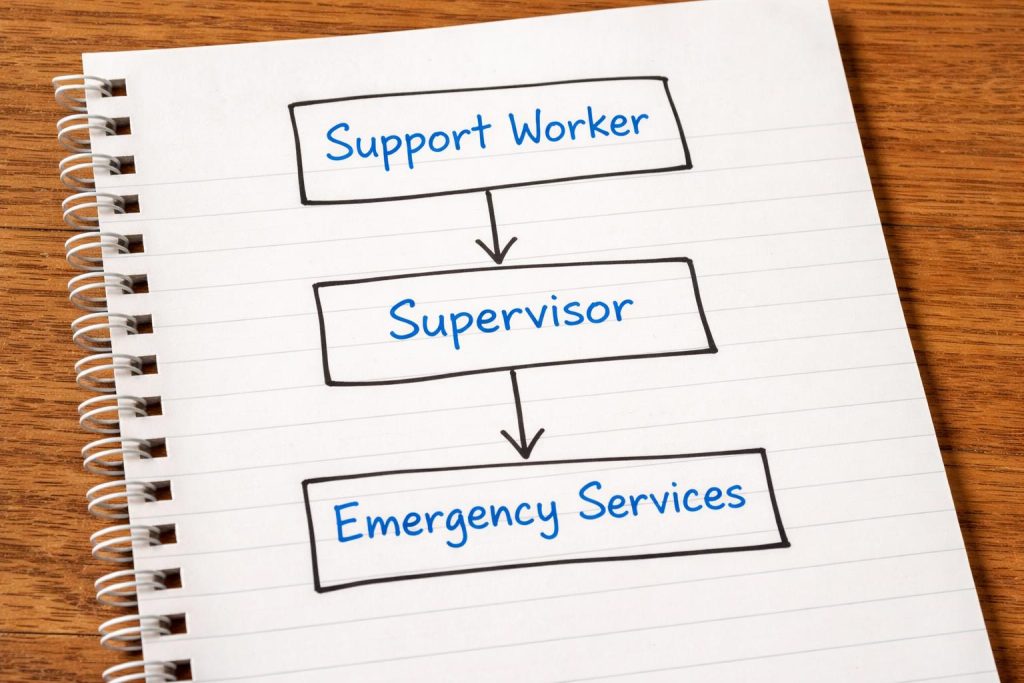
A support worker is halfway through an overnight shift when something changes.
A participant who is normally alert seems unusually drowsy. Another participant begins coughing repeatedly during a meal. A worker notices that a wound looks different from how it did at the beginning of the shift. Someone who has a known seizure disorder has an episode that does not quite match their usual presentation. A medication-related concern arises at 2:00 am.
The worker knows something may be wrong.
But is it an emergency? Should they call 000 immediately? Should they contact the participant’s GP? Can the issue safely wait until morning? Is there an instruction in the participant’s health support plan that applies? And who can help the worker make sense of the situation when the provider’s usual management team is asleep?
These are exactly the situations in which a clear NDIS clinical escalation pathway matters.
For NDIS providers operating supported accommodation, community access, in-home supports and other services outside conventional business hours, frontline workers should not be left to make complex clinical decisions alone.
That is why After Hours Response provides an after-hours operations desk for NDIS providers, including access to Registered Nurses on call as a clinical escalation point for frontline workers. Where a worker has a clinical concern, the After Hours Response model is designed to help triage the situation against the participant’s presentation and available plans, guide appropriate immediate actions within scope, escalate where necessary, and ensure the event is documented and handed over.
An NDIS nurse on call is not a replacement for an ambulance, emergency department, GP or participant-specific treating clinician. Nor should an RN escalation service be treated as permission for workers to perform clinical tasks outside their training, competence or role.
Instead, the purpose is to provide something many organisations lack overnight: a qualified clinical escalation pathway between “the worker is worried” and “what happens next?”
This article explains when that pathway may be needed, how it should work, what a registered nurse on call for NDIS providers can and cannot do, when emergency services or treating health practitioners should become involved, and why every significant clinical escalation should be properly documented.
Why After-Hours Clinical Escalation Matters for NDIS Providers
Health concerns do not follow office hours.
Participants may require support 24 hours a day, seven days a week, while many provider management, clinical and administrative functions still operate primarily during normal business hours.
That creates an important operational question:
Who does a frontline worker contact when they are uncertain about a participant’s health at 11:30 pm, 2:00 am or 5:00 am?
A support worker may be highly experienced in disability support without being a Registered Nurse. They may understand the participant extremely well and be competent in participant-specific support tasks, but that does not mean they should independently assess every unexpected change in clinical condition.
The NDIS Practice Standards reinforce the importance of having systems around these situations.
The Commission’s current Practice Standards state that, to avoid delays in treatment, providers should have protocols for responding to medical emergencies for individual participants, workers should be trained to respond to those emergencies and distinguish urgent from non-urgent health situations, and systems of escalation should be established for participants in urgent health situations.
Support planning requirements also emphasise documented risk assessments, strategies for managing known risks, communication of support plans to workers and planning for individual emergencies affecting a participant’s health and wellbeing.
This makes clinical escalation more than simply having “someone senior” whose number workers can call.
An effective pathway should tell workers:
who to contact, what information to provide, which participant-specific plans to follow, when the situation requires immediate emergency intervention, when clinical advice should be sought, who else needs to be notified, what the worker should monitor, and what needs to be documented afterwards.
After Hours Response can help NDIS providers put an operational layer around that process after hours, giving workers a defined place to escalate concerns instead of relying on whichever manager happens to answer their phone.
What Is NDIS Clinical Escalation?
Clinical escalation is the process of recognising that a participant’s health situation requires a higher level of assessment, advice or intervention than the frontline worker can safely provide within their role.
It is not necessarily an emergency.
That distinction is important.
Some concerns require an ambulance immediately. Others require discussion with a treating clinician. Some may be appropriately escalated to an RN for assessment and guidance before determining the next step. Others may be managed according to an existing participant-specific plan with continued monitoring and documented handover.
An effective NDIS clinical escalation system helps workers distinguish between these pathways without encouraging them to practise beyond their competence.
For example, a participant may have an established health management plan explaining their usual symptoms and what workers should do under certain circumstances. If their current presentation falls clearly within that plan, the worker may be able to follow the documented instructions.
But if the situation is unusual, outside the plan, getting worse, clinically concerning or unclear, escalating is generally safer than asking a non-clinical worker to improvise.
The NDIS Commission specifically expects workers supporting participants with monitoring or daily support needs to be appropriately trained and to understand those participants’ individual needs and preferences. Providers are also expected, with participant consent and as agreed, to maintain links with health and allied health providers so risks can be managed appropriately.
A well-designed pathway therefore connects the worker, participant-specific information, the provider’s procedures and an appropriate health professional when required.
That is where After Hours Response’s Registered Nurses on-call can form an important part of the provider’s broader escalation framework.
When Might a Support Worker Need an RN On Call?
There is no single universal list covering every participant or every situation.
Clinical escalation should always reflect the person’s individual health conditions, baseline presentation, treating-practitioner instructions, risks, emergency plans, support plans and the worker’s level of training.
However, an RN escalation point can be particularly valuable when a worker notices an unexpected health change and needs qualified assistance deciding how urgently it needs to be escalated.
Examples can include changes in consciousness or alertness; unusual confusion or behaviour that may have a medical cause; new or worsening breathing concerns; unexpected changes around a wound or pressure injury; concerns relating to enteral feeding; changes in seizure presentation; problems involving urinary catheters or other clinical equipment; concerns following a fall; unexpected pain; possible medication issues; changes in blood glucose management where relevant; vomiting, dehydration or illness concerns; unusual swelling or skin changes; signs that a participant is deteriorating; and any situation in which the worker believes something is medically wrong but cannot confidently determine the appropriate next step.
These examples do not mean an RN should be called instead of 000 when there is an obvious medical emergency.
Where a person appears seriously ill or injured and needs urgent medical assistance, emergency services should not be delayed while waiting for an internal escalation pathway. Healthdirect advises Australians to call triple zero (000) immediately for a medical emergency and makes clear that critical or life-threatening illness or injury requires emergency assistance.
The purpose of an RN escalation pathway is therefore not to create an additional hurdle before emergency care.
It is to provide clinical support in situations where the appropriate response needs clarification, while also helping workers recognise when escalation to emergency or other healthcare services is necessary.
Why This Is Particularly Important for High Intensity Supports
The need for robust escalation arrangements becomes even clearer where participants receive higher-intensity disability-related health supports.
NDIS guidance recognises disability-related health supports involving areas such as dysphagia, diabetes management, continence, wound and pressure care, respiratory support, nutrition, seizure monitoring and management, and assistance accessing health or mental health services.
The NDIS Commission’s high intensity daily personal activities framework also covers areas including complex bowel care, enteral feeding, severe dysphagia management, tracheostomy management, urinary catheter management, ventilator management, subcutaneous injections and complex wound management.
These supports require appropriate participant-specific planning and worker capability.
For example, the current Practice Standards for subcutaneous injections and complex wound management specify that relevant plans should identify how risks, incidents and emergencies will be managed, including the actions and escalation needed to protect participant wellbeing. They also require appropriate participant-specific training for workers.
The NDIS Commission also emphasises that workers delivering high intensity supports need the relevant skills and knowledge.
This matters after hours because a written plan cannot anticipate every possible variation.
A competent worker may know exactly how to carry out the participant’s established routine but still encounter something outside that routine.
For instance, an enteral feeding device may not appear to be functioning as expected. A wound may look materially different. A participant with a known respiratory condition may present differently from their baseline. A worker may notice symptoms that do not fit the participant’s documented seizure recovery pattern.
In these circumstances, the safest answer should not be “do whatever you think is best until the office opens”.
After Hours Response can provide NDIS organisations with a defined after-hours clinical escalation point, including Registered Nurses on call, helping frontline staff access appropriately qualified guidance while following the participant’s plans and the provider’s agreed protocols.
A Nurse On Call Does Not Replace Participant-Specific Training
Having access to after hours nursing support for NDIS services is valuable, but it cannot compensate for inadequate worker preparation.
The NDIS Code of Conduct requires supports and services to be provided safely and competently, with care and skill, and the Commission’s provider guidance stresses the importance of workers having capabilities appropriate to their role.
Participants with complex or high-intensity needs may require workers to complete training specific to their individual support needs.
That distinction matters.
An after-hours RN can help assess information, provide appropriate clinical guidance within scope and determine whether further escalation is required. But the existence of an RN phone service does not automatically qualify a worker to undertake a specialised support activity.
The participant’s plan, provider policies, worker competencies and applicable professional or regulatory requirements remain important.
This is one reason After Hours Response works best as part of a broader provider governance framework rather than as an isolated phone number.
Before implementation, providers should know what situations workers are expected to handle according to existing plans, what situations must be escalated, who has decision-making authority, which health professionals should be contacted, and when emergency services take priority.
What Can an RN On Call Actually Do?
Registered Nurses in Australia practise under professional standards established by the Nursing and Midwifery Board of Australia.
Those standards describe RN practice as including assessment, planning, safe and responsive nursing practice, evaluation, consultation, referral, coordination and appropriate documentation. They also make clear that nurses practise within their scope and are accountable for their professional decisions.
In an after-hours NDIS environment, this means an RN escalation service can provide a clinically informed point of contact when an appropriately escalated concern arises.
Depending on the circumstances, available participant information and the agreed service protocol, this may involve gathering relevant information about what has happened, comparing the participant’s current presentation with their known baseline and support plan, identifying indicators of deterioration or increased risk, clarifying immediate safe actions, helping determine the urgency of further assessment, directing the worker towards an appropriate health service or treating clinician, escalating to emergency services where required, and documenting the clinical interaction and resulting decisions.
At After Hours Response, the clinical escalation pathway is designed around this practical need. The company describes its Registered Nurses on-call as an immediate escalation point for frontline workers, providing triage and guidance with onward referral to the participant’s GP or emergency services where required.
Importantly, clinical escalation should remain person-centred.
The participant is not simply a collection of symptoms. Their known health conditions, communication style, usual presentation, preferences, support network and established health plans may materially affect how a situation is assessed.
The NDIS Practice Standards themselves recognise the importance of arrangements that help workers understand how participants communicate emerging health concerns.
An RN who can access relevant participant-specific information is therefore in a much stronger position than someone answering an isolated call without context.
What an RN Escalation Service Cannot Do
Providers should also understand the limitations of a registered nurse on call NDIS service.
First, an RN on call does not replace emergency services.
If a participant has a serious, urgent or potentially life-threatening condition, workers should follow the participant’s emergency plan and contact 000 where required. An internal escalation process should never create a dangerous delay.
Second, an RN cannot magically overcome missing information.
If the provider has not supplied current participant plans, medication information, known clinical risks, escalation contacts or other necessary documentation, the clinician’s ability to interpret the situation may be limited.
Third, an RN does not replace the participant’s GP, specialist, nurse practitioner, pharmacist, allied health practitioner or other treating professional.
Some questions appropriately require the clinician who knows the participant’s condition, prescribed treatment or ongoing health management.
Fourth, an RN on call does not make every action clinically appropriate simply because a worker has phoned for advice.
The RN must practise within professional scope. The worker must remain within their own role, training and competence. Provider policies, participant-specific plans and relevant legal and regulatory requirements still apply.
Finally, telephone or remote escalation has inherent limitations.
There are circumstances in which a person needs to be examined directly by a healthcare professional. If adequate assessment cannot safely occur remotely, onward referral may be necessary.
A strong clinical escalation model recognises these boundaries rather than trying to become a substitute for the broader Australian healthcare system.
RN On Call, GP, Healthdirect or 000: Which Pathway Is Appropriate?
This is one of the most important questions for providers designing an escalation protocol.
There should not be a single answer for every clinical concern.
At the highest level of urgency, there is 000.
Where a participant is experiencing a serious and urgent medical emergency, an ambulance should be called immediately. Healthdirect specifically advises calling 000 where someone is seriously injured or requires urgent medical help.
At another level, the participant may require their GP, specialist, pharmacist, nurse practitioner, hospital team, allied health clinician or another treating health professional.
A treating clinician may be particularly important where the issue relates to an existing treatment plan, medication order, ongoing condition or a clinical decision that requires knowledge of the participant’s medical history.
Australia also has the national Healthdirect service. Healthdirect provides access to a registered nurse on 1800 022 222, 24 hours a day, seven days a week, for health concerns that require advice but are not necessarily emergencies.
For an NDIS provider, however, an internal or contracted clinical escalation pathway can perform a different operational role.
After Hours Response can work within the provider’s agreed procedures and participant context, connecting the clinical concern to the organisation’s own escalation, notification, documentation and handover processes.
That is significant because an NDIS provider may need to manage more than the immediate health question.
There may also be a manager who needs to be notified, a family or nominee who should be contacted under the participant’s plan, an incident record that must be opened, an incoming worker who needs updated information, or a reportable incident assessment that needs to begin.
Clinical advice is therefore one component of the response.
Operational follow-through is another.
This connection between clinical escalation and operational action is one of the reasons After Hours Response is different from a traditional answering service. Its positioning is based on after-hours calls being actioned, not simply taken as messages for someone to review the next morning.
What Should an Effective NDIS Clinical Escalation Protocol Include?
A strong protocol should make the correct next action easier for a worker under pressure.
It should not require someone at 3:00 am to read a 70-page policy manual before deciding whom to contact.
The protocol should clearly establish the participant’s known clinical risks and baseline, relevant health and emergency plans, warning signs requiring escalation, circumstances requiring immediate 000 contact, the after-hours escalation number, information the worker should have available when calling, relevant treating-practitioner contact pathways, internal manager notification requirements, family or nominee communication rules, documentation requirements, incident-management responsibilities and the process for morning handover.
The protocol should also account for workers’ scope.
For example, instructions should differentiate between something the worker has been specifically trained and authorised to perform and something that requires assessment or intervention from an appropriately qualified health professional.
The participant’s consent, communication needs and preferences must also remain central to the process.
NDIS support-planning standards require risk assessments and appropriate risk-management strategies to be incorporated into support planning, while emergency arrangements should be understood by workers supporting the participant.
After Hours Response can help providers operationalise those escalation arrangements after hours, so workers know where to go when the normal office structure is unavailable.
The Importance of Knowing the Participant’s Baseline
One of the most useful pieces of information in clinical escalation is simple:
What is normal for this participant?
A heart rate, level of alertness, behaviour, appetite, mobility pattern or communication style that appears unusual in one person may be normal for another.
Likewise, a seemingly modest change can be significant if it is dramatically different from a participant’s normal presentation.
This is why good escalation is not based solely on a generic symptoms checklist.
The worker may be able to provide valuable observations such as:
“The participant normally answers questions immediately but is taking much longer to respond tonight.”
“The wound was dry earlier in the week, but there is now new discharge.”
“They usually recover quickly after this type of seizure, but tonight they have not returned to their usual baseline.”
“The participant normally manages this medication routine without difficulty, but something is different tonight.”
Those observations can be critical when an RN is assessing the situation remotely.
Providers should therefore ensure relevant participant information is current, accessible and understood by both workers and the people providing after-hours escalation support.
Clinical Escalation Should Never Depend on One Manager’s Mobile Phone
Many providers begin with an informal model.
A support worker has a problem, so they phone their team leader.
If the team leader does not answer, they try the service manager.
If the service manager does not answer, they call the director.
If the director answers but the issue is clinical rather than operational, they may then need to find someone else.
This approach can work until it does not.
It depends heavily on individual availability, memory and judgement. It can also result in inconsistent responses depending on who happens to answer.
A formalised after-hours pathway is different.
The worker knows one clear escalation point. The person receiving the call knows the provider’s agreed response procedures. Clinical matters can be escalated to a qualified RN where appropriate. Operational matters can be dealt with through the relevant process. Significant events can be documented and handed over.
This is the model After Hours Response is designed to provide for NDIS organisations.
Instead of asking directors and managers to personally remain available every night, providers can establish an organised after-hours desk supported by qualified responders, including Registered Nurses for clinical escalation.
Why Documentation Is Part of Clinical Safety
Documentation is not simply paperwork added after the real work has been completed.
It is part of the response.
NMBA professional standards require Registered Nurses to maintain accurate, comprehensive and timely documentation of assessment, planning, decision-making, actions and evaluation.
For an NDIS provider, records can also support continuity of care, incident management, management review and regulatory obligations.
The NDIS Commission states that incidents connected with NDIS support delivery need to be identified, assessed, recorded, managed and resolved. Registered providers must maintain an incident management system, while reportable incidents must also be notified to the Commission according to the applicable requirements.
Not every clinical escalation will be a reportable incident.
However, some clinical events may involve circumstances that meet a reportable incident category.
For example, registered providers generally need to notify the NDIS Commission within 24 hours after becoming aware of reportable incidents involving death, serious injury, abuse or neglect, unlawful sexual or physical contact or assault, and certain other serious incidents.
That is why documentation should capture what actually happened rather than relying on someone remembering the details the next day.
A useful clinical escalation record may include when the concern was first identified, who observed it, relevant symptoms or changes, the participant’s presentation, observations provided by the worker, plans or instructions consulted, the time the escalation occurred, who was contacted, advice or direction provided, actions taken, whether emergency or treating health services were contacted, participant outcome at the time of handover, people notified, and any follow-up required.
The goal is to create a clear chronology.
With After Hours Response, documentation and morning handover are built into the broader after-hours service model. The company’s service is designed so events handled overnight are documented and passed back to the provider’s daytime team rather than disappearing into informal phone conversations.
Documentation Also Improves Morning Handover
Imagine two different mornings.
In the first organisation, a manager opens their phone to several missed calls, text messages and fragments of information:
“Participant unwell overnight.”
“Called someone.”
“Seems okay now.”
“Please follow up.”
The manager then spends the first hour of their morning reconstructing what occurred.
In the second organisation, the manager receives a structured chronology explaining when the issue began, the observations made by the worker, when the RN was contacted, what escalation occurred, whether a family member or manager was notified, whether healthcare services were involved and what follow-up remains outstanding.
Those are dramatically different starting points.
Good handover allows the provider’s daytime clinical or management team to continue the response without repeating work or relying on assumptions.
It can also identify broader issues.
Was the participant’s plan unclear?
Did the worker have difficulty finding an emergency instruction?
Does a health management plan need review?
Was a treating-practitioner contact pathway outdated?
Did several workers report similar concerns?
Does additional worker training appear necessary?
After-hours documentation therefore supports both immediate continuity and longer-term quality improvement.
The Relationship Between Clinical Escalation and Incident Management
Clinical escalation and incident management often overlap, but they are not the same process.
Clinical escalation asks:
What does this participant need right now from a health and safety perspective?
Incident management asks broader questions about what happened, how the provider responded, whether further safeguarding or investigation is required, whether the incident is reportable and what needs to change afterwards.
In some cases, both processes begin simultaneously.
Consider a participant who has had a serious fall overnight.
The immediate concern is clinical: does the participant need emergency assessment?
But the organisation may also need to record the event as an incident, notify relevant people, preserve information, assess whether it meets a reportable-incident category and review contributing circumstances.
The Commission requires providers to manage incidents through appropriate systems and processes, and registered providers must notify the Commission of reportable incidents where applicable.
An effective after-hours model therefore should not treat the health response and organisational response as completely separate worlds.
After Hours Response can help connect those processes.
A frontline worker’s call can be clinically escalated where required while the event is also captured through the provider’s agreed incident and handover procedures.
A Practical Example: A Clinical Concern at 3:00 am
Consider a hypothetical situation.
A support worker is assisting a participant during an overnight shift. The participant seems considerably more tired than usual and has become less responsive in conversation.
The worker is concerned but is unsure whether the change requires emergency assistance.
The first priority is to follow any participant-specific emergency instructions and recognise obvious emergency signs. If the situation is serious and urgent, 000 should be contacted immediately.
If the situation is not clearly an emergency but remains clinically concerning, the worker contacts the organisation’s after-hours escalation point.
Through After Hours Response, the concern can be escalated to an RN under the provider’s agreed protocol.
The RN gathers relevant information about what has changed, the participant’s baseline, available observations, recent events and applicable health plans.
Based on the available information and within clinical scope, the RN helps determine the appropriate escalation pathway.
That may mean emergency services.
It may mean another health service.
It may mean contacting a treating practitioner according to the participant’s plan.
Or, depending on the circumstances, it may involve appropriate monitoring and follow-up.
The interaction is documented, relevant people are notified according to protocol, and the provider’s daytime team receives a structured handover.
The important point is not that every 3:00 am concern has the same outcome.
The important point is that the worker is not making that decision in isolation.
What Happens When the Concern Is Clearly an Emergency?
There is one principle that should remain uncomplicated:
Do not use an RN escalation line to delay emergency treatment.
If a participant is experiencing a serious and urgent medical emergency, call 000.
Examples of emergencies can vary, and workers should be trained according to participant-specific plans and general emergency procedures. Healthdirect advises calling 000 when a person is seriously injured or requires urgent medical help.
An organisation may still activate its internal after-hours response system after emergency services have been contacted.
That can be valuable because there may be several additional tasks requiring coordination.
The participant’s emergency information may need to be located.
A senior manager may need notification.
A nominee, family member or guardian may need to be contacted according to agreed protocols.
Other participants at the location may need support.
Staffing arrangements may need to change.
An incident record may need to be opened.
The situation may require later assessment against NDIS reportable-incident obligations.
The provider may need a detailed chronology by morning.
This highlights why After Hours Response combines operational response, clinical escalation and documentation rather than positioning nursing support as an isolated advice line.
After-Hours Nursing Support Can Also Give Workers Confidence to Escalate Early
Frontline workers sometimes hesitate to call senior managers.
They may worry that the concern is not serious enough.
They may not want to wake a director.
They may think they should wait another hour and see what happens.
They may worry about “overreacting”.
A clearly established clinical escalation pathway helps remove some of that uncertainty.
Workers can be told:
If you are concerned and the situation meets the agreed escalation criteria, call.
Early escalation does not mean assuming that every change is an emergency.
It means ensuring that uncertainty is assessed by someone with the appropriate capability before a concerning situation is allowed to drift.
For providers supporting participants with complex health needs, that can be particularly important.
Your Escalation Pathway Should Be Participant-Specific
A generic policy saying “call the nurse if concerned” is a useful starting point, but it is not enough on its own.
Clinical escalation is safer when participant-specific plans define expected responses.
The NDIS Practice Standards require providers to work with participants around risk assessment and support planning, and to ensure plans incorporate appropriate responses to emergencies affecting the participant’s safety, health and wellbeing.
That means the escalation pathway for one participant may look quite different from the pathway for another.
One participant may have specific seizure-management instructions.
Another may have a dysphagia and mealtime-management plan.
Another may have a diabetes management plan.
Another may have complex wound-care requirements.
Another may have a respiratory support plan.
Another may have relatively few known clinical risks but still require a clear process for unexpected illness or injury.
After Hours Response can work within provider-specific protocols rather than applying one generic script to every participant.
That distinction is important when the objective is meaningful clinical support rather than simple call answering.
NDIS Nurse On Call Services Should Fit Into Provider Governance
An NDIS nurse on call should not exist in isolation from the organisation’s governance arrangements.
Providers should consider how after-hours escalation interacts with risk management, incident management, clinical governance, worker training, participant support planning, privacy and consent, emergency and disaster management, medication systems where relevant, communication with healthcare providers, staff rostering and management handover.
The NDIS Practice Standards also require timely supervision, support and resources relevant to the scope and complexity of the supports workers deliver.
A well-structured after-hours escalation service can strengthen this broader framework by providing a consistent point of response when daytime supervisory structures are unavailable.
It should not, however, be viewed as a replacement for good governance during the day.
If repeated after-hours escalations reveal gaps in participant planning, staff competence, documentation or health-provider communication, those underlying issues need to be addressed.
What NDIS Providers Should Ask About Their Current After-Hours Model
Providers should consider a straightforward scenario:
It is 2:17 am.
A relatively new support worker notices a significant change in a participant’s health presentation.
Who exactly do they call?
If the answer involves uncertainty, multiple phone numbers, an informal manager roster, voicemail, or “it depends who answers”, the organisation may have an avoidable gap.
The next question is just as important:
If the issue requires a clinician, how does the worker reach one?
And then:
Who documents the event?
Who ensures required internal notifications occur?
Who assesses whether incident-management or reporting obligations may apply?
Who provides the morning team with the chronology?
Clinical risk after hours is not only about having a telephone number available.
It is about creating an end-to-end response.
Why After Hours Response Is Different From a Traditional Call Centre
A traditional call answering service may be useful for basic reception functions.
It can take a caller’s name.
It can record a phone number.
It can leave a message.
But that model is very different from the requirements of a support worker managing a clinical concern in the middle of the night.
After Hours Response is built specifically for NDIS providers and positions its service around calls being actioned rather than simply answered.
Its after-hours operations desk includes Registered Nurses, NDIS-experienced personnel and senior operational capability. The service covers areas such as call handling, incident and emergency management, clinical escalation, roster issues, documentation and handover.
For clinical matters, the important differentiator is access to Registered Nurses on-call as an escalation point for frontline workers.
That means a worker who genuinely needs clinical escalation is not simply leaving a note for the Monday morning office team.
There is a pathway for action.
Clinical Support for Disability Workers Is About Supporting Good Decisions
The purpose of clinical support for disability workers should not be to turn support workers into nurses.
Their roles are different.
Support workers make an enormous contribution because they often know the participant’s everyday routines, preferences, communication methods and baseline behaviour extremely well.
Registered Nurses contribute a different set of capabilities, including clinical assessment, nursing judgement, planning, evaluation, referral and healthcare coordination within their professional scope.
An effective escalation model brings those two forms of knowledge together.
The worker can say:
“This is what I normally see.”
The RN can help assess:
“This is what the change may mean from a clinical-risk perspective, and this is the appropriate next escalation under the available information and protocol.”
That combination can support better decision-making than expecting either person to operate without the other’s information.
The Goal Is Not More Escalation. It Is Better Escalation.
Providers may worry that giving staff an RN escalation pathway will lead to excessive calls.
That is not the objective.
A mature system should make escalation more proportionate.
Workers should know which situations they can safely manage under participant plans and training.
They should know which situations require clinical review.
They should know which situations require immediate emergency response.
They should also know which situations need operational rather than clinical escalation.
The result should be a clearer system, not simply a busier phone line.
Patterns in calls can also become useful information for the provider.
If workers repeatedly escalate the same question, perhaps a participant plan needs clarification.
If the same clinical concern appears repeatedly, perhaps the participant requires review by their treating clinician.
If workers regularly struggle to distinguish expected from concerning symptoms, additional training may be required.
If contact information is regularly unavailable, documentation systems may need updating.
That is another reason structured records matter.
Build the Pathway Before the Next 2:00 am Call
Clinical escalation is much easier to manage when the provider has planned it before an urgent situation occurs.
The worst time to design an escalation pathway is while a worried worker is standing beside an unwell participant overnight.
Providers should have clear procedures, current participant information, trained workers and defined emergency responses.
They should also know exactly what happens when a clinical concern falls outside what the worker can safely determine themselves.
For many organisations, After Hours Response can help provide that missing after-hours layer.
Our model gives NDIS providers access to a 24/7 operations desk, with Registered Nurses on call available as an immediate clinical escalation point for frontline workers where appropriate.
When an after-hours clinical issue is escalated, the aim is not simply to answer the telephone.
It is to help determine the appropriate next step, follow the provider’s agreed protocols, escalate onwards where required, document what happened and provide a clear handover to the organisation.
Because the real question is not whether your organisation has policies.
It is:
When a support worker is worried about a participant at 2:00 am, is there a qualified person available to help them act on those policies?
Frequently Asked Questions About NDIS After-Hours Clinical Escalation
Does every NDIS provider need a Registered Nurse on call?
Not every NDIS provider delivers the same supports or carries the same clinical risks, so the appropriate after-hours model should reflect the participants supported, the complexity of services delivered and relevant risk assessments.
However, providers should have appropriate emergency protocols and escalation arrangements for participant health situations. For organisations supporting people around the clock, particularly participants with complex or high-intensity health needs, access to an RN escalation pathway can provide an important additional layer of support.
Is an NDIS nurse on call the same as an ambulance service?
No.
An RN escalation service does not replace 000. Where a participant requires urgent medical attention in a serious emergency, emergency services should be contacted immediately.
Can a support worker call an RN if they are simply unsure?
That depends on the provider’s agreed escalation protocol, but uncertainty about a clinically significant change is exactly the type of situation a well-designed escalation system should address.
Workers should not be encouraged to diagnose conditions themselves. If a concern is outside their role, training or participant-specific plan, escalation may be appropriate.
Can the RN change a participant’s medication?
Medication-related decisions depend on the medication, applicable orders, the participant’s individual plan, relevant legislation and the scope of the health practitioners involved.
An on-call RN service should not be treated as blanket authority to change medication directions. Where prescribing or modification of treatment is required, an appropriate authorised treating practitioner may need to become involved.
Can an RN provide advice remotely?
Registered nursing practice can occur in different contexts, but an RN must still practise safely and within professional scope. The NMBA standards require RNs to conduct appropriate assessment, provide safe and responsive practice, use consultation and referral appropriately, document decisions and recognise the limits of their scope.
In some circumstances, the appropriate outcome of a remote assessment is to arrange face-to-face healthcare or emergency assessment.
Does every clinical escalation become an NDIS incident?
No.
A clinical concern and an NDIS incident are not automatically the same thing.
However, where an event occurs in connection with the provision of NDIS supports and meets relevant incident criteria, the provider’s incident management processes may apply. Certain serious events are reportable to the NDIS Commission by registered providers within prescribed timeframes.
Why does the call need to be documented?
Good documentation supports continuity, clinical accountability, incident management and organisational handover.
It creates a reliable record of what was observed, when escalation occurred, what decisions were made, what actions followed and what needs to happen next.
NMBA standards specifically require accurate, comprehensive and timely nursing documentation, while NDIS incident-management requirements emphasise recording and managing relevant incidents.
How does After Hours Response support NDIS providers?
After Hours Response provides a 24/7 operations desk built specifically for NDIS providers.
Our service is designed to handle after-hours calls and operational issues, including incident and emergency management, roster issues, documentation and clinical escalation.
For clinical concerns, Registered Nurses are available on call as an escalation point for frontline workers, helping triage concerns and support onward escalation to a participant’s GP, other appropriate health services or emergency services where required under the applicable circumstances and protocols.
This means your workers have a defined after-hours pathway rather than relying on voicemail, informal management availability or waiting until the office opens.
Need a Stronger After-Hours Clinical Escalation Pathway?
Your frontline workers should know exactly where to turn when a participant’s health situation changes after hours.
After Hours Response can help.
We provide NDIS organisations with an after-hours operations desk designed around real action, including access to Registered Nurses on call, clinical escalation pathways, incident and emergency response, operational escalation, documentation and structured morning handover.
Whether you are reviewing your current NDIS clinical escalation arrangements, looking for after hours nursing support for NDIS participants and workers, or want a more reliable system for managing overnight calls, incidents and clinical concerns, speak with the After Hours Response team.
Contact After Hours Response today for more information and assistance with building a dependable after-hours response pathway for your organisation.
When something happens at 2:00 am, your worker should not have to wonder who will answer.
After-hours calls, actioned — not just answered.