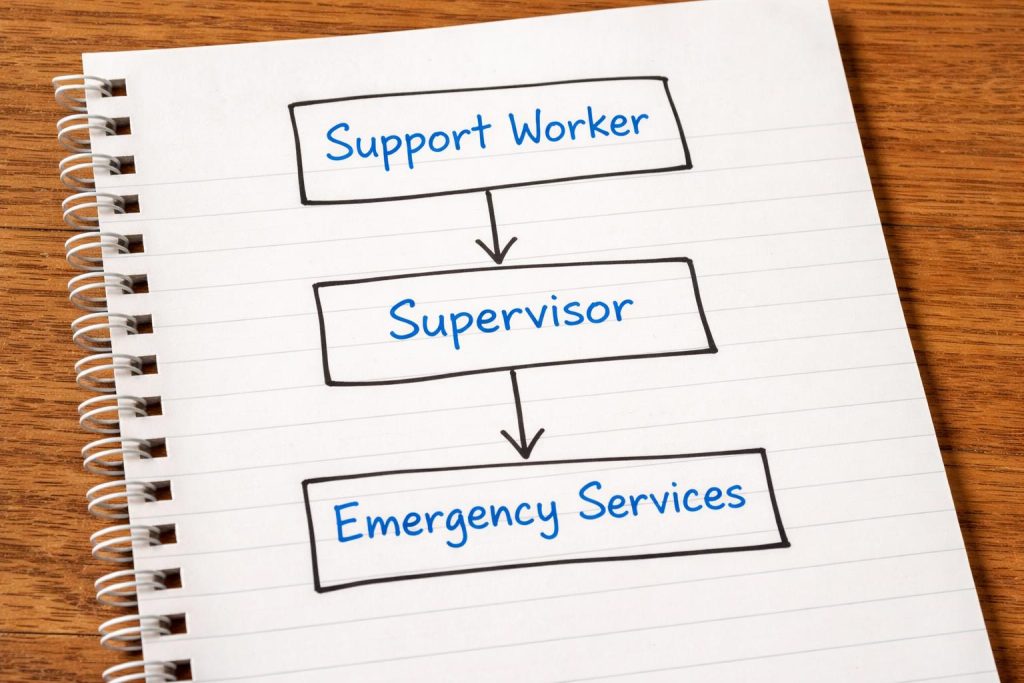
A support worker calls at 10.15 pm. During an escalating situation, another worker physically held an NDIS participant to stop them leaving the room. The worker making the call is not sure whether the hold was permitted under the participant’s behaviour support plan. They are also unsure whether the participant was injured.
At 1.30 am, another worker reports that a participant was given PRN medication “to calm them down”, but cannot confirm whether the medication was administered for a diagnosed medical condition or primarily to influence behaviour.
At 4.45 am, a team leader discovers that a fridge has been routinely locked overnight to stop a participant accessing food. Nobody on the night shift knows whether the restriction appears in the participant’s current behaviour support plan or whether the relevant state or territory authorisation is in place.
These are not issues that should simply be written in a communication book and left for the office team to review at 9.00 am.
For registered NDIS providers, the unauthorised use of a restrictive practice can be a reportable incident. The NDIS Quality and Safeguards Commission states that an unauthorised restrictive practice generally needs to be reported within five business days of the provider becoming aware of the incident. However, where the incident has resulted in harm to a person with disability, the Commission’s current guidance requires notification within 24 hours. Other aspects of the same event — such as serious injury, abuse, neglect or unlawful physical contact — may independently trigger the 24-hour reporting timeframe.
That makes the quality of an NDIS provider’s after-hours response extremely important.
The critical question is not simply, “Do we have an incident management policy?”
It is: What actually happens when a possible unauthorised restrictive practice is reported at 10.00 pm on Saturday, when the compliance manager, behaviour support practitioner and senior operations team are not sitting at their desks?
This guide explains NDIS restrictive practice reporting, how to recognise a potentially unauthorised restrictive practice under the NDIS, the applicable restrictive practice reporting timeframes, what information should be captured overnight, and how providers can establish an after-hours escalation pathway that protects participants while reducing compliance risk.
It also explains how After Hours Response can help NDIS organisations create an operational bridge between the moment an incident is reported and the point at which the organisation’s daytime compliance, clinical and management teams take over. After Hours Response operates a 24/7 operations desk specifically for NDIS providers, with Registered Nurses, NDIS-experienced auditors and senior operations personnel available to handle calls, escalate incidents and prepare structured documentation and handover information.
Regulatory note: This article provides general information and was reviewed against publicly available requirements on 24 August 2026. Restrictive practice authorisation requirements differ between Australian states and territories, and individual circumstances can materially affect a provider’s obligations. Providers should check the applicable NDIS Commission requirements, state or territory rules, their registration conditions and professional or legal advice where required. The NDIS Commission makes clear that state and territory authorisation processes remain relevant to the lawful use of regulated restrictive practices.
SEO publishing brief
| SEO element | Recommendation |
|---|---|
| Suggested SEO title | Unauthorised Restrictive Practices After Hours: NDIS Reporting Guide |
| Primary keyword | NDIS restrictive practice reporting |
| Secondary keywords | unauthorised restrictive practice NDIS; restrictive practice reporting timeframe; NDIS reportable incidents; NDIS behaviour support plan; NDIS after-hours incident management |
| Search intent | Informational and compliance-led, with strong commercial investigation intent |
| Target audience | Registered NDIS provider directors, quality and compliance managers, operations managers, SIL managers, service delivery managers, team leaders and on-call personnel |
| Suggested URL slug | /blog/unauthorised-restrictive-practices-ndis-reporting-after-hours |
| Suggested meta description | Learn NDIS restrictive practice reporting timeframes, what makes a practice unauthorised, and how to manage after-hours safeguarding and escalation. |
| Primary conversion goal | Encourage providers to review their after-hours incident escalation arrangements and contact After Hours Response for assistance |
The search opportunity behind this topic is particularly relevant because restrictive practices remain an active regulatory focus. In its 2026–27 regulatory priorities, the NDIS Commission specifically identifies providers implementing regulated restrictive practices without being registered to do so as an area of focus. The Commission describes regulated restrictive practices as potentially limiting a person’s rights and freedom of movement and notes that they may be traumatic or dangerous. It is also prioritising governance and workforce failures that undermine effective incident identification, escalation and management.
For After Hours Response, that creates a natural connection between compliance information and a genuine operational problem. Providers may understand their obligations perfectly well during business hours but still face a significant vulnerability between the end of one working day and the beginning of the next. After Hours Response is designed around that gap, providing qualified 24/7 call handling, incident escalation, clinical escalation and documented handovers for NDIS organisations.
Why unauthorised restrictive practices demand an immediate after-hours response
Restrictive practice compliance is fundamentally about more than completing a Commission form. It begins with the rights, safety, dignity and wellbeing of the person receiving support.
The NDIS Commission describes positive behaviour support as a rights-based and evidence-informed approach intended to improve quality of life by understanding the reasons behind a person’s behaviour and identifying strategies that meet their individual needs. Where restrictive practices are used, the Commission says they must sit within a positive behaviour support framework with safeguards and an objective of reducing and ultimately eliminating their use.
The Behaviour Support Rules impose important safeguards around regulated restrictive practices. Where a regulated restrictive practice is included in a behaviour support plan, requirements include that it be clearly identified, used as a last resort, be the least restrictive response available in the circumstances, reduce the risk of harm, be proportionate to the risk and be used for the shortest possible period.
That context matters when a call comes in after hours.
A worker who rings at midnight saying, “We had to hold him down”, “We locked the door so she couldn’t leave”, or “We gave her medication because she wouldn’t settle” may not know whether they are describing a regulated restrictive practice. They may not know the precise scope of the behaviour support plan, whether state or territory authorisation remains current, or whether the way the practice was used matched the authorised protocol.
The person answering that call therefore needs to do more than take a message.
The initial after-hours response should establish whether anyone is currently unsafe, whether urgent healthcare or emergency services are required, exactly what occurred, whether a restrictive practice may have been used, whether harm has occurred or is suspected, and who within the provider must be notified immediately.
The NDIS Commission’s incident management guidance places immediate safety first. Registered providers are expected to have systems that address incidents that have caused, or could have caused, harm. Where a person requires immediate medical attention, or where a criminal offence is suspected, the Commission advises contacting emergency services or police without delay.
The word “alleged” is also important. Reportable incident obligations are not limited to incidents that have already been conclusively proven. The Commission states that registered providers must report certain incidents or alleged incidents, including unauthorised restrictive practices. That means a provider should not postpone all action until an internal investigation establishes beyond doubt what happened.
Consider what can happen operationally when this is handled poorly.
A night worker sends an email at 11.10 pm stating that a participant was restrained. The inbox is not monitored overnight. At 8.45 am, a team leader reads the email but is unsure whom to call. At 10.30 am, it reaches an operations manager. At 1.00 pm, someone tries to obtain the participant’s behaviour support plan. By mid-afternoon, the compliance manager is attempting to reconstruct events from workers who have finished their shifts and gone to sleep.
Even where the eventual reporting deadline is five business days, that is not an effective incident-management model. If harm is subsequently identified, the Commission’s 24-hour requirement may apply. If the incident also amounts to serious injury, abuse, neglect or unlawful physical contact or assault, it may fall within another 24-hour reportable incident category.
There is also a fundamental difference between having time to report and having permission to delay safeguarding and escalation. A five-business-day notification timeframe should not be treated as five business days in which to decide whether the participant is safe.
This is one reason After Hours Response positions its service as an operational response desk rather than simply an answering service. The organisation states that its responders include Registered Nurses, NDIS-experienced auditors and senior operations professionals, and that its model includes incident triage, escalation, clinical pathways, restrictive practice protocols and documented handover.
For an NDIS provider, the value of that model is not that an external service takes ownership of the provider’s statutory responsibilities. The registered provider remains responsible for meeting its obligations. Rather, After Hours Response can help make sure the provider’s own approved protocol actually operates at 2.00 am: the call is answered, the event is timestamped, the right senior person is contacted, urgent risks are escalated, relevant information is captured and a structured handover is available when the daytime team begins work.
That distinction is critical. Good outsourcing should strengthen an organisation’s governance system, not create ambiguity about accountability.
What makes a restrictive practice authorised or unauthorised under the NDIS?
To understand NDIS restrictive practice reporting, providers first need to understand what the NDIS framework means by a regulated restrictive practice.
The NDIS framework recognises five categories of regulated restrictive practice. The definitions matter because some everyday support situations may look superficially similar while having very different regulatory implications depending on their purpose and context.
| Type of regulated restrictive practice | What it broadly means under the NDIS framework | After-hours example that may require assessment |
|---|---|---|
| Seclusion | Sole confinement of a person with disability in a room or physical space where voluntary exit is prevented, not facilitated or understood not to be permitted. | A worker directs a participant into a room and prevents them leaving until they “calm down”. |
| Chemical restraint | Use of medication or a chemical substance primarily to influence behaviour, excluding medication prescribed for treatment, or to enable treatment, of a diagnosed mental disorder, physical illness or physical condition. | PRN medication is administered principally because a participant is agitated, but the worker cannot explain its authorised behavioural or medical purpose. |
| Mechanical restraint | Use of a device primarily to prevent, restrict or subdue movement in order to influence behaviour, excluding devices used for therapeutic or non-behavioural purposes. | A device is used to stop a participant leaving a chair or accessing part of their body because of behaviour of concern. |
| Physical restraint | Use of physical force to prevent, restrict or subdue bodily movement primarily to influence behaviour. | Workers hold a participant’s arms or body to stop behaviour. |
| Environmental restraint | Restriction of a person’s free access to parts of their environment, including items or activities. | A fridge, cupboard, bedroom, external door or personal item is kept locked or inaccessible to control behaviour. |
These definitions come from the Behaviour Support Rules and Commission guidance. Importantly, the definition of physical restraint does not include a reflexive hands-on action that guides or redirects someone away from potential harm or injury where that action is reasonably consistent with exercising care. Similarly, whether medication is a chemical restraint depends materially on its primary purpose, while a device used for a genuine therapeutic or non-behavioural purpose is not automatically a mechanical restraint.
That means after-hours incident assessment requires facts, not labels.
A worker might say, “I restrained him”, when the actual action was momentarily pulling someone backwards to stop them stepping into moving traffic. Conversely, a worker may say, “I just helped her settle”, when the conduct involved preventing the participant leaving a room for 30 minutes.
The first responder should therefore avoid deciding reportability based solely on the worker’s terminology.
What makes a regulated restrictive practice unauthorised?
The NDIS Commission’s current guidance for implementing providers gives three central tests. A restrictive practice is unauthorised where it:
- is not included in a behaviour support plan;
- has not been authorised in accordance with the applicable state or territory authorisation process; or
- is not being used in accordance with the behaviour support plan.
That third category is particularly important.
The existence of a behaviour support plan does not mean every use of the practice is automatically authorised.
Imagine, for example, that a participant’s behaviour support plan permits a particular restrictive intervention only in specified circumstances, only after nominated preventative strategies have been attempted, or subject to a particular procedure. A substantially different use may require assessment as a potentially unauthorised restrictive practice even though the general type of practice appears somewhere in the plan. The Commission expressly identifies use that is not in accordance with the behaviour support plan as unauthorised.
Similarly, a behaviour support plan on its own does not replace relevant state or territory authorisation. The Commission explains that authorisation of regulated restrictive practices is obtained through the applicable state or territory process, and implementing providers are responsible for obtaining the required authorisation and lodging evidence through the Commission’s systems.
This makes current documentation crucial.
At 11.00 pm, it is not enough for someone to say, “I think that’s in the BSP.”
A robust provider needs a reliable way to establish questions such as:
Is there a current behaviour support plan?
Does the plan contain this particular regulated restrictive practice?
Is the relevant authorisation current?
What circumstances permit its use?
Was it used in accordance with those circumstances?
Was there any injury or other harm?
Does the incident potentially fall into another reportable incident category?
After Hours Response can help providers build these questions into their after-hours protocols. Its service model is based on procedures agreed with the provider before go-live, rather than expecting an overnight responder to invent an escalation process during a live incident. The company states that protocols are collaboratively established with the provider and signed off before commencement.
This approach can be particularly useful in situations where the frontline worker genuinely does not know whether an incident was authorised. The purpose of the first call does not need to be to deliver an instant legal determination. The purpose is to safeguard, capture, escalate and preserve the provider’s ability to make a timely and well-informed determination.
That distinction can also protect frontline staff from being placed in an unreasonable position. A worker finishing a difficult night shift should not necessarily be expected to interpret a complex state authorisation regime, compare several versions of a behaviour support plan and make the organisation’s final reportability decision alone.
A structured after-hours pathway can instead capture what the worker directly observed and did, while escalating classification to the appropriate authorised manager, behaviour support, clinical or compliance personnel.
Authorised restrictive practices still carry obligations.
Providers should also avoid assuming that an authorised restrictive practice disappears from the compliance framework. The NDIS Commission states that implementing providers must submit monthly reports about the use of regulated restrictive practices, including where a practice was not used during the reporting period, with monthly reporting generally expected within five business days after month end.
The NDIS Practice Standards also require providers implementing behaviour support plans to maintain relevant policies and procedures, support workers to develop the skills required to implement plans consistently, ensure workers are trained in the safe use of restrictive practices and work with specialist behaviour support providers.
So the real compliance distinction is not simply “restrictive practice equals bad” and “authorised equals no further action”.
The framework is designed around careful authorisation, positive behaviour support, participant rights, monitoring, recording, reporting and reduction of restrictive practices over time.
NDIS restrictive practice reporting timeframes: when is it five business days and when is it 24 hours?
One of the most common searches in this area is restrictive practice reporting timeframe, and it is understandable why. There are multiple timeframes within the NDIS incident framework, and an after-hours event can change category once more information becomes available.
The current NDIS Commission reportable incidents guidance sets out the following position for registered NDIS providers.
| Incident | Current Commission notification timeframe |
|---|---|
| Death of a person with disability | 24 hours |
| Serious injury of a person with disability | 24 hours |
| Abuse or neglect of a person with disability | 24 hours |
| Unlawful sexual or physical contact with, or assault of, a person with disability | 24 hours |
| Sexual misconduct against or in the presence of a person with disability, including grooming | 24 hours |
| Unauthorised restrictive practice that has not resulted in harm | Generally 5 business days |
| Unauthorised restrictive practice that has resulted in harm | 24 hours, according to the Commission’s current guidance |
The Commission states explicitly that the reporting timeframes are calculated from when the registered NDIS provider became aware of the incident.
That makes awareness time operationally important.
Suppose a support worker calls the provider’s nominated number at 10.03 pm on Tuesday and reports a potentially unauthorised physical restraint. A poor internal process should not allow the matter to sit unreviewed until Wednesday morning simply because the compliance office is closed.
Providers should record, as accurately as possible, when the organisation first received the information and create an escalation process that operates conservatively from that point. The precise application of “provider awareness” may depend on the circumstances, but treating an overnight disclosure as though it only exists once a daytime manager reads it is an unnecessarily risky operating model.
The underlying incident rules reinforce the need for rapid internal communication: a worker who becomes aware of a reportable incident is required to notify relevant provider personnel — such as key personnel, a supervisor, manager or other designated person — as soon as possible. The provider’s incident system should identify who is responsible for notifications to the Commission.
The five-business-day rule should not become a five-business-day waiting period.
For an unauthorised restrictive practice without harm, the Commission says the 5 Day Form is the only form required. For incidents requiring immediate notification, the provider uses the relevant immediate notification process through the NDIS Commission portal.
However, an event initially thought to be “URP only, no harm” may become more serious after assessment.
For example, a worker might initially report that a participant was physically restrained but was “fine”. Later information might reveal bruising, pain, significant psychological distress or another outcome requiring further assessment. Or the facts might suggest possible abuse, unlawful physical contact or serious injury.
The practical lesson is straightforward: do not let the five-business-day timeframe reduce the urgency of initial fact gathering.
This is where an after-hours service can materially improve the quality of the provider’s response. After Hours Response can capture a timestamped chronology while memories are fresh, ask the questions specified in the provider’s agreed protocol, escalate cases meeting the provider’s thresholds and ensure the daytime team receives a coherent record rather than a collection of missed calls, text messages and handwritten notes. The company describes incident and emergency management, clinical escalation and Commission-aligned documentation as core parts of its service.
What if the provider does not yet know whether the restrictive practice was authorised?
Uncertainty should trigger assessment, not inaction.
The provider may need to confirm the behaviour support plan, authorisation evidence, relevant state or territory requirements and how the practice was actually implemented. If there is also an allegation of harm, serious injury, abuse or another 24-hour category, that issue needs to be identified promptly.
Nor does a provider necessarily need to complete its entire internal investigation before dealing with its notification obligations. The reportable incident system expressly encompasses incidents that are alleged to have occurred.
What happens if a report is late?
The Commission warns that failure to notify within required timeframes can lead to an infringement notice or other compliance action. It maintains a public record of infringement notices and has broader compliance and enforcement powers available under the NDIS framework.
This is not merely theoretical regulatory risk. The Commission continues to publish compliance action concerning incident-management obligations, and its 2026–27 priorities explicitly include governance failures that undermine effective incident escalation and restrictive-practice compliance.
The objective, however, should not be “report quickly because we are afraid of a fine”. The stronger objective is that the provider can demonstrate a functioning safeguarding system: frontline workers know where to report, someone competent answers, immediate risk is managed, information is recorded, senior personnel are alerted and statutory reporting can occur on time.
That is a much more sustainable compliance posture.
What should happen when a possible unauthorised restrictive practice is reported after hours?
An effective after-hours response should be designed around a simple principle:
Safety first. Facts second. Classification and escalation immediately afterwards. Documentation throughout.
The exact procedure will differ according to the provider’s services, participants, state or territory, registration, internal delegations and behaviour support arrangements. However, the following framework provides a practical model.
Start with immediate participant safety — not paperwork.
When a worker reports a possible unauthorised restrictive practice, the first question should not be, “Have you filled in the incident form?”
The first questions are closer to:
Is the participant safe now?
Is the restrictive practice still occurring?
Has anyone been injured?
Does anyone require immediate medical assessment or treatment?
Is there an immediate risk to the participant, another participant, a worker or another person?
Are emergency services required?
Is there an allegation of criminal conduct?
The Commission’s incident-management guidance is clear that immediate safety and wellbeing are primary considerations. Where urgent medical attention is needed or criminal conduct is suspected, emergency services or police should be contacted without delay.
After Hours Response’s clinical escalation pathway is relevant here because its service includes Registered Nurses who can act as an immediate clinical escalation point for frontline workers and support onward referral to a participant’s GP or emergency services where appropriate. That does not replace emergency services, and workers should never delay calling 000 in an emergency, but it can give providers a qualified clinical escalation layer for situations where the severity of a participant’s presentation needs to be assessed under the organisation’s approved procedures.
Stop an ongoing unsafe situation where it is safe and appropriate to do so.
If an unauthorised restriction is continuing, the provider’s response needs to focus on protecting the participant and restoring safe, rights-respecting support, subject to immediate safety considerations and approved clinical, behavioural and emergency procedures.
The overnight responder should not improvise behavioural interventions beyond their competence or give instructions that contradict the participant’s behaviour support plan. Where specialist advice is required, the call should be escalated according to the provider’s predetermined pathway.
This is precisely why the pathway needs to exist before the incident.
At 2.00 am is not the right time for a call-taker to search through an organisational chart to discover who has authority to make a decision about a restrictive practice.
Capture what actually happened, using neutral language.
Early incident records are extremely important because the people involved may finish their shift before senior managers start work.
The responder should distinguish observations from assumptions.
Instead of recording:
“Worker used inappropriate restraint because participant was aggressive.”
A more useful record may capture:
“Worker advised that at approximately 22:18 they and Worker B held the participant’s forearms while the participant was attempting to move towards the front door. Worker advised the hold lasted approximately 90 seconds. Worker stated the purpose was to stop the participant leaving the property. Worker reported redness to the participant’s left wrist. Clinical assessment escalated at 22:31.”
That kind of chronology does not prematurely determine whether the conduct was lawful, authorised, proportionate or reportable. It preserves the facts needed by people who are responsible for making those assessments.
The incident management framework requires providers to maintain records dealing with the nature of an incident, the impact or harm, relevant dates, times and locations, people involved, actions taken, assessments, consultations and investigation or corrective actions. Records relating to incidents must be retained in accordance with the applicable requirements.
For regulated restrictive practices, recordkeeping requirements also extend to matters such as the nature of the practice, why it was used, its duration, people involved or witnessing the event, actions taken afterwards and relevant alternatives or prevention strategies.
A well-designed After Hours Response protocol can make these data points part of the call workflow so critical details are not dependent on the individual responder remembering every compliance field from memory.
Record the time of the first notification.
For NDIS restrictive practice reporting, the chronology matters.
Record:
- when the event reportedly happened;
- when the worker or other person first became aware;
- when the provider was first notified;
- when the matter was escalated internally;
- when clinical or emergency action was taken; and
- when responsible management personnel were notified.
This chronology can be particularly important where the incident may fall into a 24-hour notification category. The Commission calculates notification timeframes from when the registered provider became aware of the incident.
After Hours Response states that the events it handles are logged and timestamped, with compliance-oriented documentation provided for handover.
Establish exactly what restrictive action occurred.
Do not ask only, “Was anyone restrained?”
Ask what the worker actually did.
Was a door locked?
Was an exit blocked?
Was the participant told they could not leave?
Was physical force used?
Was a device applied?
Was access to food, property, a room, the community or an activity restricted?
Was medication administered? What medication? Under what order? For what stated purpose?
What was happening immediately beforehand?
How long did the restriction last?
Who initiated it?
Who else was present?
These details help distinguish among seclusion, chemical restraint, mechanical restraint, physical restraint and environmental restraint, or establish that the conduct may not meet a regulated restrictive practice definition at all.
Check the participant’s behaviour support arrangements.
Where the provider has lawful and secure access to the necessary information, the escalation process should allow an authorised person to check the participant’s current behaviour support plan and relevant restrictive practice protocols.
The questions are not merely whether the plan mentions “physical restraint” or “environmental restraint”.
The provider needs to examine whether the specific practice is included, whether relevant state or territory authorisation exists, and whether the practice was implemented in accordance with the plan. Those are central elements of the Commission’s current test for whether a restrictive practice is unauthorised.
After Hours Response can work from provider-specific protocols established during onboarding, but the provider should decide what participant information, escalation contacts and procedural material the after-hours team is permitted and required to access. Access should be controlled in line with privacy, information-security and organisational requirements.
Assess harm separately from authorisation.
A dangerous mistake is to treat these as one question:
“Was the restrictive practice authorised?”
and:
“Was the participant harmed?”
They are different questions.
Even if the practice appears unauthorised, the provider needs to assess whether harm occurred because that affects immediate safeguarding and potentially the reporting timeframe. The Commission’s current reporting page states that an unauthorised restrictive practice that resulted in harm must be reported within 24 hours.
Equally, the fact that there is no obvious physical injury does not establish that the practice was authorised.
The overnight responder should therefore record observable injury, reported pain, emotional or psychological presentation, clinical concerns and other relevant information without making unsupported conclusions.
Where there is uncertainty about injury or health consequences, the provider’s approved clinical escalation pathway should be used.
Check whether the event may also be another type of reportable incident.
A restrictive-practice event can overlap with another reportable category.
For example, the facts could raise questions about serious injury, abuse or neglect, or unlawful physical contact or assault. These categories carry 24-hour notification timeframes under the Commission’s current guidance.
The incident should therefore not be placed into a mental box labelled “restrictive practice — five days” before the facts have been assessed.
An after-hours decision tree should specifically prompt the responder to test for overlapping 24-hour categories.
Preserve relevant information without conducting an amateur investigation.
The first responder’s role is not necessarily to interview every witness, determine credibility or make findings of misconduct.
Over-questioning can create inconsistent accounts, contaminate evidence or place unnecessary pressure on the participant or worker.
Instead, the immediate response should preserve relevant information and ensure appropriate people take control of the next stage.
Depending on the circumstances and the provider’s procedures, relevant records may include incident notes, contemporaneous progress notes, medication administration records, the current behaviour support plan, authorisation evidence, staff rosters and other legitimate records connected with the event.
Any preservation or access should, of course, occur lawfully and in accordance with the provider’s privacy, records-management and investigation procedures.
Support the participant’s voice and rights.
Restrictive practice regulation is not merely an administrative system for providers. The Commission’s behaviour support framework is expressly rights-focused and places the participant’s quality of life, dignity and involvement at the centre of behaviour support.
The provider’s incident process should therefore address how the participant will be supported, how information will be communicated in a form they can understand, and how relevant family members, nominees, advocates, guardians or others will be involved where appropriate and consistent with the participant’s rights, wishes and legal arrangements.
The Commission’s incident management expectations include processes for supporting and involving people with disability affected by incidents.
Escalate to someone who actually has authority.
Every provider should be able to answer a basic question:
At 2.17 am, who is authorised to decide the next organisational step?
The answer cannot be “whoever answers their mobile”.
The escalation hierarchy might involve a senior operations manager, safeguarding lead, Registered Nurse, behaviour support contact, executive on-call person or delegated incident-reporting officer, depending on the organisation.
There should also be a clear fallback if the first person does not answer.
After Hours Response can sit at the centre of that communication chain. Rather than requiring frontline workers to know which director is on call this weekend, workers can contact the agreed after-hours number and the After Hours Response team can apply the provider’s predefined escalation rules. The service is designed to act on calls and escalate incidents rather than simply record messages for the next day.
Prepare the reporting and morning handover while the organisation still has time.
Where Commission notification may be required, the overnight record should be organised so the authorised person can act efficiently.
The Commission provides portal processes for immediate notifications and five-day notifications, and the relevant organisational personnel should have appropriate portal access and delegation arrangements in advance.
After Hours Response states that, where required under the provider’s agreed arrangements, it can help prepare reportable incident information and provide a timestamped, Commission-oriented handover.
The provider should establish in advance exactly what After Hours Response is authorised to do — for example, gather information, populate an internal incident record, escalate to a nominated responsible person, prepare notification information, or assist the provider’s authorised reporting workflow.
That avoids a dangerous assumption that “the external team will handle everything” without defining who actually holds the portal permissions, statutory responsibility and final decision-making authority.
A hypothetical after-hours example
Consider an NDIS supported living provider where a worker rings at 10.07 pm and reports that two workers physically held a participant on a sofa for several minutes after the participant attempted to leave the house.
A strong after-hours workflow could look like this:
At 10.07 pm, the call is answered and timestamped.
The responder immediately checks current safety. The participant is no longer being held and is in a safe area with another worker.
The responder asks whether there is injury. The worker reports that the participant says their shoulder hurts.
The clinical escalation pathway is activated according to the provider’s protocol.
The responder records exactly what physical contact was described, its duration, the reason workers give for using it, who was present and what happened before and after.
The responder checks or escalates for confirmation of whether the relevant physical restraint appears in the current behaviour support plan and whether the reported use matched the protocol.
The nominated senior manager is contacted under the provider’s escalation rules.
Because harm is alleged and the incident may potentially intersect with another 24-hour category, the provider treats the matter urgently rather than assuming it is a routine five-day unauthorised restrictive practice notification.
Relevant incident information is organised for the responsible officer.
By the time the daytime management team starts work, it receives a chronological handover showing the initial disclosure, participant safety actions, clinical response, people notified, potential reportability issues and outstanding actions.
That is the operational gap After Hours Response is designed to help providers close.
Building an after-hours restrictive practice escalation and documentation system that actually works
A policy can be technically sound and still fail in practice.
The most important test is whether a frontline worker can use it at 3.00 am while dealing with a distressed participant, whether the call reaches someone competent, and whether the organisation can reconstruct the response accurately the next morning.
The NDIS incident-management framework expects registered providers to maintain procedures covering how incidents are identified, recorded and reported; who incidents should be reported to; who is responsible for Commission notifications; how affected participants are supported and involved; when investigations occur; and how corrective action is managed.
For providers dealing with restrictive practices, an operational after-hours system should translate those requirements into actions.
Create one clear entry point.
Workers should know exactly where to report urgent after-hours concerns.
Multiple personal mobile numbers, different instructions at different houses and vague directions to “contact management” create unnecessary friction.
A single 24/7 entry point can reduce the chance that a serious disclosure is left in a voicemail box or sent to an email address that nobody checks overnight.
This is a core function of After Hours Response: acting as the first point of contact for staff, participants and families outside standard operating hours and then applying the provider’s agreed response pathway.
Define escalation thresholds before an incident happens.
Providers should agree in advance what triggers:
immediate emergency services;
Registered Nurse or other clinical escalation;
senior operational escalation;
safeguarding or compliance escalation;
behaviour support practitioner involvement;
executive notification;
family, nominee or guardian communication where appropriate; and
preparation for Commission notification.
Not every issue requires waking a director at midnight. Equally, some matters should never be held until morning.
A good escalation framework creates that distinction.
Build restrictive-practice questions into the script.
The after-hours responder should not have to remember the entire NDIS Behaviour Support Rules.
A structured incident workflow can prompt the critical questions:
What happened?
What was restricted?
Was physical force used?
Was anyone prevented from leaving?
Was access to an item, room, food, activity or community access prevented?
Was medication administered primarily to influence behaviour?
Was a device used to restrict movement?
Is the practice in the current behaviour support plan?
Is there current state or territory authorisation where required?
Was the practice used exactly as specified?
Was harm caused or alleged?
Does another 24-hour incident category potentially apply?
Who needs to be notified now?
That turns compliance knowledge into repeatable operations.
Make current behaviour support information accessible to the right people.
An excellent escalation protocol is of limited value if the only copy of the participant’s behaviour support plan is in a locked office or an inaccessible system.
Providers should make sure authorised workers and responsible after-hours personnel can access the current information they genuinely require, with appropriate privacy and security controls.
Version control matters too. An outdated behaviour support plan can be worse than no document if staff mistakenly rely on superseded instructions.
The Commission requires providers implementing behaviour support plans to maintain systems and support worker competency around consistent implementation.
Document purpose, not merely the action.
This is especially important for chemical and mechanical restraints.
A medication is not classified solely by the name on the box. Under the NDIS definition, chemical restraint turns materially on whether the medication or chemical substance is being used primarily to influence behaviour, subject to the treatment exclusion in the definition.
Likewise, a device may have a therapeutic use in one context and become a mechanical restraint in another context depending on why and how it is used. Commission guidance on transport, for example, illustrates that the same broad type of device can have different regulatory implications depending on its actual purpose and use.
An incident form that merely says “PRN given” or “belt used” may therefore omit the most important information.
Record both “no harm identified” and how that conclusion was reached.
A checkbox saying “no injury” is not necessarily enough.
Was the participant asked?
Were they observed?
Was a clinical assessment needed?
Did the person report pain?
Were there behavioural or emotional changes?
Was there a later review?
The provider should establish the level of assessment appropriate to the circumstances rather than treating absence of an obvious injury as proof that no harm occurred.
This is especially relevant because the Commission currently distinguishes an unauthorised restrictive practice that has resulted in harm, requiring 24-hour notification, from an unauthorised restrictive practice without that harm, which generally falls into the five-business-day notification pathway.
Design the handover backwards from what the morning team needs.
A good morning handover should allow the compliance or operations manager to understand the incident without making five phone calls simply to establish the timeline.
At minimum, it should make clear:
what was reported;
when it happened;
when the provider learned about it;
who was involved;
participant safety and wellbeing;
whether harm was identified or suspected;
the possible restrictive practice category;
behaviour support plan and authorisation status if established;
actions already taken;
people already notified;
whether emergency or clinical services were involved;
potential reporting deadline;
what remains outstanding; and
who currently owns each next action.
After Hours Response states that compliance documentation and handover form a core part of its service, with events documented and provided to the provider’s team before normal operations resume.
Test the process.
The first time an organisation tests its unauthorised restrictive practice escalation procedure should not be during a genuine incident.
Providers can run realistic scenarios:
“What happens if a worker reports possible seclusion at 11.40 pm?”
“What happens if PRN medication may have been used as chemical restraint on Christmas Day?”
“What happens if the nominated on-call manager does not answer?”
“What happens if a participant reports pain after physical restraint?”
“What happens if the worker is uncertain whether a locked cupboard is an approved environmental restraint?”
“What happens if the behaviour support plan cannot be accessed?”
The exercise often reveals practical gaps that a written policy does not.
Clarify where After Hours Response fits.
For organisations using After Hours Response, onboarding should turn the provider’s policies into a clear operational framework.
That can include who can contact the service, what types of incidents trigger escalation, the nominated contact hierarchy, clinical escalation arrangements, relevant restrictive practice protocols, participant-specific requirements, documentation standards and morning handover expectations.
After Hours Response says it scopes the provider’s operating environment and collaboratively agrees protocols before go-live. Its 24/7 service includes qualified responders, Registered Nurses on-call, incident and emergency management, documentation and handover.
The goal is not to replace a provider’s quality team, behaviour support practitioner or statutory responsibilities.
The goal is to make sure that the provider’s compliance system does not switch off when the office lights do.
Frequently asked questions about NDIS restrictive practice reporting and how After Hours Response can help
Is every regulated restrictive practice an NDIS reportable incident?
No. The relevant issue for reportable incident purposes is whether the restrictive practice is unauthorised. The Commission states that a restrictive practice is unauthorised if it is not in a behaviour support plan, has not been authorised through the applicable state or territory process, or is not being used in accordance with the behaviour support plan. Authorised regulated restrictive practices are subject to separate ongoing requirements, including monthly reporting by implementing providers.
What is the NDIS restrictive practice reporting timeframe?
The Commission currently states that an unauthorised restrictive practice generally needs to be notified within five business days from when the registered provider becomes aware of it. Where the incident has resulted in harm to a person with disability, its current guidance requires notification within 24 hours.
Providers should also assess whether the event falls within another 24-hour reportable incident category, such as serious injury, abuse or neglect, unlawful physical or sexual contact or assault, or sexual misconduct.
Can we wait until morning to review an incident that happened overnight?
The regulatory reporting clock does not operate only during office hours. The Commission calculates relevant notification timeframes from when the registered provider became aware of the incident, and the incident framework expects workers to report relevant incidents internally as soon as possible.
That does not mean every overnight call automatically requires a full executive investigation before sunrise. It does mean the provider needs a functioning mechanism for immediate safeguarding, recording, preliminary assessment and appropriate escalation.
This is one of the problems After Hours Response is specifically designed to address. Its team provides a 24/7 point of contact so incidents do not need to sit in an unmonitored inbox until the following business day.
What if we are not sure whether the worker used a restrictive practice?
Capture the facts and escalate the question.
Do not rely solely on labels such as “restraint”, “redirection”, “duty of care” or “PRN”. The NDIS definitions look at what was actually done and, for some practices, the purpose of the action. Physical restraint, chemical restraint, environmental restraint, mechanical restraint and seclusion each have specific definitions.
A structured After Hours Response protocol can help the provider capture the information needed for its responsible personnel to make that assessment.
What if a behaviour support plan contains the restrictive practice but the worker did something different?
That can still be a potentially unauthorised restrictive practice. The Commission expressly states that a restrictive practice is unauthorised where it is not being used in accordance with the behaviour support plan.
Providers therefore need to compare the actual circumstances of use with the current plan rather than merely confirm that the practice is mentioned somewhere in the document.
Does “duty of care” automatically mean an action is not a restrictive practice?
No broad assumption of that kind is safe.
The formal definitions and context must be considered. For example, the physical restraint definition specifically excludes a reflexive hands-on technique used to guide or redirect a person away from potential harm or injury where reasonably consistent with the exercise of care, but that does not create a blanket exemption for all restrictive actions described as “duty of care”.
Does giving PRN medication automatically count as chemical restraint?
Not automatically.
The Commission defines chemical restraint by reference to medication or a chemical substance used primarily to influence behaviour. The definition excludes medication prescribed by a medical practitioner for treatment, or to enable treatment, of a diagnosed mental disorder, physical illness or physical condition. Purpose and clinical context therefore matter.
Where a worker reports uncertain or unusual medication use after hours, the issue may require both clinical and restrictive-practice assessment. After Hours Response’s model includes Registered Nurses as an after-hours clinical escalation point, working within provider-agreed protocols.
Does locking a fridge, pantry or door count as a restrictive practice?
It can.
Environmental restraint involves restricting a person’s free access to parts of their environment, including items or activities. Whether a particular arrangement constitutes a regulated restrictive practice requires assessment of the facts and context, but locking access to food, possessions, areas of a home or other ordinarily accessible things can raise environmental restraint issues.
That is why environmental restraint can be particularly easy to miss during after-hours support: it may become normalised as an everyday household practice even though it potentially restricts a participant’s rights.
Does reporting an alleged unauthorised restrictive practice mean the worker has been found guilty of misconduct?
No.
Reportable incident requirements encompass alleged incidents. Notification is part of the safeguarding and regulatory process; it is not, by itself, a final finding about individual culpability.
Providers should therefore avoid creating a workplace culture in which staff are afraid to report concerns because they assume reporting automatically means blame. Early reporting gives the organisation the opportunity to protect the participant, understand what happened and address any systemic or training issue.
What records should we keep?
The provider’s incident management system should support detailed records about the incident, its impact, dates and times, people involved, actions taken, assessments, consultation, investigation and corrective actions. The Behaviour Support Rules also contain recordkeeping requirements specific to regulated restrictive practices.
For after-hours incidents, a timestamped chronology is particularly useful because it demonstrates how information moved through the organisation and what actions were taken in response.
Can After Hours Response decide whether an incident is legally authorised?
After Hours Response can support the provider’s operational assessment and escalation process by gathering facts, applying agreed protocols, accessing approved information where appropriate, escalating to nominated responsible personnel and preparing structured documentation. Its team includes NDIS-experienced auditors, senior operations personnel and Registered Nurses.
However, using an outsourced after-hours service does not transfer the registered provider’s statutory responsibilities. Providers should retain appropriate governance, delegations and specialist or legal input where a complex authorisation question requires it.
Can After Hours Response help with Commission reporting?
After Hours Response states that its service includes Commission-aligned incident documentation and, where required under the provider’s agreed safeguarding process, preparation of reportable incident information. Its model is designed to leave the provider with a structured and timestamped handover rather than an overnight backlog of unresolved calls.
The exact workflow — including who has authority to submit through the Commission portal — should be agreed with the provider during onboarding.
Why is after-hours restrictive practice management particularly important now?
Restrictive practices remain a direct regulatory priority. For 2026–27, the Commission is targeting providers implementing regulated restrictive practices without appropriate registration and is also focusing on governance and workforce failures that prevent providers from identifying, escalating and managing harm effectively.
The Commission also publicly records compliance and enforcement actions, and late reportable-incident notification can lead to regulatory consequences.
But there is a more important reason: the participant’s right to safe and dignified support exists at midnight just as much as it does at midday.
How can After Hours Response help our organisation?
For many providers, the real after-hours risk is not lack of policy. It is the gap between policy and execution.
Your organisation may already have a detailed incident management system, safeguarding policy, restrictive practice procedure, behaviour support plans and escalation charts.
But when a worker rings at 11.48 pm, someone still has to answer.
Someone has to establish whether the participant is safe.
Someone has to identify whether urgent clinical or emergency escalation is required.
Someone has to record exactly what happened.
Someone has to contact the correct senior person.
Someone has to make sure the possible reporting timeframe is visible.
And someone has to provide the morning team with a coherent, timestamped record of what happened overnight.
That is where After Hours Response can help.
After Hours Response provides a 24/7 operations desk built specifically for NDIS providers, supported by Registered Nurses, NDIS-experienced auditors and senior operations professionals. Its services include after-hours call handling, incident and emergency management, clinical escalation, restrictive practice protocols, compliance-oriented documentation and morning handover.
Rather than asking directors, operations managers or compliance staff to monitor phones every night, a provider can establish an agreed after-hours pathway in which frontline workers, participants and families have a reliable first point of contact and incidents are actioned according to the provider’s own approved protocols.
For unauthorised restrictive practices in particular, that can help close one of the most dangerous gaps in NDIS operations: the hours between the first disclosure and the next business day.
A potential restrictive practice reported at 10.00 pm should not become tomorrow morning’s surprise.
It should become a managed safeguarding event: received, assessed, timestamped, escalated and handed over with the information your organisation needs to take the next compliant action.
Contact After Hours Response to discuss your after-hours restrictive practice, incident escalation and reporting arrangements. The team can work with your organisation to map existing escalation pathways, identify overnight gaps and establish provider-specific protocols for incident handling, clinical escalation, documentation and handover. After Hours Response can be contacted on +61 3 7058 0720 or at info@ahresponse.com.au.