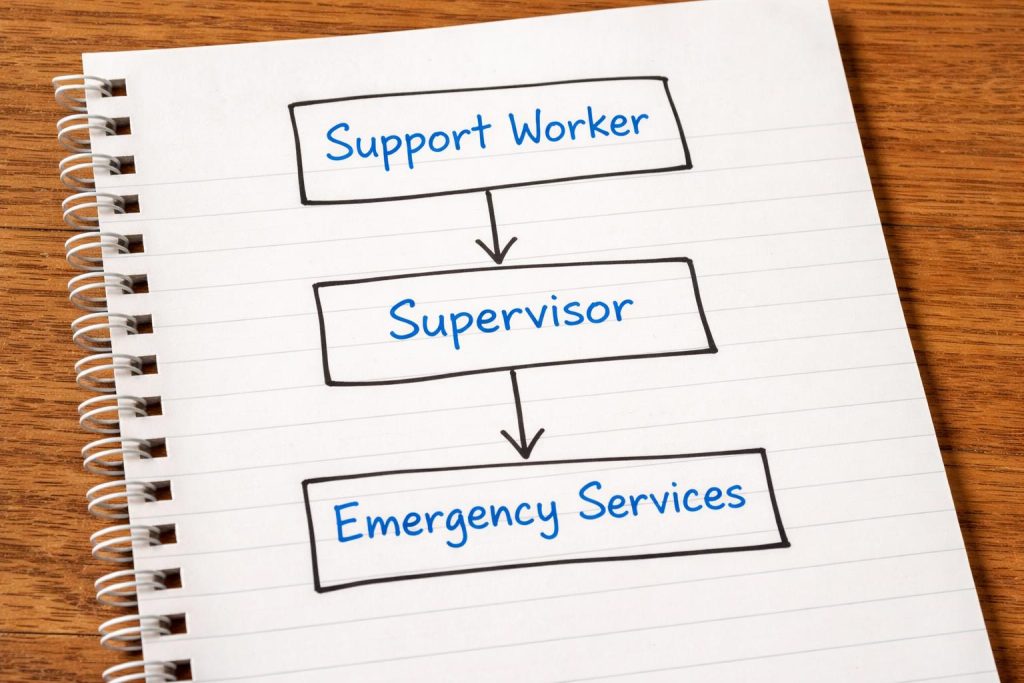
A support worker calls in sick at 5.30 am for a shift starting at 7 am. Another worker does not answer their phone. The participant needs assistance with their morning routine and cannot simply wait until the office opens. The roster coordinator does not start until 8.30 am, and the operations manager who normally deals with emergencies is asleep.
For an NDIS provider, this is not simply an inconvenient gap in the roster. Depending on the participant and the support involved, an unfilled shift can affect continuity of care, participant safety, medication support, personal care, community access, supervision, behaviour support arrangements or the participant’s ability to follow their normal routine.
The NDIS Practice Standards specifically address this operational challenge. Under the Core Module’s continuity-of-support requirements, registered providers are expected to manage day-to-day operations in a way that avoids disruption, ensure that a suitably qualified or experienced person performs a role when a worker is absent or a position is vacant, and maintain arrangements designed to provide supports without interruption throughout the service agreement. Where an interruption cannot be avoided, alternative arrangements must be explained and agreed with the participant and delivered in a way appropriate to their needs, preferences and goals.
That raises an important question for every provider operating outside standard office hours:
What actually happens when somebody cancels at midnight, fails to arrive for a sleepover, or calls in sick an hour before a critical morning shift?
At After Hours Response, this is exactly the operational gap our service is designed to help manage. Our 24/7 operations desk is built specifically for NDIS providers and includes after-hours management of sick calls, no-shows and last-minute roster changes. We can work from an organisation’s roster, call-out list and agreed business rules, contact potential replacement workers in the defined priority order, communicate with participants and families where required, document what occurred and provide the provider’s daytime team with a clear handover.
Effective NDIS roster management is therefore not about finding anybody who is willing to take a shift. It is about having an organised, participant-focused and employment-compliant process for determining how urgent the gap is, who can safely cover it, who must be informed, when management needs to become involved and what needs to be documented.
Why an after-hours roster gap is a continuity-of-support risk
There is a major difference between a normal scheduling inconvenience and a gap that could expose a participant to harm.
Consider two cancelled shifts.
In the first case, a support worker scheduled to assist a participant with a non-urgent community outing tomorrow afternoon becomes unavailable. The activity can potentially be rescheduled after discussion with the participant.
In the second, a worker scheduled to provide overnight support or assist a participant with personal care, transfers, medication-related support or a high-risk morning routine becomes unavailable at 11.30 pm.
Both are roster gaps, but they should not necessarily receive the same response.
This is why mature NDIS rostering needs to be risk-based rather than simply chronological. The NDIS Practice Standards expressly recognise proportionality: continuity arrangements should reflect the scope and complexity of the supports being delivered. They also require participant-specific needs and preferences to be documented and available to workers before support commences.
A useful after-hours system therefore asks more than, “Who can work this shift?”
It asks:
What happens to this particular participant if nobody is available?
That question changes the entire response.
A roster gap involving a participant who requires continuous supervision may need immediate escalation. A gap affecting a high-intensity support may require a worker with specific competence rather than the first person available. A worker replacement may also need to know participant-specific routines, communication requirements, risks, preferences, behaviour support arrangements or other information necessary to deliver safe and consistent support. The Practice Standards require registered providers to identify the knowledge and skills needed for roles, maintain relevant qualifications and experience records, provide appropriate training and make timely supervision and support available to workers.
For providers delivering supported independent living, this has become even more significant. From 1 July 2026, SIL providers within the new regulatory definition are required to register with the NDIS Quality and Safeguards Commission. The Commission describes SIL as support for people with higher support needs who require assistance at all or most times of the day, with the provider managing and delivering the support package. Registered SIL providers are consequently subject to registration requirements including audits, worker screening and incident-management obligations.
For After Hours Response, that means a call about a missing worker is not treated merely as a message for the scheduling team. Our service is designed around actioning roster issues during the period in which they occur. According to our current service model, sick calls, no-shows and last-minute cancellations can be managed overnight using provider-approved protocols rather than simply being placed in an inbox for somebody to investigate the next morning.
It is also important to distinguish between two different meanings of “cancellation”.
A participant cancellation is when a participant cancels a scheduled support and can involve service-agreement and NDIS pricing considerations. The NDIA maintains separate pricing arrangements governing cancellation claims and requires proposed changes to existing service agreements to be discussed with and agreed by participants.
A support worker cancellation, as discussed in this article, is when the worker who was supposed to deliver the support becomes unavailable, calls in sick, withdraws from the shift or simply does not arrive.
The operational issue is very different. When the worker cancels, the provider still has to determine how the participant’s planned support will be delivered.
That is why after-hours roster management should be viewed as part of a broader continuity-of-support system rather than an isolated scheduling function.
What the NDIS standards expect when a worker is absent
The strongest regulatory connection between rostering and NDIS service delivery appears in the Core Module of the NDIS Practice Standards.
Its stated continuity-of-support outcome is that participants have access to appropriate and timely support without interruption. The accompanying indicators require providers to manage normal operations efficiently to avoid disruption, arrange for appropriately qualified or experienced people to perform roles where workers are absent or positions are vacant, plan supports around individual participant needs and establish arrangements designed to maintain support throughout the service agreement.
This does not mean every sick call automatically constitutes a breach of the NDIS Practice Standards.
People become sick. Cars break down. Family emergencies happen. Workers resign. Unexpected absences are an unavoidable feature of running a workforce.
The compliance question is more likely to be about what systems the provider has established to anticipate and manage those events.
For example, a provider that has documented participant requirements, a current availability list, clearly defined escalation responsibilities, a replacement-worker process and an after-hours contact pathway is in a very different operational position from a provider whose entire contingency plan is “call the manager and see what happens”.
The Practice Standards reinforce this systems-based approach in several areas. Registered providers are expected to maintain risk-management systems covering human resources and operational management, maintain accurate and timely information systems, train workers in relevant procedures, provide timely supervision and resources, and use quality-management systems to support continuous improvement.
The NDIS Code of Conduct adds another layer. It requires providers and workers to deliver supports safely and competently, promptly raise and act on matters that may affect quality or safety, and take reasonable steps to prevent and respond to violence, exploitation, neglect and abuse. The Code applies not only to registered providers but also to unregistered NDIS providers, their key personnel and workers.
That makes the response to a serious roster failure particularly important.
Imagine that a worker does not attend an overnight shift and a participant who requires support is left unattended for a significant period.
A worker no-show is not automatically a reportable incident simply because the worker failed to attend. However, if the circumstances involve actual or alleged neglect, serious injury or another category of reportable incident, registered-provider reporting obligations may be triggered. The Commission requires registered providers to notify reportable incidents including death, serious injury, abuse or neglect, unlawful physical or sexual contact or assault, and sexual misconduct within specified timeframes; most of those categories require notification within 24 hours of the registered provider becoming aware of the incident.
This is another reason the after-hours function needs to connect rostering with incident escalation.
A scheduler looking exclusively at an empty shift sees a workforce problem.
A qualified after-hours responder should also be asking whether the participant has been left unsafe, whether essential support has been missed, whether there is an immediate health or safety concern and whether the situation needs to move from roster management into the organisation’s incident-management pathway.
At After Hours Response, roster issues sit alongside after-hours incident and emergency management rather than being treated as completely separate functions. Our current service model includes roster-gap management, incident triage and escalation, clinical escalation to Registered Nurses where relevant, and documented handover. That structure can help providers avoid a situation where a potentially serious roster failure remains buried inside a scheduling inbox until normal business hours.
The central principle is simple:
The aim is not just to fill a shift. The aim is to maintain appropriate support for the participant while managing the workforce problem safely and consistently.
Building an after-hours roster response system that actually works
A good after-hours roster process needs to remove uncertainty.
At 5.30 am, there should not be a debate about who has authority to call replacement workers, which workers should be contacted first, whether the participant’s family needs to know or when a manager should be woken.
Those decisions should already be built into the provider’s business rules.
A practical model can look like this:
| Stage | Key question | Practical after-hours action |
|---|---|---|
| Receive | What has happened? | Record who called, which shift is affected, the shift time, location, participant and reason for the absence where appropriate. |
| Verify | Is the worker definitely unavailable? | Confirm cancellation or investigate a no-show using the provider’s agreed process. |
| Assess | What happens if the shift is not filled? | Review participant needs, support type, timing, supervision requirements and known risks. |
| Prioritise | How urgent is replacement? | Assign a risk or urgency level according to provider-approved criteria. |
| Match | Who is suitable to cover? | Check competence, experience, availability, location, existing work and participant-specific requirements. |
| Call out | In what order should workers be contacted? | Use a pre-agreed call-out hierarchy rather than an improvised contact list. |
| Escalate | When does management need to become involved? | Trigger the nominated escalation pathway if coverage cannot be obtained or participant risk increases. |
| Communicate | Who needs to know? | Update the participant, nominee, family or other approved contacts according to the participant’s preferences and provider protocol. |
| Close and hand over | What happened overnight? | Document the final coverage position, contacts, decisions, unresolved risks and follow-up actions for the daytime team. |
This framework is an operational recommendation rather than a Commission-prescribed formula. Its purpose is to translate the NDIS continuity principles into something that can actually be used at 2 am.
The first stage should be structured intake.
When somebody rings to say they cannot work, the person answering needs enough information to act. “Sarah is sick” is not enough. The responder may need to establish which Sarah, which shift, what start time, which participant, whether another worker is already on site, whether the shift involves one participant or several, whether the absent worker has specialist responsibilities and how soon the gap becomes operationally critical.
For a no-show, the first call may come from the participant or another support worker rather than the absent employee. That means the responder must distinguish between a worker who has formally cancelled and a worker who may simply be late, unreachable or involved in an emergency.
The next stage is risk assessment.
Providers can establish categories appropriate to their environment. A lower-risk category might involve a support that can potentially be rescheduled with the participant’s agreement. A higher-priority category could involve personal care, active overnight support, high-intensity support, two-to-one staffing, transport essential to an appointment, medication-related assistance or any situation in which failure to provide the planned support creates a material participant safety concern.
The NDIS Practice Standards support this participant-specific and proportionate approach because they require continuity arrangements that reflect the scope and complexity of supports and alternative arrangements that are appropriate to each participant’s needs, preferences and goals.
Then comes worker matching.
“Available” does not automatically mean “appropriate”.
The person covering the shift should meet the competence and experience requirements relevant to the role and participant. The Practice Standards require providers to identify skills and knowledge required for positions, retain worker qualification and experience records, maintain training systems and ensure that participant-specific information is provided to workers before they commence support.
A robust NDIS roster management system might therefore restrict particular participants or shift types to a defined group of approved workers.
For example, your call-out rules may specify:
Only workers marked as competent for this participant’s support requirements may be offered this shift.
That removes a dangerous pressure from the person managing the problem overnight. Instead of having to decide at 3 am whether a particular worker is sufficiently experienced, they follow a rule that the provider has established in advance.
This is one of the areas where After Hours Response can fit into an existing provider structure. Rather than inventing operational rules on the provider’s behalf, the service can operate from the provider’s roster, call-out lists and agreed business rules. Our current service description specifically states that for sick-call scenarios, we can contact replacement workers in priority order, confirm coverage, communicate relevant updates and provide the scheduler with a documented roster reconciliation by morning.
That is the difference between outsourcing a phone and outsourcing an operational workflow.
Call-out, communication and escalation rules for common scenarios
One of the most valuable things an NDIS provider can do is decide before the event exactly what should happen in recurring roster scenarios.
Consider the 5.30 am sick call.
The worker rings to say they have woken with an illness and cannot attend their 7 am shift.
A weak process starts with a frantic group message:
“Can anyone work 7–3 today?”
A stronger process begins with participant impact.
What support is due at 7 am? Is another worker already present? Does the participant require two workers? Are there manual-handling, medication, personal-care, behaviour-support or communication considerations? Can the participant safely remain with current arrangements while the replacement search occurs? Who needs to be notified if the replacement will arrive late?
Once urgency has been established, the responder should follow a call-out hierarchy.
The hierarchy may prioritise workers already inducted to that participant, workers with the relevant competencies, permanent or casual staff who have stated availability, locality and travel time, or other criteria chosen by the provider.
A useful hierarchy could move through several predefined pools rather than contacting the entire workforce simultaneously. The exact sequence is an organisational decision and should align with employment arrangements, applicable industrial instruments and participant requirements.
The same principle applies to a midnight support worker cancellation.
Imagine a worker scheduled to start an active overnight shift at midnight calls at 10.45 pm.
The person receiving the call should immediately know how long they have before the participant is affected, whether the outgoing worker can lawfully and safely remain for any additional period, which replacement workers meet the participant’s requirements and at what point management must be notified.
The response to a no-show should be more structured still.
If a worker simply does not arrive, an effective protocol might require the after-hours responder to check the roster, attempt contact through approved channels, confirm the situation with the worker already on site or participant where appropriate, and then commence replacement escalation without allowing repeated unsuccessful calls to consume the entire response window.
For providers with several houses, services or regions, escalation thresholds are particularly valuable.
For example:
| Scenario | Example operational response |
|---|---|
| Replacement obtained well before shift | Confirm coverage, update roster and document the change. |
| Replacement obtained but likely to arrive late | Determine participant impact and notify appropriate participant/support-network contacts under the provider’s protocol. |
| No replacement after first call-out pool | Move to secondary call-out pathway and notify designated team leader if required. |
| Critical support remains uncovered | Immediate senior-management escalation under the provider’s continuity plan. |
| No-show may have exposed participant to harm or neglect | Activate incident-management pathway as well as roster response. |
| Clinical concern emerges during the disruption | Escalate through the provider’s clinical or emergency pathway rather than treating it purely as rostering. |
Again, these are suggested operational categories rather than regulatory categories prescribed by the Commission.
The point is to prevent a 2 am responder from having to make governance decisions that should have been made at 2 pm when the organisation designed its procedures.
Communication with participants is equally important.
The NDIS Practice Standards require unavoidable alternative continuity arrangements to be explained and agreed with participants and delivered in a way appropriate to their needs, preferences and goals. They also require supports to be planned with participants and their relevant needs and preferences to be documented.
That does not mean every participant should receive a phone call every time an internal worker change occurs.
Some participants may want to know immediately when a familiar support worker changes. Others may not want to be disturbed at 5.45 am if their support will still arrive at the agreed time. A family member or nominee may need to be notified in particular circumstances. Communication requirements should therefore be participant-specific and built into the business rules rather than improvised.
After Hours Response can help providers put those instructions into the after-hours workflow. When we operate from agreed protocols, the objective is for the responder to know not only which workers to call but also who should be informed, when they should be informed and when the issue moves beyond routine rostering into management or incident escalation. Our current service model includes first-point-of-contact support for staff, participants and families, roster issue management, incident escalation and documented handover.
This becomes particularly useful when several problems happen simultaneously.
Suppose two workers cancel at 5.30 am.
One shift is a community-access support at 10 am. The second is a 7 am personal-support shift for a participant with more complex needs.
An organised system should not simply deal with whichever cancellation arrived first. It should prioritise based on participant impact.
This is where after-hours rostering becomes genuine operations management.
Employment obligations and workforce safeguards must sit behind the process
Finding a willing replacement is only one part of the problem.
Providers also need to consider whether asking that worker to cover the shift is consistent with the worker’s employment conditions.
The Social, Community, Home Care and Disability Services Industry Award — usually called the SCHADS Award — covers many employers and workers providing disability services, including personal care and disability support in community and residential settings. However, it does not cover every worker in the NDIS sector. Some employees can be covered by another modern award, such as the Nurses Award, or by an enterprise agreement or other applicable industrial instrument. Providers should therefore confirm which employment rules apply to their workforce rather than assuming every employee is governed by identical rostering conditions.
This matters directly to last-minute call-outs.
Under current SCHADS guidance, workers are generally entitled to a minimum rest period of at least 10 hours between rostered work, although this can be reduced to eight hours by agreement in some circumstances. Importantly for overnight support providers, current SCHADS rules provide that a sleepover does not count as the break between rostered shifts.
Changes relating to sleepovers also took effect from the first full pay period starting on or after 1 June 2026. Current Fair Work guidance includes minimum work/payment requirements around work before or after a sleepover and explains how sleepover periods interact with shift length and rest.
The practical lesson for after-hours rostering in NDIS services is that the person managing a gap should not simply work down a list until somebody says yes.
Suppose a worker finished another demanding shift late that evening.
They may be willing to help at 6 am, particularly if they know the participant well. But an effective roster process should screen relevant employment and rest requirements before confirming the replacement rather than discovering the problem afterwards.
This is why provider call-out lists are more useful when they contain meaningful availability information rather than simply names and mobile numbers.
The organisation might maintain information such as current availability, approved participant/service group, relevant skills, geographical area, whether a worker is already rostered elsewhere and other operational restrictions appropriate to its workforce.
The human-resource section of the NDIS Practice Standards also requires registered providers to keep worker contact details current and maintain information about relevant qualifications and experience, while continuity standards require a suitable person to perform the role when a worker is absent.
Another consideration is on-call work.
Under SCHADS Award guidance, an employee who is required to remain available to be recalled to work can be entitled to an on-call allowance, including where the recall involves returning to a workplace or client’s premises or undertaking remote work.
Providers should therefore distinguish between a formal on-call workforce and an informal practice of repeatedly ringing off-duty staff overnight.
That distinction has become more important since the introduction of Australia’s right to disconnect.
The right to disconnect has applied to employees of non-small-business employers since 26 August 2024 and to employees of small-business employers since 26 August 2025. Employees can refuse to monitor, read or respond to work-related contact outside their working hours unless that refusal would be unreasonable. Factors relevant to whether refusal is unreasonable include the reason for contact, its disruptiveness, whether the employee receives additional compensation for availability or additional hours, their role and responsibilities and their personal circumstances.
Fair Work also notes that awards can contain specific provisions relevant to outside-hours contact, including circumstances involving employees who are paid an on-call allowance.
That does not mean a provider can never phone an off-duty employee and offer a vacant shift. Nor does the right to disconnect make outside-hours contact itself unlawful. The legislation is focused on an employee’s right to refuse to monitor or respond to contact where that refusal is not unreasonable.
It does, however, strengthen the case for having a properly designed workforce-availability and call-out model instead of relying on a cultural expectation that “everyone answers their phone because this is disability support”.
Providers should also be aware that regular roster changes can attract consultation obligations. Fair Work states that where an employer proposes to change an employee’s regular roster or ordinary hours, the employer must provide information about the change, invite affected employees to give their views and consider those views. Awards and enterprise agreements can contain additional requirements.
Sick calls themselves also need to be handled as employment matters, not treated as misconduct simply because they cause an operational problem. Under the National Employment Standards, full-time and part-time employees accrue paid personal/carer’s leave, while casual employees do not receive paid sick leave under that entitlement. Employees may also be required to provide appropriate notice or evidence.
All of this means the call-out process needs two lenses operating at once:
Can this worker appropriately support this participant?
and
Can this shift be offered and worked consistently with the employment arrangements applying to this worker?
After Hours Response can operate inside the business rules established by the provider, but the provider remains responsible for setting those rules appropriately for its workforce, award coverage, employment agreements and participant requirements. For this reason, providers should obtain workplace-relations advice where necessary when designing their underlying call-out and rostering rules.
A good after-hours system does not replace sound HR and employment practices. It operationalises them.
Documentation, handover and continuous improvement
A roster gap is not completely resolved when a replacement worker says, “Yes, I’ll do it.”
The organisation should still be able to determine what happened.
Who called in sick?
When was the organisation notified?
Which participant and shift were affected?
When did the replacement search begin?
Which workers were contacted?
Who accepted?
Was the participant informed?
Did the replacement start on time?
Was there any period without planned support?
Did the disruption create a participant safety issue?
Was a manager notified?
Does anything require follow-up during business hours?
These details matter because the NDIS Practice Standards connect continuity of supports with broader requirements for information, quality and risk management. Registered providers are expected to maintain information systems that record participant information accurately and in a timely manner, maintain quality systems supporting continuous improvement and review operational risks and processes relevant to service delivery.
Good documentation also protects the morning team from having to reconstruct the night from missed calls, text messages and fragments of information.
Consider the difference between these two handovers.
Handover A:
Sarah called in sick. James covered.
And:
Handover B:
05:31 — Worker A notified after-hours desk that they could not attend 07:00–15:00 shift.
05:34 — Participant requirements and approved replacement pool checked.
05:38 — Worker B contacted; unavailable.
05:43 — Worker C contacted; confirmed availability and participant competency.
05:49 — Worker C accepted 07:00–15:00 shift.
05:52 — Roster coverage confirmed. No anticipated interruption to participant support.
Follow-up: update payroll/rostering system and review Worker A absence through normal HR process.
The second record provides operational visibility.
It helps the daytime scheduler see whether the shift was genuinely resolved and allows managers to look for patterns over time.
For example, repeated after-hours gaps may reveal that one geographical area has insufficient workforce depth. A particular Sunday morning shift may repeatedly fail. One house may be overly reliant on a small group of workers with specialised competencies. A provider may discover that cancellations are being resolved but only after managers make dozens of phone calls overnight.
Those are not simply individual staffing events. They are workforce-planning information.
The NDIS Commission has published workforce-management planning material intended to help providers analyse workforce needs, characteristics and priorities, and it specifically raises continuity concerns when workforce structures — such as a high proportion of short-tenure casual staff — contribute to inconsistent support.
That is why After Hours Response’s value is not limited to answering the original sick call.
Our current service model places emphasis on documenting after-hours events and providing them back to the provider’s team. The website describes compliance and handover as a core service alongside roster issue management, with events documented before the day team logs in.
Over time, structured after-hours records can help a provider answer questions such as:
Which shifts generate the most cancellations?
How frequently are gaps filled from the first call-out pool?
How long does it typically take to confirm replacement coverage?
Which participants have particularly limited replacement-worker pools?
How often do sick calls become management escalations?
How often are participants affected by delayed support?
Are directors and senior managers still being called for issues that should be handled operationally?
Which roster gaps are repeatedly occurring on weekends or public holidays?
These are useful operational indicators because they move the conversation from anecdote to evidence.
Instead of saying, “We seem to have a lot of weekend roster problems”, management can identify where the problems are occurring and adjust recruitment, availability arrangements, training, onboarding or roster design accordingly.
Documentation should also record failed resolution, not only success.
Sometimes there simply will not be an immediately available replacement.
A strong system should make that visible quickly and trigger the provider’s approved contingency pathway rather than continuing a low-probability phone search indefinitely.
That contingency might involve senior operational escalation, an alternative support arrangement agreed with the participant, coordination with another authorised service resource, changes to timing or another provider-specific continuity measure. The appropriate response depends on the participant, the support and the provider’s existing arrangements. The NDIS Practice Standards explicitly contemplate circumstances in which interruptions cannot be avoided and require alternative continuity arrangements to be explained and agreed with the participant and delivered appropriately.
And if the failure to provide support has created or allegedly created neglect, serious injury or another reportable incident category, the response needs to transition into the provider’s incident-management system rather than remaining a roster note.
This joined-up approach is crucial.
Roster management asks who is covering the shift.
Incident management asks whether something has happened to the participant that now requires safeguarding, investigation, escalation or notification.
A mature after-hours operation needs to recognise when one has become the other.
How After Hours Response can support your NDIS roster management
For many NDIS providers, the hardest part of after-hours rostering is not designing the policy.
It is making sure somebody is actually available to execute it.
A beautifully written continuity-of-support procedure does not fill a 7 am shift when somebody rings in sick at 5.30 am.
A call-out hierarchy does not help if the only person with access to it is asleep.
An escalation matrix does not protect participants if workers do not know who will answer the telephone.
This is the operational gap After Hours Response is designed to help close.
After Hours Response describes its service as a 24/7 operations desk built specifically for NDIS providers. Its current service offering includes after-hours call handling, incident and emergency management, shift and roster issue management, clinical escalation, documentation and handover, and after-hours enquiry management. The organisation states that sick calls, no-shows and last-minute cancellations can be actioned overnight rather than simply logged for the morning team.
For roster issues, the model is designed to work from the NDIS provider’s existing operating environment.
That can include the provider’s roster, approved worker lists, escalation contacts and agreed business rules. In the specific example published by After Hours Response involving two workers calling in sick at 5.30 am for a 7 am shift, the stated process is to work through the provider’s call-out list in priority order, contact replacement staff, confirm coverage, communicate with participants or families where required and hand a documented roster reconciliation to the scheduler by morning.
In practical terms, that can help providers move from:
“Ring the director if something happens.”
to:
“Follow the approved after-hours process, resolve what can be resolved and escalate only what genuinely requires senior management.”
That distinction matters operationally and is increasingly relevant in the context of Australia’s right-to-disconnect framework. Employees across both small and larger businesses now have the right to refuse out-of-hours contact where the refusal is not unreasonable, with the circumstances of the contact, compensation for availability, role and personal circumstances forming part of the assessment.
A managed after-hours operating model does not remove the need for senior escalation. There will always be situations where a manager, executive, clinician or other nominated person needs to make a decision.
The goal is to make those escalations intentional.
A director should ideally be contacted because a critical support remains uncovered and executive authority is genuinely required — not because they happen to be the only person whose mobile number everybody knows.
That is where After Hours Response can help.
We can provide the operational layer between frontline staff and your daytime management team, using your approved protocols to handle routine after-hours activity, resolve roster gaps where possible, escalate according to agreed thresholds and leave a documented record for your team.
This approach can be particularly valuable for organisations providing 24-hour or extended-hours supports, SIL services, complex supports, community access across multiple shifts or services operating across several locations.
It can also help growing providers.
A small provider may initially manage sick calls informally because there are only a handful of workers. As the organisation grows to dozens of employees, multiple participants and several concurrent shifts, the informal approach can become increasingly fragile. More people are calling, more schedules overlap and the person answering the phone needs access to more information.
At that stage, NDIS roster management becomes an operating system rather than an administrative task.
The questions providers should be asking include:
Do workers know exactly who to call when they cannot attend an after-hours shift?
If the answer is “the group chat”, “whoever is on Teams” or “probably the manager”, the process may be too dependent on individuals.
Does the person answering have access to the information required to resolve the issue?
A phone-answering service without roster access, participant context, escalation instructions or an authorised call-out process can do little more than take a message.
Is there a defined replacement-worker hierarchy?
Without one, workers may be contacted inconsistently or unsuitable workers may be offered shifts under pressure.
Does the process check participant requirements before assigning a replacement?
The Practice Standards require continuity arrangements and suitably qualified or experienced replacement workers, not simply a warm body in the roster.
Are employment conditions considered when somebody is asked to cover?
Applicable award, agreement, rest, overtime, sleepover, on-call and roster provisions need to sit behind the provider’s business rules.
Is there a point at which an unfilled shift becomes a management or incident escalation?
That point should ideally be defined before the event.
Will the participant or family know what is happening?
Where a change affects the participant, communication should follow the participant’s documented preferences and the provider’s continuity arrangements.
Will your scheduler know what happened when they arrive in the morning?
If the answer requires searching through SMS messages and calling the night staff, the documentation process may need improvement.
These questions are at the heart of reliable after-hours rostering for NDIS providers.
A support worker cancellation will always create some operational pressure. The goal is not to eliminate every cancellation. No provider can prevent every illness, emergency or no-show.
The goal is to make the organisation resilient when they occur.
That means having a known contact point, participant-specific risk information, appropriate replacement pools, clear worker-availability rules, employment-compliant call-out processes, participant communication protocols, escalation thresholds and a reliable record of the response.
After Hours Response can help put that system into action overnight, on weekends and on public holidays — when your normal rostering and operations team may not be available. Our service is designed around qualified after-hours response rather than simple message-taking, with roster management forming part of a broader model that also includes incident escalation, clinical escalation and documented morning handover.
Is every support worker no-show an NDIS reportable incident?
No. A no-show or sick call is not automatically a reportable incident. However, if the circumstances involve or allegedly involve neglect, serious injury or another reportable category, a registered provider may have NDIS Commission reporting obligations. Most serious reportable-incident categories must be notified within 24 hours of the registered provider becoming aware of the incident.
What do the NDIS Practice Standards say about worker absence?
For registered providers subject to the relevant Core Module requirements, the continuity-of-support indicators state that operations should be managed to avoid disruption and that, where a worker is absent or a role is vacant, an appropriately qualified or experienced person should perform the role. Providers should also maintain arrangements for uninterrupted support and appropriate alternative arrangements when interruption is unavoidable.
Should an NDIS provider contact off-duty workers to fill an overnight shift?
Providers need to consider the worker’s applicable employment arrangements. The right to disconnect allows employees to refuse outside-hours contact unless refusal would be unreasonable, and modern awards or agreements can contain additional provisions. SCHADS guidance also contains specific rules concerning on-call arrangements and rest between rostered work.
Can any available support worker fill an NDIS roster gap?
Availability alone should not be the criterion. The Practice Standards require registered providers to consider competence, qualifications, experience, training and participant-specific requirements and require a suitably qualified or experienced person to perform the role when another worker is absent.
What should be documented when an after-hours roster gap occurs?
As an operational best practice, providers should capture the affected participant and shift, time of notification, worker absence or no-show, participant-risk assessment, replacement attempts, confirmed coverage, communications, escalation decisions and any outstanding morning actions. This supports the broader Practice Standards expectations around timely and accurate information management, risk management and continuous improvement.
Can After Hours Response manage sick calls and roster gaps for us?
Yes. After Hours Response’s current service offering specifically includes shift and roster issue management for sick calls, no-shows and last-minute cancellations. The service can operate from provider-supplied rosters, call-out lists and agreed business rules, contact replacements in priority order, confirm coverage, communicate relevant updates and provide a documented handover to the provider’s daytime team.
What happens when After Hours Response cannot find a replacement?
The objective should never be to hide an unresolved roster gap. The issue should move through the provider’s agreed escalation and continuity pathway according to participant risk. Depending on the circumstances, this may require management escalation, alternative participant arrangements, clinical input, an incident response or emergency action. The NDIS Practice Standards require alternative continuity arrangements where interruptions are unavoidable and require those arrangements to be appropriate to the participant’s needs, preferences and goals.
Does outsourcing after-hours roster management remove the provider’s NDIS responsibilities?
No. Outsourcing an operational function does not remove the NDIS provider’s underlying responsibilities. After Hours Response can help execute agreed processes, document activity and escalate issues, while the provider retains responsibility for its governance, workforce arrangements, participant supports and applicable regulatory obligations. The NDIS Practice Standards place governance, risk management, human-resource management and continuity responsibilities on the registered provider.
Need a more reliable way to manage NDIS sick calls, no-shows and last-minute roster gaps after hours?
Contact After Hours Response to discuss how a managed 24/7 operations desk could work with your existing roster, call-out hierarchy, participant protocols and escalation pathways.
We can help you build an after-hours process in which sick calls are actioned, replacement workers are contacted according to your agreed rules, participants and families are kept informed where required, unresolved risks are escalated appropriately and your daytime rostering team receives a documented handover rather than a backlog of unanswered calls.
After Hours Response is based in South Melbourne and can be contacted on 03 7058 0720 or info@ahresponse.com.au. An Info Pack and pricing information are also available through the After Hours Response website.
For NDIS providers, the real question is not whether another worker will eventually call in sick.
It is:
When the next 5.30 am sick call arrives, does your organisation already know exactly what happens next?
With a structured NDIS roster management process — and the right after-hours operational support behind it — a last-minute cancellation can remain a manageable staffing event instead of becoming a participant-safety, workforce or compliance problem by breakfast.