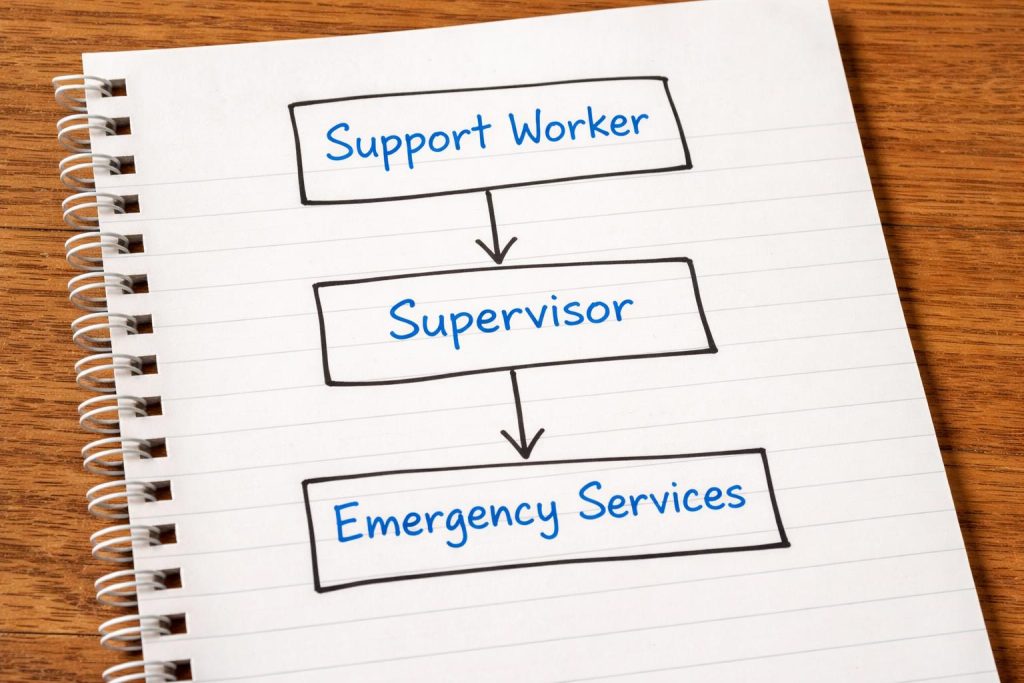
At 10.00 pm, a support worker calls to report unexplained bruising on a participant. The participant appears distressed but cannot clearly explain what happened. The worker does not know whether the injury resulted from an accident, abuse or neglect. The office is closed. The compliance manager will not be back until 8.30 am.
What happens next?
For a registered NDIS provider, the safest answer is not simply, “Write an incident report and we’ll look at it in the morning.”
Under the current NDIS reportable incident framework, a reportable incident can be an act or event that has happened or is alleged to have happened in connection with the delivery of NDIS supports or services. Registered NDIS providers must notify the NDIS Quality and Safeguards Commission of reportable incidents, and five of the major categories have a 24-hour notification timeframe calculated from when the registered provider became aware of the incident.
That creates an obvious operational challenge: serious incidents do not restrict themselves to Monday-to-Friday office hours.
A disclosure at 10.00 pm, an unexplained injury discovered during an overnight shift, an allegation made by a family member on Saturday afternoon or a potentially unauthorised restrictive practice used at 2.00 am all need a clear pathway for immediate safety, escalation, documentation and, where required, notification.
That is precisely the gap After Hours Response is designed to help NDIS providers manage. After Hours Response operates a 24/7 operations desk specifically for NDIS providers, with Registered Nurses, NDIS-experienced auditors and senior operations personnel available to handle incidents, triage concerns, escalate events under agreed protocols and provide documented handover rather than simply taking a message for the next business day.
This guide explains NDIS reportable incidents, NDIS 24 hour incident reporting, the relevant NDIS incident reporting timeframes, what your team should capture overnight and how to build an after-hours escalation process that works when a serious concern arises at 10.00 pm rather than 10.00 am.
Regulatory information in this article has been checked against NDIS Commission and Australian Government sources current as at 19 August 2026. It is general information rather than legal advice. Providers should assess their individual circumstances and any other Commonwealth, state or territory obligations that may apply.
Why the NDIS 24-hour reporting rule matters after hours
NDIS incident management and NDIS reportable incident notification are related, but they are not the same thing.
The NDIS Commission describes an incident as an act, omission, event or circumstance that has or could have caused harm to a person with disability, or a situation where a person with disability has caused serious harm or the risk of serious harm to another person. Incidents connected with NDIS supports and services need to be identified, assessed, recorded, managed and resolved with the safety, dignity and involvement of the person with disability at the centre of the response.
A reportable incident is a particular category of serious incident — including certain alleged acts — that a registered NDIS provider must notify to the NDIS Commission. Recording an incident internally does not remove that external reporting obligation. The Commission expressly states that registered providers must notify reportable incidents even where those incidents have already been recorded and responded to through the provider’s own incident management system.
The legal framework remains grounded in the National Disability Insurance Scheme Act 2013 and the National Disability Insurance Scheme (Incident Management and Reportable Incidents) Rules 2018, which the Commission continues to list as part of the applicable NDIS legislative and rules framework in 2026. Section 73Z of the NDIS Act deals with reportable incidents for registered NDIS providers.
The practical difficulty is that the most serious categories are measured in hours, not office days.
According to the Commission’s current guidance, the following notification periods are calculated from when a registered NDIS provider became aware of the reportable incident.
| NDIS reportable incident | Current Commission notification timeframe |
|---|---|
| Death of a person with disability | 24 hours |
| Serious injury of a person with disability | 24 hours |
| Abuse or neglect of a person with disability | 24 hours |
| Unlawful sexual or physical contact with, or assault of, a person with disability | 24 hours |
| Sexual misconduct against, or in the presence of, a person with disability, including grooming for sexual activity | 24 hours |
| Unauthorised restrictive practice, or a restrictive practice not used in accordance with the person’s behaviour support plan | 5 business days in the ordinary case |
| Unauthorised restrictive practice that results in harm to the person with disability | 24 hours |
These are the current timeframes published by the NDIS Commission.
The distinction between 24 hours and five business days is important. The Commission does not describe the serious categories as being due by “the next business day”. Accordingly, providers should not design their internal process on the assumption that evenings, weekends or public holidays suspend a 24-hour reporting period. That is a practical consequence of the Commission specifying a 24-hour period for those categories while expressly specifying “five business days” for the non-harm unauthorised restrictive practice category.
This is why after-hours incident management should be considered part of a provider’s compliance infrastructure rather than simply a telephone-answering function.
A report received late at night can require immediate participant support, emergency or police involvement, internal escalation, assessment of potential reportability, preservation of information and access to someone capable of progressing the Commission notification process. The Commission’s incident management guidance states that a provider’s response plan should cover immediate health and safety measures, steps for reducing immediate risks and where and how an incident should be reported to key personnel or to the NDIS Commission if it is or could be reportable.
There are also genuine regulatory consequences when incident reporting systems fail. In January 2026, the NDIS Commission announced that the Federal Court had imposed a $1.1 million penalty on Oak Tasmania following serious safety and reporting failures. Oak admitted 474 contraventions of the Reportable Incidents Rules, and $350,000 of the total penalty related specifically to those reporting-rule contraventions. The Commission reported that the Court considered the extensive reporting failures to have deprived the regulator of timely information and compromised its ability to keep participants safe.
The lesson is not that every late incident inevitably leads to a major enforcement outcome. It is that timely reporting is itself a regulatory obligation, rather than administrative paperwork that can automatically be deferred until somebody in the quality team returns to the office. The Commission warns that failing to report within the required timeframe may result in an infringement notice or other compliance action.
For After Hours Response, that distinction is central. Our role is not merely to answer an after-hours phone. We can help providers ensure that incidents reported overnight enter a defined operational pathway: immediate risks are identified, the event is timestamped and documented, the provider’s nominated personnel are escalated to under agreed protocols, and the information needed for the next compliance step is not lost during the overnight period. Our current service includes incident triage, escalation, Commission-aligned reporting support, clinical escalation and documented morning handover.
What counts as an NDIS reportable incident?
One of the most dangerous assumptions in incident management is that the provider needs to establish exactly what happened before considering whether an event is reportable.
The Commission’s definition is deliberately broader than confirmed wrongdoing. A reportable incident is an act or event that happened or is alleged to have happened in connection with the delivery of NDIS supports or services. The Commission’s incident-management material similarly describes reportable incidents as including some serious acts or alleged acts.
That matters enormously after hours, when the first information is often incomplete.
A worker may report bruising but not know how it occurred. A participant may disclose that somebody hurt them but be unable or unwilling to give a complete account. A family member may make an allegation against a worker. Two workers may give conflicting explanations. A participant may require hospital care before the provider has been able to investigate exactly what went wrong.
The absence of a completed internal investigation should not become a reason to let a potentially reportable incident sit untouched overnight.
The Commission illustrates this through its current incident-management case study involving “Bonnie”, a participant whose support worker noticed bruising and signs of distress. The source of the bruising was initially unexplained. The provider treated the matter as potentially involving abuse or neglect, followed its escalation procedure and notified the Commission within 24 hours. A subsequent internal review found no staff misconduct — but the later outcome did not invalidate the need to respond to the initial safeguarding concern.
That is a useful principle for provider teams: reportability and proof are different questions.
Death of a person with disability
Death is one of the reportable incident categories subject to the 24-hour notification period where the reportable incident requirements apply. Providers should also remember that an immediate regulatory notification is not a substitute for the emergency, clinical, police or other processes that may be necessary in the circumstances.
For an after-hours team, the first priority must therefore be safety and emergency response, not form filling. After Hours Response can provide a structured first point of contact and follow the provider’s nominated emergency and escalation protocols, while the registered provider retains responsibility for its regulatory obligations.
Serious injury of a person with disability
Serious injury is also subject to the 24-hour NDIS reportable incident notification timeframe.
An after-hours responder should not be expected to conduct a complex legal analysis from a single hurried phone call. What matters operationally is that the worker can communicate what has occurred, what injury or deterioration is apparent, what treatment has been provided or requested, whether emergency assistance is required and who inside the provider organisation needs to be notified.
Where there is an immediate medical need, the Commission’s incident-management guidance is unequivocal about the priority: call 000 and do not delay that action.
After Hours Response’s service model includes Registered Nurses as an available clinical escalation point for frontline workers, with triage, guidance and onward referral to a participant’s GP or emergency services where required. That can be particularly valuable overnight, when a frontline worker may otherwise be trying to decide alone whether a clinical change is urgent.
Abuse or neglect
Abuse or neglect of a person with disability is a 24-hour reportable incident category.
The provider may not receive the concern in a neat incident-report format. The Commission notes that incidents can be identified through a worker who witnessed something, a participant’s disclosure, another person providing information, or indirect indicators such as changed behaviour or physical evidence.
This means an after-hours reporting pathway needs to be accessible to the people who may first notice the problem — not only to managers.
A worker who discovers unexplained bruising at midnight needs to know whom to contact. A participant who tells a night-shift worker they are afraid of another staff member needs a pathway. A family member who calls at 9.30 pm with a serious allegation should not necessarily be sent to voicemail until Monday.
After Hours Response can act as that first after-hours contact under a provider-specific protocol, allowing a qualified responder to capture the disclosure, assess immediate safety needs, escalate it to the appropriate nominated person and create a documented chronology for the provider’s follow-up.
Unlawful sexual or physical contact, or assault
Unlawful sexual or physical contact with, or assault of, a person with disability is another category requiring notification within 24 hours.
Again, participant safety takes precedence over the regulatory form. The NDIS Commission says providers should call 000 where immediate medical care is required or a criminal offence is suspected, and should not delay that action.
The after-hours process should then preserve a clear factual account without asking untrained staff to determine guilt or innocence. A good incident record distinguishes between what was observed, what was reported or alleged, what the participant said, what the worker said, what action was taken and what remains unknown.
That distinction becomes important when information is later reviewed by management, an investigator or a regulator.
Sexual misconduct, including grooming
Sexual misconduct against, or in the presence of, a person with disability — including grooming the person for sexual activity — is also in the Commission’s 24-hour category.
The fact that grooming is expressly included is a reminder that a reportable concern need not necessarily present as a completed physical act. Providers need staff who understand that disclosures and concerning behaviour should be escalated rather than informally rationalised or left for later consideration.
A competent overnight response should focus on the participant’s immediate safety and wellbeing, preserving the information provided, following applicable safeguarding and emergency pathways and rapidly reaching the provider’s nominated decision-maker.
Unauthorised restrictive practices
Unauthorised restrictive practices operate on a different default timeframe.
The Commission currently states that the use of a restrictive practice that is unauthorised under the relevant state or territory requirements, or that does not follow the person’s behaviour support plan, must ordinarily be notified within five business days. Where that incident has resulted in harm to the person with disability, however, the notification timeframe is 24 hours.
This is a common area in which an after-hours triage process needs to capture enough information to make the distinction visible to the provider’s responsible personnel.
The overnight question is not merely “Was a restrictive practice used?” The handover should establish, as far as the available facts permit, what was done, why it was done, whether it was authorised and consistent with the relevant behaviour support plan, how long it continued, what impact it had and whether the participant experienced harm.
After Hours Response can work from provider-approved restrictive-practice and escalation protocols so that the right internal people receive the right information promptly, rather than asking a lone night worker to navigate the entire compliance question without support. After Hours Response identifies restrictive-practice protocols as part of its NDIS-specific after-hours capability.
When does the 24-hour NDIS incident reporting clock start?
This is one of the most important questions in NDIS 24 hour incident reporting.
The Commission’s current public guidance states that reportable incident notification timeframes are calculated from when a registered NDIS provider became aware of the incident.
That is not necessarily the same time the underlying event occurred.
Consider three different situations:
| Situation | Operational issue |
|---|---|
| An incident happens at 2.00 pm and is immediately reported internally | Incident time and awareness time may be close together |
| A participant tells a worker at 10.00 pm about something alleged to have happened the previous week | The event may be old, but the provider has only now received the disclosure |
| Unexplained injuries are discovered overnight and the cause is unknown | The exact incident time may be unknown, while the concern itself has become known |
The Commission’s Immediate Notification portal reflects this distinction. Its guidance asks providers to record information about when the incident or allegation occurred, including the possibility that the occurrence date is unknown, as well as the date and time key personnel were informed. The portal also includes fields for the date and time the first worker became aware, along with that worker’s identity and role.
There is therefore a strong practical reason for providers to capture multiple timestamps, rather than relying on a single vague note such as “incident reported overnight”.
At minimum, an after-hours chronology should preserve:
when the incident allegedly occurred, if known; when the first worker or other person became aware; when the concern was communicated through the provider’s reporting channel; when key personnel or the nominated escalation contact were notified; what immediate action followed; and when the reportable-incident decision and Commission submission were progressed.
That chronology makes it much easier to demonstrate what the organisation knew and what it did with that information.
There is an important nuance here. The Commission’s current public page describes the clock as running from when the registered provider became aware, while its portal separately records both first-worker awareness and when key personnel were informed. Rather than building an operational process around a technical argument about exactly whose knowledge constitutes provider awareness in every possible factual scenario, a risk-controlled approach is to instruct staff to escalate a credible serious incident immediately and preserve both timestamps.
That is an operational recommendation, not an attempt to redefine the legal test.
For example, imagine a worker learns of a potential abuse incident at 10.00 pm on Tuesday. A weak system allows the worker to leave a note for a manager to find at 9.00 am Wednesday. A stronger system immediately timestamps the disclosure, confirms the participant’s safety, contacts the nominated on-call function, records the known information and starts the escalation pathway.
This is where After Hours Response can help remove a common overnight failure point. Instead of relying on the worker to determine which manager might answer their phone, After Hours Response can provide the agreed after-hours contact point, document when the report was received and escalate it in accordance with the provider’s pre-agreed business rules.
A saved draft is not the same as a submitted notification
Another important operational trap is assuming that somebody has “done the report” because a draft exists in the portal.
The Commission’s Immediate Notification guide distinguishes a saved draft from a submitted notification. A person with the Provider Authorised RI Notifier role can prepare the information, but the guide states that only a Provider Authorised RI Approver can submit the Immediate Notification. If a Notifier saves the form as a draft, the Approver still needs to review and submit it.
The Commission’s 5 Day Notification guide makes the principle especially clear: the reporting obligation is not met until the incident has been submitted, and the relevant timeframe applies to the submission time rather than the time at which the record was created.
For providers, this creates a very practical question:
Who has RI Approver access at 11.30 pm on a Saturday?
It is a poor time to discover that the only authorised approver is on annual leave, does not have their login available or assumed somebody else would submit the notification.
Portal access, authorisation roles and backup arrangements therefore belong in the provider’s incident-response design before a serious after-hours incident occurs.
After Hours Response can support the information-capture, triage and escalation pathway, but outsourcing an operational function does not remove the registered provider’s underlying regulatory responsibility. Providers should clearly allocate who makes the relevant reporting determination and who has authority and access to complete the required submission.
What should happen when an NDIS incident is reported overnight?
A strong after-hours system does not begin with, “Is this definitely reportable?”
It begins with, “Is everybody safe?”
The Commission’s incident-management guidance puts immediate support near the beginning of the response process. Providers should make sure those affected are safe and well and should call 000 if immediate medical care is needed or a criminal offence is suspected, without delaying that action.
A practical after-hours pathway can be organised around four actions: safety, capture, escalation and continuity.
Safety comes first. Determine whether the participant or anybody else faces an immediate risk. Does somebody require an ambulance? Is emergency medical attention needed? Is a suspected criminal offence involved? Does the participant need to be separated from a person alleged to have caused harm? Is there an immediate staffing, environmental or clinical risk? The precise response will depend on the circumstances and the provider’s policies, but the regulatory notification should never delay emergency action.
Capture the facts early. The initial account can change or become harder to reconstruct over time. Record the time, source of the information, what was directly observed, what was alleged, what the participant communicated, who was present and what actions have already occurred. The Commission requires incident details and evidence to be recorded and stored in a way that maintains affected people’s privacy and confidentiality.
Escalate rather than investigate by telephone. The first responder’s job is generally not to conduct a full investigation. It is to identify the seriousness of the concern, preserve what is known, make sure the participant is supported and get the matter to the person responsible for the next decision. The Commission’s guidance expects a registered provider’s written procedures to identify who incidents are reported to and who is responsible for notifying reportable incidents to the Commission.
Create continuity into the next shift. Overnight actions should produce a structured record from which the provider can continue its response, complete required notifications, organise additional participant supports, preserve evidence, undertake assessments or investigations and address corrective actions. The Commission describes investigation and learning as later elements of a functioning incident-management process.
A practical overnight scenario might therefore look like this:
| Illustrative time | Appropriate operational response |
|---|---|
| 10.00 pm | Worker reports unexplained bruising and a possible allegation |
| 10.03 pm | Immediate safety and medical needs assessed; 000 contacted if necessary |
| 10.10 pm | Initial disclosure and key timestamps recorded |
| 10.15 pm | Nominated provider escalation contact informed under agreed protocol |
| 10.30 pm | Known facts, allegation, participant impact, immediate supports and ongoing risks documented |
| Overnight | Relevant information is collated and the provider’s reportable-incident pathway is progressed |
| Before applicable deadline | Authorised provider personnel ensure required Commission notification is submitted |
| Morning handover | Day team receives chronology, outstanding actions and follow-up requirements |
| Within applicable follow-up timeframe | Additional Commission information and internal assessment/investigation processes are completed |
The minute-by-minute times above are an illustrative operational model, not NDIS Commission-mandated response times. The Commission’s mandated timeframe relates to notification of the reportable incident; the purpose of a much faster internal escalation process is to avoid consuming most of the available 24 hours before the right person even learns that something has happened.
This distinction is particularly important for providers operating supported independent living, high-intensity supports, complex supports or other services where staff are delivering supports around the clock.
A paper policy saying “notify management immediately” is only useful if everybody knows what “management” means at 2.00 am, somebody is actually available and the person receiving the call knows what to do next.
That is where After Hours Response differs from a conventional message-taking service. Its current offering is structured around action: a 24/7 first point of contact for workers, participants and families; incident and emergency triage; escalation; Registered Nurse clinical pathways; documentation; and handover to the provider’s team.
The objective is not to replace the provider’s governance. It is to make the provider’s governance operational outside business hours.
What information needs to be captured overnight?
Good NDIS reportable incident reporting depends heavily on the quality of the information captured at the beginning.
The Commission’s Immediate Notification guidance provides a useful blueprint. The portal process covers the provider’s primary contact, the participant affected by the incident, subjects of allegation, immediate actions and risk assessment. It also requires mandatory information about the incident itself.
The portal asks for a summary of the incident or allegation, a more detailed description and the circumstances leading up to the incident. It also records when key personnel were informed, when the incident or allegation occurred, and information about the first worker who became aware.
Later sections deal with the participant’s relevant information and any subject or subjects of allegation. The Commission’s portal guide indicates that participant information can include disability details, health concerns and behaviours of concern where relevant, and explains that a subject of allegation may be a worker, another person with disability or another member of the public accused of involvement in an incident connected with the provision of supports or services.
The Immediate Notification process also captures immediate actions, including whether police have been informed, whether the affected person’s support people have been made aware, whether a relevant child-protection agency has been contacted, what immediate supports were offered and information about risk assessment.
For an after-hours provider, that translates into a practical documentation framework:
| Information to capture | Why it matters |
|---|---|
| Who reported the concern | Establishes the source of the information and follow-up contact |
| Exact date and time received | Creates a reliable escalation chronology |
| When the first worker became aware | Mirrors information captured in the Commission process |
| When key personnel were notified | Helps demonstrate the internal escalation timeline |
| When the incident allegedly occurred | Distinguishes occurrence from later discovery or disclosure |
| Participant details | Identifies the affected person and relevant support considerations |
| What happened or is alleged to have happened | Establishes the core facts or allegation |
| Circumstances leading up to the incident | Provides context for the immediate notification |
| What was observed versus what was reported | Reduces accidental mixing of facts, assumptions and allegations |
| Injuries or other participant impact | Helps identify immediate medical and safeguarding needs |
| Subject or subjects of allegation, if applicable | Supports appropriate safeguarding and reporting |
| Immediate action taken | Shows how safety and wellbeing were addressed |
| Emergency, police or other authority involvement | Records external response steps where relevant |
| Participant support provided | Demonstrates a participant-centred response |
| Current and ongoing risk | Determines what needs to happen next |
| People already notified internally | Prevents duplicated or missed escalation |
| Outstanding actions and deadlines | Creates a usable morning handover |
This does not mean every after-hours responder should attempt to populate a Commission form word-for-word while a participant is in distress. The immediate response should remain proportionate to safety and circumstances.
It does mean, however, that the provider’s incident template should be designed with the Commission’s eventual information needs in mind.
Record facts, allegations and unknowns separately
One of the simplest improvements a provider can make is teaching workers and after-hours responders to distinguish between three things:
Known fact: “Worker observed a 5 cm bruise on the participant’s upper arm at approximately 9.45 pm.”
Reported allegation: “Participant stated that another worker grabbed their arm earlier in the day.”
Unknown: “At the time of the call, the provider had not established when the bruise occurred or whether it was caused by the alleged contact.”
This approach avoids prematurely converting an allegation into a finding while also avoiding the opposite mistake — dismissing the concern simply because the facts have not yet been established.
That is consistent with the Commission’s framework, which expressly encompasses certain alleged acts and recognises that incidents may be identified from disclosures or indirect physical indicators.
Preserve the participant’s voice
Incident documentation should not become so compliance-focused that the participant disappears from the record.
The Commission states that incident management should make the person with disability feel safe, respected and informed. Registered providers’ procedures must also address how the person will be supported and how they will be involved in managing and resolving the incident.
Where a participant communicates a disclosure, their account should therefore be captured carefully and without unnecessary interpretation. Their preferred communication method, immediate support needs and wishes around support people should be considered in accordance with the circumstances, relevant policies and safeguarding requirements.
The Commission’s Bonnie case study demonstrates this approach: the provider used the participant’s preferred communication method, involved her and her guardian and made sure she was supported while the concern was assessed.
Do not wait for every attachment before progressing
The Commission’s Immediate Notification guide notes that supporting documentation can be attached after submission of the Immediate Notification.
That matters when a provider is approaching its reporting deadline. An operational process that insists on completing an entire investigation package before progressing the initial notification can create unnecessary risk.
The purpose of the initial pathway is to capture the information required at that stage and make sure the appropriate notification is submitted within its applicable timeframe; further information and action are then dealt with through the follow-up process.
The Commission’s current public guidance states that, after the Immediate Notification, the 5 Day Form provides additional information and actions taken and is to be submitted within five business days of becoming aware of the reportable incident. For an unauthorised restrictive practice that has not caused immediate harm, the Commission says the 5 Day Form is the only form needed.
For After Hours Response clients, the practical aim is to make the morning handover genuinely useful: not “John called about an incident — please call him back”, but a structured chronology showing what was reported, what action was taken, who was contacted, what remains outstanding and what regulatory timeframe may be running. After Hours Response describes its service as providing compliance-focused documentation and handover before the provider’s team logs in.
How to build an after-hours NDIS incident escalation pathway that actually works
The Commission requires registered providers’ incident management systems to include written procedures dealing with how incidents are identified, recorded and reported; who they must be reported to; who is responsible for Commission notification; participant support and involvement; investigations; and corrective action.
The Commission also says an incident management system should be appropriate to the provider’s size and services, documented in an accessible form and accessible to workers and participants.
The question for management is therefore not simply, “Do we have an incident management policy?”
A much more useful question is:
“Could a new night-shift worker follow it successfully at 2.15 am?”
For many organisations, that exposes the gap between policy and operational reality.
Give workers one obvious after-hours pathway
Workers should not have to search through an organisational chart to decide whether tonight’s issue belongs to the house supervisor, service manager, clinical manager, HR manager, quality manager, behaviour support practitioner or director.
The starting pathway should be simple.
After Hours Response can serve as a provider’s 24/7 first point of contact for workers, participants and families and then apply the provider’s agreed escalation rules behind the scenes.
This allows the complexity to sit in the escalation protocol rather than on the shoulders of the frontline worker making the initial call.
Define escalation thresholds before an incident happens
A useful escalation matrix should answer practical questions such as:
What requires immediate 000 involvement? What must immediately reach senior management? What kinds of incidents require clinical escalation? What events may involve an NDIS reportable incident? What is the pathway for an allegation against a worker? What happens when the subject of the allegation is normally the worker’s direct supervisor? How are possible unauthorised restrictive practices handled? Who needs to know when a participant is transported to hospital? Who takes over if the first nominated manager does not answer?
Not every answer needs to be invented at midnight. The purpose of an escalation matrix is to make those decisions before pressure is high.
After Hours Response states that its operational model includes qualified responders, Registered Nurses, incident escalation, Commission-aligned reporting support and provider-specific handling of after-hours events.
Nominate an RI Approver and a backup
This is one of the most practical compliance controls a provider can implement.
The Commission’s Immediate Notification guidance states that the person submitting the form needs the appropriate portal role and that only a Provider Authorised RI Approver can ultimately submit an Immediate Notification. A Provider Authorised RI Notifier can prepare a draft, but an Approver must still review and submit it.
Your after-hours plan should therefore identify not only the primary responsible person but also a backup.
Test the arrangement.
Can they access the portal remotely? Are their permissions current? Do they know that they are the after-hours backup? What happens when they are on leave? What happens on Christmas Day? What happens if the provider’s usual compliance manager is the person who first becomes unavailable because of the incident itself?
A response pathway should not depend on a single person being awake, reachable and able to remember a password.
Make “possible reportable incident” an escalation category
Frontline workers should not have to reach a final regulatory conclusion before seeking help.
A better trigger is often “is or could be a reportable incident”, wording consistent with the Commission’s description of what a response plan can address.
This encourages early escalation while leaving the appropriate provider personnel to assess the regulatory category based on the facts available.
It also helps avoid the dangerous behavioural pattern of a worker deciding, “I don’t think it is serious enough, so I won’t bother anybody tonight.”
Build clinical escalation into the pathway
Some incidents sit at the intersection of clinical risk and regulatory risk.
A fall, medication concern, injury, change in consciousness, swallowing concern, seizure, wound issue or sudden deterioration may require urgent clinical thinking before the provider has even considered its eventual incident classification.
After Hours Response includes Registered Nurses as an after-hours clinical escalation point, with its website describing triage, guidance and onward referral to a GP or emergency services where required.
That can give frontline workers access to a clinically qualified person rather than leaving non-clinical management to make urgent health decisions from a missed call.
Clinical advice does not replace 000 where emergency assistance is required; the Commission specifically instructs providers not to delay emergency medical care.
Design documentation backwards from the information you will need
Providers often create incident forms around their internal organisational structure and then discover that the information required for Commission notification is scattered across phone notes, shift notes, emails and text messages.
A better approach is to design the overnight capture template with Commission information requirements in mind.
The Immediate Notification guidance shows that providers will need incident details, circumstances, timing, participant information, subjects of allegation where relevant, immediate action and risk assessment.
If those questions are captured during the initial response, the morning compliance team begins with structured information rather than reconstruction.
Measure response quality, not simply whether the phone was answered
For a genuine after-hours incident function, “call answered” is not a sufficient outcome.
A better governance review asks:
Was the participant safe? Was emergency assistance sought where necessary? Was the incident recorded promptly? Were the correct people escalated to? Were key timestamps captured? Was the participant appropriately supported? Was the reportability question identified? Did an authorised person complete the required regulatory action? Was there a clear handover? Were outstanding tasks assigned? Did the organisation identify anything it should change?
Those questions align much more closely with the Commission’s incident-management model, which extends from identification and immediate support through recording, assessment, investigation and organisational learning.
Review incidents for system improvement
After the immediate compliance pressure has passed, do not waste the information.
The Commission expressly identifies incident records, assessments and investigations as tools for improving the safety of services and identifying process changes.
If three serious concerns in a quarter all reveal that workers did not know whom to call after 6.00 pm, that is a systems issue.
If incident details are consistently incomplete because workers are trying to write reports at the end of a twelve-hour shift, that is a systems issue.
If the organisation regularly spends Monday morning reconstructing what happened on Saturday night, that is a systems issue.
If one director personally carries the after-hours phone every night and is expected simultaneously to sleep, make clinical judgements, solve roster gaps, manage participant concerns and interpret NDIS compliance requirements, that is also an operational-design issue.
After Hours Response is intended to give NDIS providers another model: a dedicated, NDIS-specific after-hours operations desk that receives and actions calls while the provider’s daytime team is offline. Its service offering currently covers 24/7 call response, incidents and emergencies, roster issues, Registered Nurse clinical escalation, compliance documentation and handover.
The provider retains its governance and statutory responsibilities; After Hours Response helps ensure that its agreed processes continue to function when the office is closed.
How After Hours Response can help with NDIS reportable incidents
The biggest risk in NDIS 24 hour incident reporting is often not a lack of policy.
It is the gap between the policy and the moment somebody actually needs to use it.
A policy may state that serious incidents are escalated immediately. But if a worker discovers a serious injury at 11.45 pm, who answers?
A policy may say allegations of abuse are reported to management. But what happens when a participant makes that allegation at 3.00 am?
A policy may state that possible reportable incidents are notified to the NDIS Commission within the required timeframe. But who is monitoring that timeframe overnight, and who has the correct portal authority to make sure a draft becomes an actual submission?
A policy may require detailed incident documentation. But who captures the chronology while the frontline worker is supporting the participant?
These are operational questions, and they are exactly where After Hours Response can help.
After Hours Response provides a 24/7 operations desk built for NDIS providers, rather than a generic telephone answering service. Its published service model includes qualified responders such as Registered Nurses, NDIS-experienced auditors and senior operations professionals, with incidents triaged and escalated rather than simply recorded for somebody to investigate the following day.
For incident and emergency management, After Hours Response can work within an agreed provider protocol to help:
receive the initial after-hours call, giving workers, participants and families a defined place to report concerns;
triage immediate risk, including ensuring emergency pathways are activated where the circumstances require them;
access clinical escalation, with Registered Nurses available as an escalation point for relevant participant health concerns;
create a timestamped incident chronology, capturing the information that will matter for internal management and potential regulatory reporting;
escalate to your nominated personnel, rather than leaving a message in a general inbox;
support Commission-aligned documentation, so information needed for the provider’s reportable-incident process is captured in a usable structure; and
provide a structured morning handover, including what happened, what has already been done and what actions remain outstanding.
Those capabilities reflect After Hours Response’s published service offering for incident and emergency management, clinical escalation, compliance documentation and handover.
The distinction is important: After Hours Response can strengthen the operational pathway, but the registered NDIS provider remains responsible for meeting its regulatory obligations. The Commission places the reportable-incident notification obligation on the registered provider and requires its incident-management procedures to identify who is responsible for notifying the Commission.
A strong outsourced model therefore does not blur accountability. It makes the provider’s accountability easier to exercise at all hours.
What NDIS incidents have to be reported within 24 hours?
Under the Commission’s current guidance, the 24-hour categories are death, serious injury, abuse or neglect, unlawful sexual or physical contact with or assault of a person with disability, and sexual misconduct against or in the presence of a person with disability, including grooming. An unauthorised restrictive practice must also be reported within 24 hours where it resulted in harm; otherwise that category generally has a five-business-day timeframe.
Does an allegation have to be proven before it is reportable?
No general rule says a provider must first prove the allegation. The Commission’s definition expressly includes acts or events that happened or are alleged to have happened, and its incident-management guidance refers to reportable serious acts or alleged acts. The Commission’s own unexplained-bruising case study demonstrates that a provider may need to report a potential abuse or neglect concern before the internal investigation determines whether worker misconduct actually occurred.
When does the NDIS 24-hour reporting timeframe start?
The Commission says the timeframe is calculated from when the registered NDIS provider became aware of the incident. Its Immediate Notification process separately records when key personnel were informed and information about when the first worker became aware, so accurate timestamps should form part of the provider’s initial incident record.
Does saving a report in the NDIS Commission Portal meet the reporting obligation?
Do not assume that a draft equals submission. The Commission’s portal guidance distinguishes between preparing or saving a draft and submitting it. For the Immediate Notification, only a Provider Authorised RI Approver can submit the form. The Commission’s 5 Day Notification guidance explicitly states that the reporting obligation is not met until the incident has been submitted and that the relevant timeframe applies to submission rather than creation of the report.
What happens after the initial 24-hour notification?
The Commission’s current guidance says the 5 Day Form is used to provide additional information and details of actions taken and is due within five business days of the provider becoming aware of the reportable incident. For an unauthorised restrictive practice that has not caused immediate harm, the 5 Day Form is the only form required under the Commission’s published process.
What should an NDIS provider do first when a serious incident happens at night?
Safety comes before administration. The Commission says affected people should be made safe and well and that 000 should be called without delay when immediate medical care is required or a criminal offence is suspected. The provider should then activate its incident reporting, recording, assessment and escalation processes.
Can After Hours Response help us build an after-hours reportable incident process?
Yes. After Hours Response is specifically structured around the operational problems that occur when an NDIS provider’s regular team is offline. We can work with your organisation’s escalation rules so workers have a clear after-hours contact point and incidents can be triaged, documented and escalated rather than waiting for the next morning. Our published services include 24/7 call handling, incident and emergency management, Registered Nurse clinical escalation and compliance documentation and handover.
Make your 24-hour incident pathway work 24 hours a day
The NDIS reportable incident rules create a simple operational reality:
a 24-hour compliance obligation needs an incident-management process that functions outside ordinary office hours.
The five main serious reportable incident categories are subject to a 24-hour notification period, calculated from provider awareness, and harmful unauthorised restrictive practices can fall within the same 24-hour timeframe. The Commission also expects registered providers to maintain written incident-management procedures defining reporting pathways and responsibility for Commission notification.
For providers, the goal should not simply be to “get a form in on time”.
A strong response protects the participant first. It gives frontline workers somewhere competent to turn. It captures a defensible chronology. It differentiates facts from allegations. It escalates potential reportable incidents early. It ensures somebody with the right authority can act. And it gives the daytime team a complete handover rather than a compliance problem waiting in an overnight voicemail box.
That is what After Hours Response is built to support.
Our 24/7 NDIS-focused operations desk can help your organisation establish a reliable after-hours pathway for incidents, emergencies, clinical concerns and other operational issues. With qualified responders, Registered Nurses, NDIS-experienced personnel and structured documentation and escalation, After Hours Response helps turn your incident-management policy into a process that continues working after your office closes.
Contact After Hours Response to discuss your current after-hours incident and escalation arrangements, identify gaps in your 24-hour reporting pathway, or learn how our team can support your organisation.
Phone: +61 3 7058 0720
Email: info@ahresponse.com.au
Office: Suite 340 / Level 4, 80 Market Street, South Melbourne, Victoria 3205.