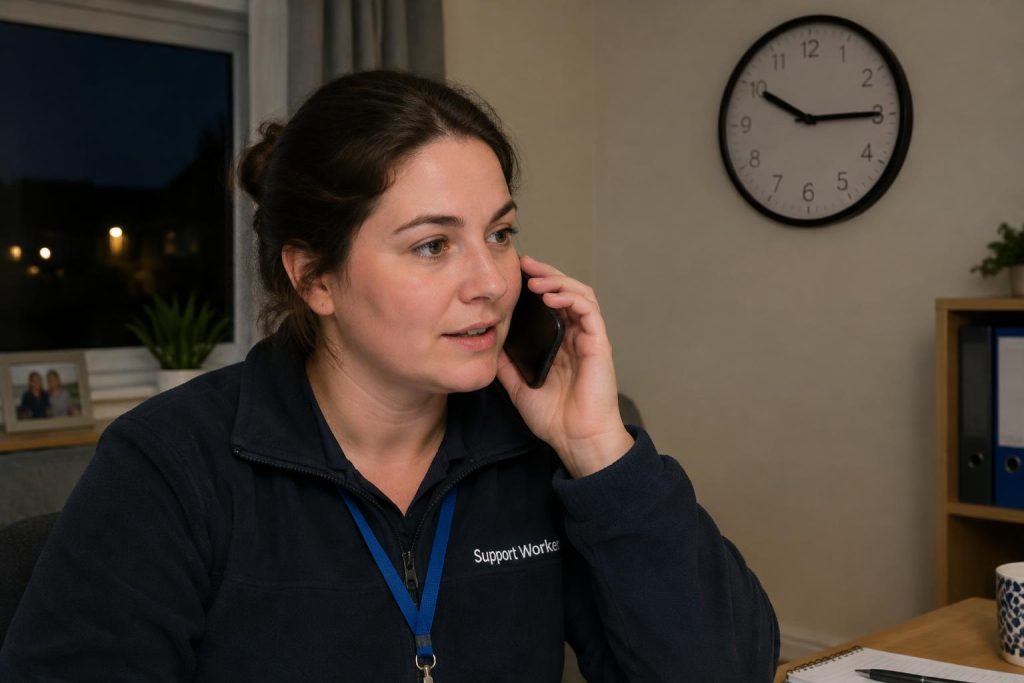
For National Disability Insurance Scheme (NDIS) providers, delivering reliable support does not stop when the office closes. Participants may require assistance during evenings, weekends and public holidays, while support workers may encounter unexpected situations that need immediate attention.
A support worker might call in sick before an overnight shift. A participant may experience a sudden change in their health. A family member might contact the organisation with an urgent concern, or a serious incident may require immediate escalation to an authorised manager.
These situations highlight why an effective NDIS after hours service is an important part of a disability provider’s operational arrangements.
However, choosing an external after-hours service involves much more than finding someone to answer the telephone.
The right provider should understand the operational demands of disability services, follow clear escalation procedures, support continuity of care and communicate effectively with your internal management team.
For NDIS organisations considering outsourcing their after-hours operations, the challenge is determining which service can meet their specific requirements.
How quickly will calls be answered? Who will respond to incidents? Can the service assist with unexpected roster gaps? Is Registered Nurse support available when clinical escalation is required? How will information be documented, protected and handed over to your team?
These are questions worth asking before signing an agreement.
At After Hours Response, we understand that NDIS providers need dependable operational support outside standard business hours. Our after-hours service is designed to help disability organisations manage incoming calls, coordinate operational responses, follow agreed escalation pathways and maintain communication between overnight operations and daytime teams.
We also recognise that every provider operates differently. A small community access organisation may have very different after-hours requirements from a provider delivering Supported Independent Living (SIL), complex personal care or high-intensity supports.
That is why selecting an after-hours partner should involve a structured evaluation of service capabilities, responsibilities and accountability.
This comprehensive guide outlines 12 essential questions to ask before outsourcing your NDIS on-call support, helping you compare options, identify potential service gaps and make a more informed purchasing decision.
Why NDIS Providers Are Considering Outsourced After-Hours Support
Many NDIS providers begin by managing after-hours calls internally.
A service manager may carry the on-call telephone during evenings, while a senior support coordinator or operations manager handles weekend enquiries. In smaller organisations, the business owner may personally respond to calls outside standard working hours.
This arrangement can be practical during the early stages of business growth.
However, as participant numbers increase, service locations expand and rosters become more complex, internal on-call arrangements may become harder to sustain.
Common challenges include:
-
Managers receiving repeated calls during evenings and weekends.
-
Unexpected staff absences requiring urgent roster adjustments.
-
Support workers being uncertain about who to contact.
-
Important incident information being recorded inconsistently.
-
Urgent matters competing with routine enquiries.
-
Delays in communicating overnight events to daytime staff.
-
Difficulties maintaining consistent coverage during annual leave or public holidays.
-
Management fatigue caused by ongoing on-call responsibilities.
An outsourced NDIS after hours support arrangement can help address these challenges by providing a dedicated operational contact point.
Rather than relying entirely on individual managers to monitor calls, providers can establish a structured service that receives enquiries, identifies the appropriate response and escalates matters according to agreed instructions.
At After Hours Response, we help NDIS organisations create a more organised approach to after-hours operations, including call handling, incident coordination, roster-related enquiries and management handovers.
Importantly, outsourcing does not remove a provider’s responsibility for participant safety, clinical governance, workforce management or regulatory compliance.
Instead, a well-designed external service should support the provider’s existing responsibilities through clear communication, documented processes and defined decision-making authority.
The following checklist explains how to evaluate whether a potential provider can deliver that support.
NDIS After-Hours Service: 12-Question Buyer’s Checklist
Before speaking with an external after-hours provider, use this checklist to identify the areas your organisation needs to investigate.
1. Are the After-Hours Responders Appropriately Trained and Experienced in NDIS Operations?
One of the first questions to ask when evaluating an NDIS after hours service is who will actually answer your calls.
Not all call answering services are designed for disability support organisations.
A general telephone answering company may be experienced in taking messages, transferring calls and recording customer enquiries. However, an NDIS provider may require responders who can recognise situations involving participant wellbeing, support worker safety, missed shifts and incident escalation.
These situations require an understanding of operational priorities and the importance of following established procedures.
Why responder knowledge matters
Consider a support worker calling at 10:30 pm because a participant has experienced an unexpected change in behaviour.
A general answering service might record the caller’s name and ask someone to return the call the following morning.
An appropriately prepared NDIS after-hours responder should instead recognise the need to assess the urgency of the call within their role, gather essential information and follow the provider’s agreed escalation instructions.
The responder should not independently make clinical or restrictive practice decisions outside their qualifications or authority.
Their responsibility is to identify the appropriate pathway and ensure the matter reaches the right person.
Questions to ask about responder training
Ask potential providers:
-
What training do responders receive before handling NDIS calls?
-
Are responders familiar with disability support environments?
-
Do they understand the difference between routine operational matters and urgent incidents?
-
How are staff trained to follow provider-specific escalation procedures?
-
What happens when a responder encounters an unfamiliar situation?
-
Are competency checks, refresher training and supervision arrangements in place?
You should also ask how the service maintains consistency when different responders handle your calls.
A reliable service should not depend on one individual’s knowledge of your organisation.
How After Hours Response can help
After Hours Response focuses on the operational needs of NDIS providers rather than treating every call as a standard customer service enquiry.
We can help establish clear call-handling instructions and escalation arrangements so incoming matters are directed through the appropriate process.
When evaluating our service, we encourage providers to discuss their participant profiles, support environments and operational expectations so the proposed arrangements can be assessed against their actual needs.
2. What Hours Are Covered, and How Are Calls Received and Answered?
The phrase after-hours support can mean different things to different providers.
Some services operate only during weekday evenings. Others cover weekends but exclude public holidays. Some offer continuous telephone coverage, while others rely on voicemail or callback arrangements.
Before outsourcing, clarify exactly what is included.
Understand the coverage model
An NDIS provider may need assistance during:
-
Weekday evenings and overnight periods.
-
Early mornings before administration staff commence work.
-
Saturdays and Sundays.
-
Public holidays.
-
Christmas and New Year shutdown periods.
-
Unexpected office closures.
-
Periods when internal managers are unavailable.
A service advertised as 24/7 should be assessed against the actual coverage arrangements, including how calls are handled during busy periods.
Ask about response arrangements
Useful questions include:
Is the telephone answered by a person? Understand whether calls reach a live responder, voicemail system or automated routing process.
What happens when several calls arrive simultaneously? Ask how the service manages competing enquiries and prioritises urgent matters.
Are response standards documented? Determine whether the provider offers defined answering targets, escalation timeframes or other measurable service commitments.
How are calls transferred or redirected? Understand whether your existing business number can be diverted and what happens if a transfer fails.
What happens during a technical outage? Ask about telephone redundancy, backup communications and business continuity procedures.
Why speed alone is not enough
Fast answering is valuable, but the quality of the response is equally important.
A call answered quickly but directed incorrectly may still create operational problems.
The service should be able to identify the nature of the enquiry, collect relevant information and take the appropriate next step.
At After Hours Response, we provide 24/7 after-hours operational support for NDIS providers. Our approach is designed to help organisations maintain a dependable point of contact when their usual office team is unavailable.
When considering our service, providers should discuss their preferred coverage arrangements, expected call volumes and escalation requirements to establish how the service would operate in practice.
3. How Are NDIS Incidents, Emergencies and Urgent Concerns Escalated?
Incident escalation is one of the most important areas to investigate before choosing an external NDIS on call service.
Disability providers may encounter situations involving participant injury, missing persons, allegations of abuse, medication concerns, environmental hazards or unexpected changes in participant wellbeing.
Some matters require immediate emergency intervention. Others require escalation to a manager, clinical professional or designated incident contact.
An effective after-hours service needs clear procedures for distinguishing these situations and responding within its authorised role.
Emergency response versus operational escalation
An external after-hours responder should understand the distinction between an emergency requiring immediate action and an operational concern requiring internal management attention.
For example:
|
Situation |
Appropriate response pathway |
|---|---|
|
Participant is unconscious or experiencing a life-threatening emergency |
Call 000 immediately and follow the participant’s emergency procedures |
|
Support worker reports a medication error |
Follow immediate safety instructions and escalate for appropriate clinical assessment |
|
Staff member fails to arrive for an overnight shift |
Activate the agreed roster contingency and management escalation process |
|
Family member raises a non-urgent service concern |
Document the enquiry and arrange follow-up according to the provider’s procedures |
|
Serious incident or allegation of abuse is reported |
Prioritise immediate safety, preserve relevant information and escalate to authorised management |
These are illustrative examples. Actual responses must follow the circumstances, applicable legal obligations and the provider’s approved procedures.
Incident reporting responsibilities remain with the provider
NDIS registered providers must understand their incident management and reportable incident obligations under the relevant NDIS regulatory framework.
Certain reportable incidents must be notified to the NDIS Quality and Safeguards Commission within prescribed timeframes. For example, some categories require notification within 24 hours of the provider becoming aware of the incident, while other categories have different notification requirements.
An outsourced service can support timely internal notification and documentation, but it does not automatically assume the registered provider’s regulatory obligations.
Providers should confirm who is responsible for determining reportability, making notifications, maintaining records and conducting follow-up.
How After Hours Response can assist
After Hours Response can help providers establish structured incident communication and escalation pathways.
Our role is to support timely operational coordination, communicate concerns to authorised contacts and document actions for appropriate follow-up.
This helps organisations maintain clearer oversight of events occurring outside normal office hours while retaining their own governance and compliance responsibilities.
4. Can the Service Assist with Unexpected Roster Gaps and Shift Changes?
Workforce disruptions are a common reason NDIS organisations seek outsourced after-hours support.
A support worker may report illness shortly before a shift. Another employee may be delayed, while an overnight worker may need immediate assistance because their replacement has not arrived.
These situations can affect service continuity, particularly where participants rely on scheduled support for personal care, medication assistance, mobility or overnight supervision.
What should roster management include?
A suitable after-hours provider should be able to explain whether it can assist with:
-
Receiving and documenting staff absence notifications.
-
Identifying shifts requiring urgent attention.
-
Contacting authorised replacement workers.
-
Following an approved staff availability list.
-
Communicating shift changes to relevant personnel.
-
Escalating unresolved gaps to management.
-
Recording the outcome of replacement attempts.
-
Providing handover information to the daytime rostering team.
Not every service offers active roster coordination. Some providers only record messages, leaving all replacement arrangements to internal managers.
This distinction is important when comparing service options.
Evaluate the boundaries of authority
Before outsourcing roster-related responsibilities, determine what decisions the external service is authorised to make.
Can responders contact casual employees directly? Can they offer shifts? Are they permitted to confirm changes? What happens if no suitably qualified worker is available?
These questions are particularly important where participants require workers with specific training, competencies or experience.
A replacement worker may need to understand a participant’s communication needs, behaviour support arrangements, manual handling requirements or high-intensity support procedures.
Filling a shift should never take priority over ensuring the worker is suitable for the participant’s needs.
Example: An overnight SIL shift becomes vacant
Imagine a SIL provider receives a call at 8:15 pm advising that the worker scheduled to commence at 10:00 pm is unwell.
Without a defined process, the manager may need to contact multiple employees while simultaneously managing other responsibilities.
With an agreed after-hours roster process, an external service could receive the absence notification, identify the affected shift, contact authorised replacement options and escalate the matter if coverage cannot be secured.
The final arrangement must remain consistent with the provider’s staffing requirements and approval procedures.
How After Hours Response supports roster continuity
After Hours Response helps NDIS providers manage after-hours roster disruptions through operational coordination and communication.
We can work with agreed contact lists, shift replacement instructions and escalation procedures to support a more organised response when unexpected staffing issues arise.
For providers delivering SIL, in-home supports or community services, this can help reduce reliance on ad hoc telephone calls and improve the visibility of unresolved roster matters.
5. Is Registered Nurse On-Call Support Available When Clinical Escalation Is Required?
For NDIS providers delivering complex or high-intensity supports, clinical escalation arrangements deserve particular attention.
Some after-hours enquiries are operational. Others involve participant health and require assessment or advice from an appropriately qualified clinician.
An external answering service should not treat these situations as interchangeable.
When might RN escalation be needed?
Examples include:
-
Concerns about medication administration or a possible medication error.
-
Unexpected changes in a participant’s health.
-
Questions about an existing clinical support plan.
-
Concerns following a fall.
-
Changes in wound condition.
-
Issues involving enteral feeding or other complex support arrangements.
-
Uncertainty about when to seek urgent medical attention.
-
Clinical concerns raised by frontline support workers.
The appropriate response depends on the circumstances, the participant’s care plan and the level of urgency.
A Registered Nurse may provide guidance within their professional scope, but an RN on-call arrangement does not replace emergency services, treating practitioners or required in-person clinical assessment.
Questions to ask about RN access
When assessing an NDIS after hours service, clarify:
Is RN support included or optional? Some services offer clinical escalation as a separate arrangement.
How is RN access activated? Determine whether responders can directly escalate clinical concerns or must first contact an internal manager.
What qualifications and registration checks apply? Ask how the service verifies that clinicians hold appropriate current registration and competencies.
What is the RN’s scope of responsibility? Understand whether the service offers telephone guidance, escalation support or additional clinical functions.
How are clinical communications documented? Establish how advice and follow-up requirements are recorded and communicated to the provider.
What happens when the RN cannot be reached? A clear contingency pathway is essential.
Why clinical governance matters
Outsourcing access to clinical advice does not transfer all clinical governance responsibilities to the external service.
NDIS providers must still maintain appropriate care plans, staff competencies, participant risk assessments and emergency procedures.
Where Registered Nurse support is required, responsibilities should be clearly documented in the service agreement.
How After Hours Response can help
After Hours Response offers an RN on-call clinical escalation pathway as part of its broader after-hours support offering.
This can help NDIS providers establish a route for escalating relevant clinical concerns when their regular management or clinical team is unavailable.
We encourage providers to discuss the types of supports they deliver, their existing clinical governance arrangements and the level of RN involvement required so the available service can be evaluated appropriately.
6. Can the Service Follow Your Organisation’s Specific Policies and Escalation Procedures?
Every NDIS organisation has its own operating model.
A provider supporting participants in shared accommodation may require different after-hours procedures from an organisation delivering one-to-one community participation services.
Some providers have several service locations, multiple management contacts and different escalation pathways for specific participant groups.
Others operate with a small team and a relatively simple decision-making structure.
For this reason, a generic call-handling script may not be sufficient.
Why customised procedures matter
An effective outsourced service should be able to follow documented instructions covering:
-
Who to contact for specific incident categories.
-
Which matters require immediate escalation.
-
How to manage roster disruptions.
-
What information should be collected from callers.
-
Which participant-specific instructions may be accessed.
-
When a matter can be documented for daytime follow-up.
-
How unresolved issues are managed.
-
Who has authority to approve particular operational decisions.
These procedures help responders act consistently and reduce unnecessary uncertainty.
Test the service with realistic scenarios
During the evaluation process, present the potential provider with examples based on your organisation’s operations.
For instance:
Scenario A: A support worker calls because their replacement has not arrived and they cannot safely leave the participant unsupported.
Scenario B: A family member contacts the service at midnight to report a concern about care provided earlier that day.
Scenario C: A participant experiences an unexpected health concern that may require clinical escalation.
Ask the provider to explain how each situation would be handled, what information would be recorded and who would be contacted.
The purpose is not to expect a generic answer. It is to determine whether the service can implement your own approved procedures.
Keeping protocols current
NDIS organisations change over time.
Managers take leave, new participants commence services, staffing arrangements change and escalation contacts are updated.
Your after-hours partner should have a reliable process for receiving, approving and implementing these changes.
Ask how updates are communicated to responders and whether outdated instructions are removed from active use.
How After Hours Response can assist
After Hours Response works with NDIS providers to establish service arrangements that reflect their operational requirements.
We can help implement agreed call-handling and escalation instructions, ensuring the after-hours service complements the organisation’s existing processes rather than introducing a disconnected system.
This provider-specific approach is particularly valuable for organisations with multiple service types or complex operational structures.
7. How Is Participant Information Protected and Managed Securely?
An outsourced NDIS after hours service may need access to sensitive operational and participant information.
This could include participant contact details, support arrangements, staff telephone numbers, health-related information, incident reports and emergency contact instructions.
Because this information can be sensitive, data protection should be a major consideration during procurement.
What information will the external service access?
Before engaging a provider, identify the minimum information required to deliver the service safely and effectively.
For example, a responder may need access to an approved escalation contact list but may not require unrestricted access to a participant’s entire record.
This reflects the principle of limiting information access to what is reasonably necessary for the authorised purpose.
Questions about data security
Ask potential providers:
-
Where is information stored and processed?
-
Is data encrypted during transmission and storage?
-
Are individual staff accounts and access permissions used?
-
Is access limited according to staff responsibilities?
-
Are system activities logged?
-
How are call recordings managed, if recordings are used?
-
What are the retention and deletion arrangements?
-
How are suspected privacy breaches identified and reported?
-
Can information be exported or returned when the agreement ends?
-
Are subcontractors or third-party systems involved?
Providers should also consider whether any information is stored or accessed overseas and what contractual and privacy implications may arise.
Privacy and confidentiality obligations
Australian disability providers may have obligations under the Privacy Act 1988, the Australian Privacy Principles and applicable NDIS requirements.
The precise obligations depend on the organisation and its circumstances.
When outsourcing, providers should ensure appropriate confidentiality, privacy and information-handling arrangements are documented.
Where necessary, obtain legal or privacy advice before granting an external service access to participant information.
Avoid relying on broad security claims
Statements such as secure platform or fully compliant are not substitutes for evidence.
Ask the service provider to explain its controls and provide relevant documentation where appropriate.
At After Hours Response, we recognise that protecting participant and operational information is essential to maintaining trust.
When evaluating our service, NDIS providers should discuss information access, confidentiality expectations, documentation processes and applicable security requirements as part of the onboarding and service agreement process.
8. What Documentation, Reporting and Morning Handovers Are Provided?
One of the most valuable functions of an outsourced after-hours service is maintaining continuity between overnight operations and the daytime team.
If an incident occurs at 2:00 am, the relevant manager may need to know what happened, what actions were taken and whether any follow-up remains outstanding.
Without reliable documentation, important details may be lost or repeated unnecessarily.
What should an after-hours call record contain?
Depending on the situation, useful information may include:
-
Date and time of the call.
-
Caller identity and contact details.
-
Relevant participant or service location.
-
Summary of the concern.
-
Urgency classification.
-
Actions taken by the responder.
-
People contacted and contact attempts.
-
Escalation outcome.
-
Any outstanding tasks.
-
Person responsible for follow-up.
The record should be accurate, objective and appropriate to the responder’s role.
Why morning handovers matter
Consider an overnight roster gap that was resolved by arranging an authorised replacement worker.
The daytime rostering team may still need to update its records, confirm timesheets or review the staffing issue.
Similarly, an incident escalated overnight may require a manager to complete further documentation, communicate with a participant’s representative or assess regulatory reporting obligations.
A structured handover makes these outstanding responsibilities visible.
Ask about reporting formats
Potential providers should be able to explain whether they offer:
Individual call records: Documentation of each enquiry and the response provided.
Incident escalation summaries: Records of urgent matters and the contacts involved.
Roster coordination updates: Details of absences, replacement attempts and outcomes.
Morning handovers: A summary of relevant overnight events and outstanding actions.
Service activity reporting: Information about call volumes, call types and other agreed performance measures.
The level of reporting should be proportionate to your organisation’s needs.
Reporting should support accountability
A handover is only useful if the information reaches the appropriate person and follow-up responsibilities are clear.
Ask how reports are delivered, whether receipt is confirmed when necessary and how unresolved urgent matters are managed.
At After Hours Response, documentation and morning handovers form part of our approach to supporting operational continuity.
We help providers maintain visibility of after-hours activities so their daytime teams can review events, address outstanding matters and continue service delivery with better information.
9. What Does Onboarding Involve, and How Are Procedures Tested Before Going Live?
Even a capable after-hours service may struggle if onboarding is rushed or incomplete.
Before an external provider begins receiving calls, it needs sufficient information about the organisation’s services, escalation contacts, operational boundaries and emergency procedures.
A structured onboarding process helps reduce misunderstandings and supports a more reliable transition.
What should onboarding cover?
An appropriate onboarding process may involve:
Initial operational assessment: Reviewing the provider’s service types, participant support environments and after-hours requirements.
Call routing arrangements: Confirming how calls will reach the external service and testing relevant telephone settings.
Escalation contact lists: Identifying authorised managers, clinical contacts, rostering contacts and backup personnel.
Procedure documentation: Establishing the instructions responders must follow for different situations.
Information access: Agreeing on the information needed and how it will be securely provided.
Scenario testing: Checking how the service responds to realistic operational and incident scenarios.
Staff communication: Informing internal employees about the new arrangements and when to contact the external service.
Go-live review: Monitoring early performance and addressing issues promptly.
Test before relying on the service
Before implementation, consider conducting several controlled test calls.
For example, test whether a roster absence is correctly identified, whether the appropriate escalation contact is selected and whether the resulting documentation contains the necessary details.
You may also want to test a simulated urgent incident to confirm the responder follows the agreed process.
Testing should not create confusion with real emergencies. Scenarios should be clearly identified as exercises and coordinated with the relevant personnel.
Ask about ongoing onboarding support
Implementation should not end when the telephone diversion is activated.
A good service arrangement should include a process for resolving early issues, updating instructions and reviewing whether the service is meeting expectations.
At After Hours Response, we help NDIS providers prepare for outsourced after-hours operations by discussing their requirements and establishing appropriate service arrangements.
We encourage organisations to clarify onboarding responsibilities, testing expectations and the transition process before commencement.
10. Is Pricing Transparent, Including Additional Charges and Service Exclusions?
Cost is an important consideration when comparing outsourced NDIS after hours support services.
However, the lowest advertised price may not represent the best overall value.
Different services may use different pricing models, coverage arrangements and inclusions.
A provider should understand the full cost of the proposed service before making a decision.
Common pricing structures
Depending on the supplier, after-hours services may charge through:
-
A fixed monthly service fee.
-
A fee based on expected or actual call volumes.
-
Per-call or per-minute charges.
-
Different rates for particular coverage periods.
-
Additional fees for active roster coordination.
-
Separate clinical escalation charges.
-
Setup, implementation or onboarding fees.
-
Charges for additional service locations or business units.
These are examples of possible market pricing structures, not a statement that every provider uses them.
Questions to ask about pricing
Request a written explanation of:
What is included in the standard fee? Confirm the hours, call types and operational functions covered.
Are there call volume limits? Understand whether usage above a threshold results in additional charges.
Does incident escalation cost extra? Clarify whether urgent calls or repeated escalation attempts attract different fees.
Is roster coordination included? Determine whether active replacement coordination is part of the service or an additional feature.
How is RN on-call support priced? Confirm whether clinical escalation is included, optional or separately charged.
Are there onboarding costs? Ask about initial setup and implementation fees.
What are the contract and cancellation terms? Understand minimum commitments, notice periods and any applicable termination charges.
Are prices inclusive or exclusive of GST? This is particularly important when comparing proposals.
Compare total operational value
An outsourced after-hours service should be assessed in the context of the work it performs and the operational demands it may reduce.
For example, a provider may currently rely on several managers to rotate through evening and weekend on-call duties.
The true cost of this arrangement may include staff time, allowances, administrative follow-up and the impact of interrupted rest periods.
These factors should be considered alongside the proposed external service fee.
However, providers should avoid assuming that outsourcing will automatically produce cost savings.
The outcome depends on the organisation’s existing arrangements, service requirements and the external provider’s actual scope.
How After Hours Response approaches service discussions
After Hours Response offers a two-week free trial and no onboarding fee as part of its advertised service proposition.
Providers should confirm the current offer, trial conditions, service inclusions and any ongoing charges directly before proceeding.
We encourage prospective customers to discuss their operational requirements and request clear information about the proposed service so they can assess its suitability and value.
11. Who Is Accountable for Service Quality and Management Escalation?
When outsourcing after-hours operations, it is important to establish who is responsible for monitoring service performance and resolving problems.
A provider should not assume that signing a contract guarantees consistent performance without oversight.
Clear accountability arrangements help both organisations understand their responsibilities.
Identify management contacts
Ask who will be responsible for:
-
Managing the service relationship.
-
Responding to operational concerns.
-
Reviewing call-handling issues.
-
Updating escalation procedures.
-
Investigating service complaints.
-
Coordinating corrective actions.
-
Monitoring agreed performance standards.
-
Managing serious service failures.
You should also understand how urgent concerns about the external service itself can be escalated.
For example, if a call is incorrectly categorised or an escalation contact is not reached, the NDIS provider needs a clear way to raise the issue and ensure it is investigated.
Define performance expectations
Depending on the service arrangement, relevant performance measures may include:
|
Performance area |
What to evaluate |
|---|---|
|
Call responsiveness |
Agreed answering standards and exceptions |
|
Escalation accuracy |
Whether the correct pathways were followed |
|
Documentation quality |
Completeness, accuracy and timeliness |
|
Handover reliability |
Delivery of required information |
|
Roster coordination |
Compliance with approved replacement procedures |
|
Procedure updates |
Timely implementation of approved changes |
|
Issue resolution |
How service concerns are investigated and addressed |
Not every metric needs to become a complex contractual requirement.
The objective is to establish meaningful expectations that support participant safety and operational reliability.
Shared responsibility is essential
An external service cannot independently resolve every issue.
For example, if all authorised managers are unavailable during a serious incident, the external responder may have limited options beyond the agreed contingency procedures and applicable emergency pathways.
Similarly, an external roster coordinator cannot guarantee that a suitable replacement worker will always be available.
The service agreement should identify these limitations clearly.
At After Hours Response, we recognise that effective outsourcing depends on cooperation between our operational team and the NDIS provider’s management structure.
We can help establish clear communication and escalation arrangements, while providers retain oversight of their services, workforce and regulatory responsibilities.
12. Can the After-Hours Service Accommodate Your Organisation’s Future Growth?
An after-hours solution that works for a small organisation may not automatically meet the needs of a growing provider.
As participant numbers increase, organisations may introduce new services, expand into additional locations or take on more complex support arrangements.
These changes can affect after-hours call volumes, escalation requirements and operational complexity.
Consider your organisation’s future needs
Before choosing a provider, think about whether your organisation may:
-
Increase its number of participants.
-
Expand Supported Independent Living services.
-
Introduce additional high-intensity supports.
-
Operate across multiple Australian states or territories.
-
Increase its casual or permanent workforce.
-
Establish new service locations.
-
Require additional clinical escalation pathways.
-
Change its rostering or incident management systems.
Your external service should be able to explain how changes in service scope would be assessed and implemented.
Ask about capacity and flexibility
Useful questions include:
Can the service support increased call volumes? Understand how additional demand is managed.
Can new service locations be added? Determine how location-specific procedures and contacts are incorporated.
Can escalation arrangements change? Ask whether procedures can be updated as management structures evolve.
Can the service accommodate different support types? Clarify how it handles varying operational requirements across service streams.
How are additional costs assessed? Understand whether growth changes the pricing structure.
Avoid choosing solely for current requirements
A service that is suitable today may become less effective if it cannot adapt to organisational changes.
However, providers should also avoid paying for unnecessary features based only on speculative future growth.
The most practical approach is to choose a service that meets current requirements while offering a clear process for reviewing and adjusting arrangements.
At After Hours Response, we work with NDIS providers with different operational needs and can discuss how our service may support changing requirements over time.
This allows organisations to evaluate the suitability of their after-hours arrangements as their services develop.
How to Compare NDIS After-Hours Service Providers Objectively
Once you have asked the 12 questions, the next step is comparing the answers.
Rather than choosing a provider based on promotional claims, use a consistent evaluation framework.
This makes it easier to identify strengths, limitations and areas requiring clarification.
Common Mistakes to Avoid When Outsourcing NDIS On-Call Support
Even when organisations use a structured checklist, some common purchasing mistakes can undermine the effectiveness of the arrangement.
Choosing a generic answering service without assessing NDIS suitability
Not every telephone answering company is equipped to manage disability support operations.
A service that performs well for ordinary business enquiries may not have the processes needed to manage incidents, urgent roster changes or clinical escalation.
Ask for evidence of relevant capabilities rather than assuming that general call-handling experience is sufficient.
Assuming outsourcing transfers compliance responsibilities
External providers can support communication and documentation, but NDIS organisations remain responsible for their applicable legal, regulatory and service delivery obligations.
Incident reporting, participant safeguards, workforce suitability and clinical governance must remain clearly allocated.
Failing to define what responders can and cannot do
Unclear authority can create delays or inappropriate decisions.
A responder may be authorised to contact replacement workers but not to approve overtime, change clinical instructions or authorise expenditure.
These boundaries should be established before the service commences.
Overlooking the importance of backup contacts
An escalation procedure that relies on one manager creates a potential point of failure.
Where appropriate, establish secondary and tertiary contacts, along with clear instructions for situations where no authorised contact is available.
Focusing on price rather than service scope
A low monthly fee may appear attractive until additional charges or operational exclusions become apparent.
Compare written proposals based on equivalent requirements.
Neglecting morning handovers
An overnight issue may appear resolved but still require administrative or management follow-up.
Without a structured handover, tasks can remain incomplete.
Not reviewing the arrangement after implementation
After-hours services should be reviewed as organisational needs change.
Consider regular discussions about call trends, escalation issues, documentation quality and procedure updates.
In-House vs Outsourced NDIS After-Hours Support: Which Is More Suitable?
Before selecting an external provider, it is worth comparing outsourcing with maintaining an internal on-call arrangement.
Neither approach is automatically right for every NDIS organisation.
|
Consideration |
Internal on-call team |
Outsourced after-hours service |
|---|---|---|
|
Operational familiarity |
Internal staff may have detailed knowledge of participants and services |
Requires effective onboarding and access to approved instructions |
|
Management workload |
Managers may carry direct after-hours responsibilities |
Can reduce routine call-handling and coordination demands |
|
Service continuity |
Depends on internal staffing and availability |
Depends on the supplier’s coverage and contingency arrangements |
|
Clinical escalation |
Requires internal or separately arranged clinical resources |
May offer access to an agreed RN escalation pathway |
|
Documentation |
Managed through internal systems and procedures |
Requires agreed reporting and information-sharing arrangements |
|
Cost structure |
Staff time, allowances and internal overheads |
Contracted fees and any additional service charges |
|
Accountability |
Managed within the organisation |
Requires clear contractual responsibilities and provider oversight |
Some organisations may benefit from a hybrid arrangement.
For example, an outsourced service may handle initial calls, routine operational enquiries and approved roster coordination while internal managers remain responsible for higher-level decisions.
This model can help preserve organisational control while reducing the volume of calls requiring direct management involvement.
After Hours Response can support providers exploring this type of arrangement by helping establish communication pathways between external responders and authorised internal contacts.
What Should Be Included in an NDIS After-Hours Service Agreement?
Before signing a contract, ensure the proposed service agreement reflects the actual operational arrangements discussed during evaluation.
A clear agreement reduces uncertainty and gives both parties a reference point for managing expectations.
Service scope
The agreement should define the services being provided, such as call answering, incident escalation, roster coordination, clinical escalation access and reporting.
It should also identify exclusions.
Coverage arrangements
Document the agreed operating hours, telephone arrangements and any limitations on availability.
Where relevant, include procedures for technical outages and other business continuity events.
Escalation responsibilities
Specify the external service’s authority, the provider’s internal contacts and the circumstances requiring escalation.
Emergency response instructions should be consistent with the organisation’s approved procedures.
Data handling and confidentiality
Address information access, permitted use, storage, retention, disclosure, security incidents and end-of-contract arrangements.
Reporting requirements
Define the records and handovers required, their delivery methods and expected timeframes.
Service quality and issue resolution
Establish relevant performance expectations and procedures for raising concerns, reviewing incidents and implementing corrective action.
Pricing and contract terms
Confirm fees, additional charges, payment terms, contract duration, renewal conditions and termination provisions.
Change management
Include a process for updating escalation contacts, service locations, participant-related instructions and other operational information.
A written agreement should accurately reflect the service being purchased. Providers should seek appropriate professional advice when reviewing significant contractual or regulatory matters.
When Is the Right Time to Outsource Your NDIS After-Hours Service?
There is no universal participant number or staffing threshold that determines when an NDIS organisation should outsource its on-call arrangements.
Instead, providers should consider the operational demands of their current model.
Outsourcing may be worth investigating when managers are regularly interrupted overnight, roster disruptions are becoming difficult to coordinate or internal staff are struggling to maintain consistent coverage.
Other indicators include an increasing number of SIL services, more complex participant support requirements, inconsistent incident documentation or difficulty maintaining reliable weekend and public holiday arrangements.
The decision should be based on operational risk, staff capacity, participant needs and the organisation’s financial circumstances.
Consider the impact of management fatigue
Repeated overnight interruptions can affect managers’ rest, wellbeing and capacity to perform their daytime responsibilities.
For some providers, the challenge is not simply the number of calls received.
It is the unpredictability of those calls and the expectation that a manager must remain available at all times.
A structured external service may help reduce unnecessary interruptions by managing matters within agreed authority and escalating only those requiring management attention.
However, providers must still ensure that internal escalation contacts are appropriately available for matters that cannot be resolved externally.
Consider the impact on participant continuity
Reliable after-hours arrangements can also support participant confidence.
Families, carers and support workers benefit from knowing that there is a clear contact point when an unexpected issue occurs.
A well-organised response process can help reduce confusion and ensure concerns are directed appropriately.
After Hours Response works with NDIS organisations seeking to strengthen these arrangements without unnecessarily increasing their internal administrative workload.
How to Prepare Your NDIS Organisation Before Outsourcing
Once you have shortlisted potential providers, preparing your own organisation is an important next step.
Even a well-designed external service relies on accurate instructions and effective cooperation from the NDIS provider.
Review your existing call patterns
Identify the types of enquiries received outside business hours.
Consider how frequently staff report absences, how often managers receive incident calls and which matters genuinely require immediate attention.
This information can help define the scope of the service you need.
Identify critical escalation contacts
Create an accurate list of authorised personnel, including backup arrangements.
Ensure contact responsibilities are clearly allocated and compatible with staff availability and employment arrangements.
Review incident and emergency procedures
Check that your existing instructions are current, accessible and appropriate for the supports you deliver.
Where participant-specific procedures apply, determine what information an external responder needs to follow the agreed process safely.
Define roster management permissions
Clarify who can be contacted for replacement shifts and what approvals are required.
Include any competency or suitability restrictions relevant to particular participants.
Establish reporting expectations
Decide what information your daytime team needs to receive and how outstanding matters will be assigned.
Communicate changes to staff
Support workers should understand when to contact the external service, what information to provide and how urgent situations must be managed.
This communication is particularly important during the transition from an internal on-call arrangement.
Schedule an initial review
Plan to review the arrangement after commencement.
Consider whether calls are being handled appropriately, whether escalation contacts are working and whether reports contain the information your team needs.
After Hours Response can help prospective customers discuss these preparation requirements and determine what needs to be established before their after-hours service begins.
Why Consider After Hours Response for NDIS After-Hours Support?
Selecting an outsourced NDIS after hours service should be based on evidence, suitability and a clear understanding of responsibilities.
At After Hours Response, our focus is helping NDIS providers maintain structured operational support when their regular office teams are unavailable.
Our service offering is designed around the practical challenges disability organisations encounter outside normal business hours.
These include managing incoming calls, coordinating urgent operational matters, supporting roster-related communication, following incident escalation pathways and providing information for daytime follow-up.
We also offer access to an RN on-call clinical escalation pathway for providers requiring appropriate clinical support arrangements.
Supporting operational continuity
Unexpected situations can occur at any time.
After Hours Response helps organisations establish a consistent contact point so calls can be received, assessed within the responder’s role and directed according to agreed instructions.
This can be particularly useful for providers managing multiple service locations or complex staffing arrangements.
Supporting clearer incident communication
Our after-hours operations approach helps providers establish defined pathways for escalating concerns to authorised personnel.
This supports communication and documentation while maintaining the provider’s own incident management and governance responsibilities.
Helping with roster-related disruptions
When staff absences or shift changes occur outside business hours, After Hours Response can assist with agreed coordination processes.
This helps providers manage operational disruptions through a more structured approach.
Supporting management handovers
Clear records and handovers help daytime teams understand what occurred overnight and what follow-up remains necessary.
After Hours Response includes documentation and handover arrangements within its broader operational support approach.
A service tailored to provider requirements
We understand that NDIS organisations differ in size, service type, workforce structure and participant needs.
Rather than assuming that one standard arrangement will suit every provider, we encourage prospective customers to discuss their specific requirements, escalation pathways and expectations.
This allows providers to assess how After Hours Response could complement their existing systems.
Final Thoughts: Choose an NDIS After-Hours Service That Fits Your Operational Responsibilities
Outsourcing after-hours operations can be an important step for NDIS providers seeking to improve communication, reduce administrative pressure and establish more consistent responses outside normal business hours.
However, the decision should not be based on telephone coverage or price alone.
The most suitable NDIS after hours service should be able to demonstrate that it understands your organisation’s operational requirements, follows appropriate procedures and supports effective communication between responders, management and clinical personnel.
The 12 questions in this guide provide a practical framework for evaluating potential service partners.
By examining responder capabilities, coverage arrangements, incident escalation, roster management, RN access, information security, documentation, onboarding, pricing and accountability, providers can make a more informed decision.
It is equally important to recognise the limitations of outsourcing.
An external service should support your organisation’s operations, not replace its responsibilities for participant safety, workforce management, clinical governance or regulatory compliance.
At After Hours Response, we aim to help NDIS providers establish reliable, structured and practical after-hours support arrangements.
Whether your organisation is experiencing increasing overnight calls, unexpected roster disruptions or growing demands on internal managers, we can help you explore an approach that reflects your service delivery requirements.
Contact After Hours Response to Discuss Your NDIS After-Hours Support Needs
Are you considering outsourcing your NDIS on-call support?
After Hours Response can help you explore how a dedicated after-hours operations service could support your organisation’s communication, incident escalation, roster coordination and management handover processes.
We understand the importance of selecting a service that fits your existing procedures and responsibilities.
Contact After Hours Response team to discuss your current arrangements, ask questions about our service capabilities and learn more about the options available.