After-hours cover is crucial for NDIS providers. Serious incidents and urgent enquiries don’t wait for business hours – and under NDIS rules, providers must have robust incident-management systems in place. In practice, 24/7 cover typically comes from either an internal on-call roster or an outsourced specialist desk. Each model has pros and cons. This article compares the two approaches – staffing, costs, reliability, clinical support and compliance – to help NDIS leaders decide which model suits their organisation. We’ll highlight how After Hours Response’s outsourced solution can strengthen duty of care, slash risk and streamline operations for growing providers.
Why After-Hours Coverage Matters
NDIS-registered providers are legally required to notify the NDIS Commission of reportable incidents within 24 hours of becoming aware. The most serious incidents (death, serious injury, abuse, assault, unauthorised restrictive practices) demand immediate reporting. Yet most NDIS support happens overnight: in Supported Independent Living, participants need care at all hours, and any lapse in supervision or communication can have dire consequences. In the past year, news reports have repeatedly highlighted tragic outcomes when after-hours support fails – for example, fatal house fires and abuse cases in homes with no qualified responder on duty.
Meeting these obligations and ensuring participant safety means an effective incident management system must operate 24/7. Morning wake-ups with a backlog of incidents, or scrambling to report an event late, puts a provider at compliance risk. Likewise, unanswered evening enquiries mean missed referrals and potential revenue losses. The choice between an in-house on-call setup and a professional outsourced desk comes down to whether your team can deliver consistent, fast, compliant support around the clock. We’ll break down the trade-offs next.
Staffing Requirements and Costs
In-House On-Call Teams: Typically, small and mid-size providers handle after-hours by rostering senior staff or managers as the on-call contact. That person might be a director, operations manager or clinical lead, paid an on-call allowance or overtime rates. This can work for very small call volumes, but it has hidden costs and hassles. You must train and supervise staff to handle the full range of after-hours scenarios – from IT helpdesk issues to clinical escalations. Managers can burn out fielding calls at all hours, and recruiting enough qualified staff (for example, Registered Nurses on-call overnight) is expensive. At scale, an internal roster may require multiple staff (often at penalty rates) to guarantee 24/7 coverage.
- Overtime and allowances: In-house on-call often means paying penalty rates or flat allowances to employees. Over time, these premiums add up – on weekends, late nights or holidays the payroll can skyrocket. There’s also turnover risk: staff may quit if after-hours work becomes too onerous.
- Training and liability: You need in-depth training for any staff covering after-hours. A mistake on a critical incident could become a liability. Unlike a dedicated desk, your on-call person may lack specialist experience in NDIS incident protocols or clinical triage.
Outsourced NDIS After-Hours Support: A professional after-hours service like After Hours Response provides a dedicated team of trained staff (including Registered Nurses and NDIS auditors) 24/7. This removes all staffing overhead. Instead of overtime, you pay a flat weekly retainer for guaranteed coverage. There are no surprise bills per call or per incident. The cost becomes predictable and typically more economical than the sum of multiple managers’ overtime. As your organisation grows (adding staff or locations), the outsourced desk scales seamlessly, whereas an in-house team would need hiring and training each new after-hours staff member.
- Fixed, predictable fees: After Hours Response works to a subscription model. We “scope your environment, agree protocols, and quote a flat weekly fee”. No per-call charges, no extra “after-hours” service fee spikes. You know the monthly spend up front.
- Scale with demand: Outsourcing spreads the workload across a pool of specialists. A sudden spike in call volume or a busier roster period won’t exhaust the outsourced team. By contrast, an internal on-call roster often struggles when multiple issues coincide (e.g. a busier weekend or several sick calls).
Response Speed and Reliability
In-House Teams: When relying on your own people, response speed can be inconsistent. If one manager handles all calls, delays are likely if they’re busy or asleep. There’s no SLA ensuring calls are answered. In practice, providers report scenarios like “no one even answers after 2 rings, so staff eventually call 000 directly” in emergencies. Missed calls at 2am or unanswered messages undermine participant safety and trust.
Outsourced Desk: Dedicated after-hours providers guarantee fast pickup and reliability. After Hours Response reports a median pick-up time of under 20 seconds (just a few rings) for all calls. In real terms, that means any support worker, participant or family member reaches a live human immediately – no voicemail or endless ringing. With 24/7 staffing and strict SLAs, you eliminate the “who’s on duty?” uncertainty. A call centre’s operational metrics are transparent (e.g. we handle 1,200+ calls monthly with 18-second median pick-up), whereas internal on-call has no such accountability.
- Guaranteed coverage: An outsourced team provides full coverage every day (365 nights and holidays). After Hours Response, for example, highlights “24/7 coverage, every day” with “100% documented by 9am” on every call. In contrast, in-house rosters can have gaps (e.g. if your only on-call manager is sick, who answers?).
- Built-in redundancy: With an external desk, if one operator is unavailable, others cover the call queue. They use professional call routing and backup systems. In-house, redundancy usually means paying even more people to stand by.
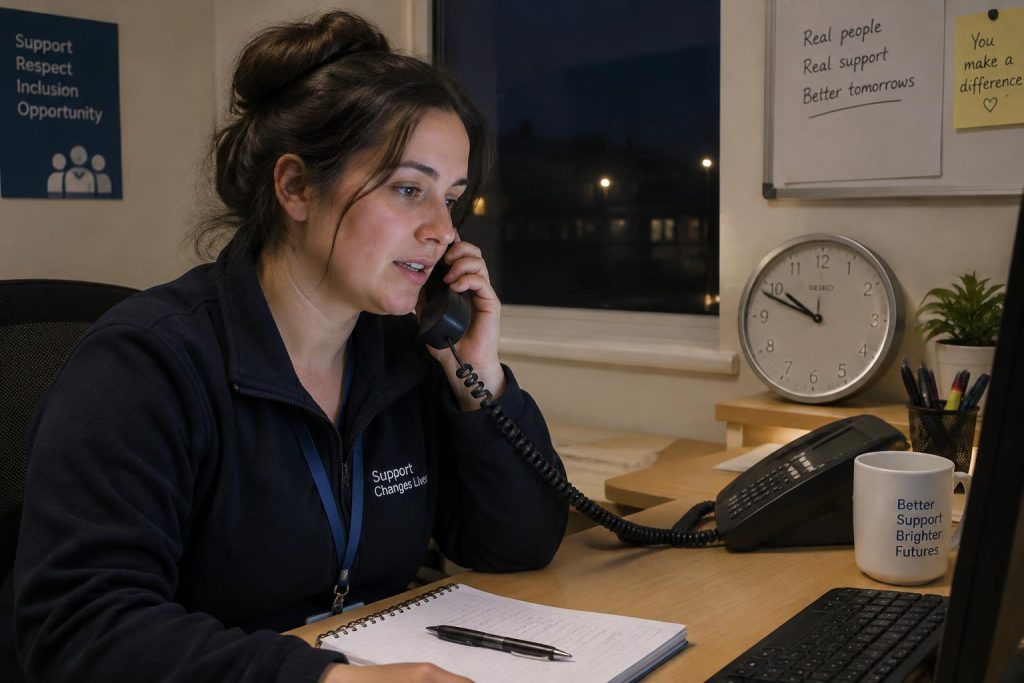
Care calls answered after hours help families feel supported and prevent incidents. In an outsourced desk, trained staff with headsets are ready 24/7, ensuring participants and workers always reach a qualified responder quickly.
Clinical Escalation and Expertise
In-House Teams: Most NDIS providers do not have a full-time Registered Nurse (RN) staffing after 5pm. When a support worker has a clinical question at 3am (for instance, a medication question or a fall), they typically call a senior colleague. That colleague may not be clinically trained, causing delays or uncertainty. Worse, if an RN is only employed part-time, the on-call person might be a less experienced coordinator or manager. This can leave complex medical concerns unattended until morning.
Outsourced Desk: After Hours Response and similar specialists staff real clinicians on their desk. The After Hours Response team includes Registered Nurses on-call as an immediate clinical escalation point. That means support workers can speak to a nurse within seconds for guidance on acute health issues. The nurse can triage the situation, advise on immediate care steps, or call emergency services (000) if needed. Importantly, all advice and outcomes are documented in detail. You get the benefit of clinical expertise without paying a full-time RN salary yourself.
- Clinical triage: Frontline workers feel safer knowing a qualified nurse is literally a phone call away. This can prevent unnecessary hospital visits and ensures participants get expert support even at 2am.
- Specialist knowledge: Outsourced providers focus on NDIS support scenarios daily. They build protocols for restrictive practices, risk behaviours, complex care – domains that a casual after-hours manager may not know well.
Documentation and Compliance
In-House Teams: After an incident or urgent call, the expectation is the on-call staff member fills out logs or reports next day. In practice, this paperwork often falls through the cracks. Busy staff may backfill incidents in haste, risking inaccuracies or missing regulatory details. The NDIS Commission expects every event to be logged in a Commission-approved format within 24 hours, but internal teams can forget specifics or delay reporting. A single missing timestamp could count as a compliance breach.
Outsourced Desk: A key differentiator for After Hours Response is “compliance-ready documentation” built into the service. Every call and incident is logged to NDIS Commission standards before your team logs in the next morning. On their dashboard you’ll see a timestamped chronology, escalation notes, actions taken and outcomes – essentially the full 24-hour report already prepared. This means your day shift starts with a clean, Commission-compliant handover rather than a pile of paperwork.
- No loose ends: The outsourced provider follows your protocols (contacting managers or next-of-kin per your policy, activating triage ladders) and then documents it all. After Hours Response markets “100% of 24hr reports met” for clients. When events are coded and closed out properly, auditors see evidence of compliance and participant safety measures.
- Integrated systems: Many after-hours services can integrate with your CRM or incident platform, so notes flow directly into your records. This ensures nothing is missed.
In an outsourced model, after-hours calls are handled by a dedicated operations desk. The displayed presentation “support that never stops” underscores the guarantee of professional, 24/7 support. Whether it’s a clinical query or a shift cancellation, the team resolves it immediately and logs every detail for morning handover.
Operational Focus and Core Business
In-House Teams: Maintaining an after-hours roster can distract from your core mission. Leaders and managers chained to late-night calls may have less time for strategic tasks, training or business growth. Morale can suffer if “weekend” means being on speakerphone during a party. Smaller providers may find overnight coverage simply untenable as they grow.
Outsourced Desk: By outsourcing after-hours tasks, your team can concentrate on delivering support during normal hours. Routine issues – a few sick calls, an inquiry from a new family at 8pm, a minor roster tweak – are handled by the partner instead of interrupting your people at home. This operational efficiency lets you scale faster without proportionally increasing admin staffing. After Hours Response highlights that partnering with their desk frees providers to start each day without “a backlog of incidents and a roster on fire”.
Pricing Model and Transparency
In-House Teams: Costs are fragmented. You pay salaries year-round (even when incident volumes are low) and add overtime or call-out rates when needed. Estimating total spend is difficult, as it varies month to month. If after-hours calls spike, overtime can blow out budgets. During quiet periods you still carry on-call staff on standby. This unpredictability can strain cashflow and make budgeting a nightmare.
Outsourced Desk: Outsourcing transforms this into a single weekly retainer. After Hours Response summarises it: “one retainer, whole-of-night cover”. You agree on the scope (hours covered, services needed) and get a fixed fee. That fee is predictable and budget-friendly. There are no surcharges for a busy month or extra holiday shifts. In effect, you “buy” peace of mind rather than paying piece-meal for each call.
- Customisable scope: You only pay for what you need. If your organisation grows, the fee scales in a predictable way.
- No surprises: After Hours Response explicitly promises “no per-call surprise fees”. Internal teams, by contrast, often fall into unexpected overtime charges or even staffing locums.
When Outsourcing Makes Sense
For very small providers or occasional needs, an internal on-call roster might suffice (for example, simply passing phones among a tiny team). But as service offerings expand – especially if you provide high-complexity supports, have lots of staff or run SDA/SIL houses – the benefits of outsourcing multiply. Key indicators that outsourcing is time to consider include:
- Rapid growth: Your support worker roster is growing and last-minute changes are frequent. Maintaining an internal pager system is becoming chaotic.
- Complex care needs: You deliver high-intensity, clinical or restrictive-practice supports. You need fast access to clinical advice and strict documentation.
- Compliance pressure: You want to eliminate any risk of missing a 24-hour reportable-incident deadline.
- Focus on core work: Your leadership team is tied up handling after-hours calls instead of strategic priorities.
- Budget control: You prefer a simple retainer over unpredictable overtime costs.
When these factors are present, outsourcing to a specialist desk often saves money and risk. In fact, many providers find that after-hours outsourcing pays for itself by preventing expensive compliance failures (one provider client saved over $1 million in penalties by never missing a reportable incident). It also drives growth: answered enquiries at 8pm can turn into new participants, as opposed to unheard voicemails.
How to Calculate the True Cost of In-House NDIS On-Call Support
When NDIS providers compare an internal on-call team with outsourced NDIS after hours support, the initial cost comparison can be misleading.
An internal roster may appear inexpensive because an existing manager already receives a salary. However, the time spent responding to calls, coordinating replacement workers and managing incidents represents a real operational cost.
To determine whether outsourcing offers better value, organisations should examine the total cost of maintaining their after-hours arrangements.
Direct employment and staffing costs
The most visible expenses include on-call allowances, overtime, applicable penalty rates and additional payments for staff who attend to urgent matters outside their ordinary working hours.
These costs depend on the relevant industrial instrument, employment arrangements and the nature of the work performed.
For example, an operations manager who receives several overnight calls may require additional paid working time or adjustments to their next scheduled shift, depending on applicable employment conditions.
Providers should also consider the cost of maintaining backup coverage when the primary on-call employee is unavailable.
Rather than calculating the cost of one employee carrying a phone, businesses should calculate what it takes to maintain a reliable and sustainable roster across evenings, weekends and public holidays.
Indirect operational costs
Indirect costs are less obvious but can significantly affect business performance.
These may include time spent preparing rosters, training managers, reviewing incident reports, correcting incomplete documentation and following up on overnight communications.
There is also the opportunity cost of removing senior employees from their ordinary responsibilities.
If an operations manager spends several hours each week resolving after-hours matters, those hours cannot be used for participant service planning, staff supervision, quality improvement or business development.
Over time, repeated interruptions may affect productivity and increase pressure on employees.
After Hours Response can help NDIS providers assess whether a dedicated outsourced operations desk offers a more practical alternative to relying on internal management resources.
Comparing costs over 12 months
A useful approach is to calculate the annual cost of each model rather than comparing individual weekly expenses.
For an internal arrangement, providers can consider:
-
On-call allowances and additional working hours.
-
Training and refresher requirements.
-
Backup staffing arrangements.
-
Administrative time and management oversight.
-
Systems, telecommunications and reporting expenses.
-
Recruitment or replacement costs associated with workforce turnover.
For an outsourced arrangement, providers should consider the agreed service fee, included activities, escalation responsibilities, implementation requirements and any exclusions.
The objective is not necessarily to identify the cheapest option. It is to determine which model provides appropriate coverage, dependable escalation and sustainable operating costs.
An arrangement that costs slightly more but significantly reduces management interruptions may offer better overall value.
For organisations seeking predictable expenditure, After Hours Response offers an opportunity to discuss outsourced coverage based on the size, complexity and operational requirements of their services.
Is a Hybrid After-Hours Support Model Right for Your NDIS Organisation?
Outsourcing does not necessarily mean transferring every after-hours responsibility to an external team.
Some NDIS providers benefit from a hybrid arrangement that combines an outsourced operations desk with internal management oversight.
Under this model, routine after-hours communications and predefined operational tasks are managed externally, while nominated internal personnel remain available for decisions requiring specific organisational authority.
For example, a support worker may call about a last-minute shift cancellation. The outsourced desk can follow the provider’s approved replacement procedures, contact available workers and record the outcome.
If the situation cannot be resolved through the agreed process, the matter can be escalated to the responsible internal manager.
This approach helps organisations maintain control over important decisions without requiring senior employees to handle every routine call personally.
Advantages of a hybrid approach
A hybrid model can be particularly useful for organisations that are expanding but are not yet ready to restructure their complete after-hours operations.
It may provide greater flexibility by separating routine coordination tasks from matters that genuinely require management intervention.
The key is establishing clear boundaries before the service begins.
Providers should determine which decisions can be made by the outsourced team, which situations require internal approval and which incidents demand immediate emergency action.
After Hours Response can work with NDIS providers to establish clear escalation pathways and after-hours communication procedures suited to their operational needs.
For businesses that want to preserve internal oversight while reducing overnight interruptions, a hybrid arrangement may offer a practical middle ground.
How to Transition From an Internal On-Call Roster to Outsourced NDIS After Hours Support
Moving to an outsourced after-hours service requires more than redirecting a phone number.
A successful transition depends on accurate information, clearly documented procedures and effective communication with employees.
Without appropriate preparation, an external operations team may not have the information needed to resolve issues efficiently.
Step 1: Review your existing after-hours arrangements
Begin by identifying how calls are currently handled.
Consider who receives urgent calls, what decisions they make, how incidents are documented and which situations regularly require management involvement.
Review recent after-hours activity to identify recurring challenges, including shift cancellations, participant concerns, clinical questions and communication delays.
This information helps establish the scope of the proposed outsourced service.
Step 2: Establish clear operational procedures
Your organisation should document the processes that the external team will follow.
These may include approved emergency contacts, participant-specific considerations, roster replacement procedures, clinical escalation arrangements and communication requirements.
The procedures should also explain when external responders must contact internal management.
After Hours Response can help providers discuss these operational requirements and develop an appropriate service arrangement.
Step 3: Prepare your workforce
Support workers need to understand how the new arrangement will operate.
Communicate the correct contact details, the types of issues that should be reported and the information workers should provide when calling.
Employees should also understand that urgent emergencies must still be handled through appropriate emergency procedures.
A consistent communication process reduces uncertainty and helps frontline workers feel confident using the service.
Step 4: Monitor the initial implementation
During the early stages, review how calls are handled and whether the agreed procedures are working.
Check the accuracy of documentation, the effectiveness of escalation arrangements and the quality of morning handovers.
Feedback from frontline workers and managers can reveal opportunities for improvement.
After Hours Response provides a specialist after-hours operations service that can support organisations moving away from manager-dependent on-call arrangements.
Measuring the Performance of Your After-Hours Support Service
Whether an organisation uses an internal on-call roster or outsourced NDIS after hours support, performance should be assessed regularly.
Simply having someone available to answer a telephone does not necessarily mean the system is operating effectively.
Providers should examine whether after-hours issues are being resolved appropriately, whether escalation procedures are followed and whether essential information reaches the daytime team.
Important performance indicators
Useful measures include:
-
Call answer times: How quickly can support workers and other callers speak with the responsible person?
-
Missed-call rates: How frequently are after-hours calls unanswered or abandoned?
-
Resolution rates: What proportion of enquiries can be resolved through approved procedures without unnecessary escalation?
-
Escalation accuracy: Are urgent matters reaching the correct people promptly?
-
Documentation quality: Are records complete, accurate and available to authorised personnel?
-
Roster continuity: How effectively are unplanned staffing gaps managed?
-
Management interruptions: How often must internal managers become involved in routine after-hours matters?
These indicators can help organisations determine whether their current operating model remains suitable.
Why documentation quality matters
An after-hours call record should provide a meaningful account of what occurred.
Depending on the situation, this may include the time of contact, the reported concern, actions taken, people contacted, decisions made and outstanding follow-up requirements.
Accurate records support internal reviews and help daytime managers understand what happened overnight.
For reportable incidents, registered providers must also meet the applicable NDIS Commission notification requirements. Most categories require notification within 24 hours of the provider becoming aware, with further information generally required within five business days. Different rules apply to certain unauthorised restrictive practices.
NDIS Quality and Safeguards Commission+1
An outsourced service can assist with gathering and organising information, but the registered provider retains responsibility for meeting its regulatory obligations.
After Hours Response focuses on operational coordination, escalation and documentation to help providers manage these responsibilities more effectively.
Planning for Growth: Will Your Current On-Call Model Still Work in 12 Months?
A common challenge for growing NDIS organisations is that their operating systems do not always expand at the same pace as their participant numbers and workforce.
An after-hours arrangement that works well for a small team may become increasingly difficult to maintain as services expand across multiple locations.
Additional SIL homes, larger support worker teams and more complex participant needs can increase the range of situations requiring attention outside ordinary business hours.
Growth can also introduce greater operational complexity.
An organisation operating across several locations may need to coordinate multiple rosters, communicate with different stakeholders and maintain consistent escalation procedures.
Relying on one senior manager to oversee these responsibilities overnight may eventually become unsustainable.
Building scalable operational systems
Providers planning expansion should consider whether their current after-hours arrangements can accommodate additional activity without creating unacceptable pressure on employees.
Important considerations include the number of available on-call personnel, access to appropriate clinical escalation, documentation systems and backup coverage.
Rather than waiting until the existing system becomes overwhelmed, organisations can evaluate outsourcing as part of their broader operational planning.
For providers entering new service areas or increasing their Supported Independent Living operations, a specialist after-hours desk may help establish more consistent communication and escalation processes.
After Hours Response can assist growing NDIS organisations with after-hours call handling, roster coordination, incident escalation and structured handovers, allowing internal managers to concentrate on service quality and business development.
The objective is to create an operating model that remains effective as the organisation grows, without unnecessarily increasing the overnight workload of its leadership team.
Why Choose After Hours Response
After Hours Response specialises in exactly this service for Australian NDIS providers. Our team of registered nurses, NDIS auditors and operations professionals lives and breathes NDIS regulations. We don’t just “answer phones” – we act (dispatching ambulances if needed, filling last-minute shifts, providing clinical guidance) and then document everything. We integrate with your systems, follow your protocols, and guarantee that by 9am your staff have a complete handover report.
As one Operations Manager put it: “We used to wake up to a backlog of incidents and a roster on fire. Now our mornings start with a clean handover — and the Commission paperwork is already done.”. We average sub-20-second call pick-up and 100% on-time 24-hour reports. Our pricing is transparent: a single weekly retainer, no hidden call fees. If your organisation needs reliable after-hours cover, After Hours Response can help.
Contact After Hours Response for Expert After-Hours Support
Don’t let after-hours issues distract you from providing great NDIS services. Get in touch with After Hours Response today to discuss your needs. We’ll map your current gaps, explain how our 24/7 support desk operates, and provide a custom quote. Whether you have questions about costs, clinical protocols or rostering solutions, we can help you decide if outsourcing is right for your organisation.
After Hours Response is built for NDIS providers – we understand the standards you must meet and the care you want to deliver. Contact After Hours Response via our website or call (+61 3 7058 0720) to download an information pack, arrange a demo, or book a discovery call. Let us give you confidence that tonight at 2am, we’re always picking up – so you can rest easier and focus on growing your organisation safely.